Dual T1 E1 Express (PCIe) Analysis & Emulation Boards
GL's Dual T1 E1 Express (PCIe) Boards are high-density dual T1 or E1 boards with newer PCIe (x1) bus interface. These cards are identical to the portable tProbe™ units, except for FXO FXS and Datacom functionality.
Request a Demo / Quote Brochure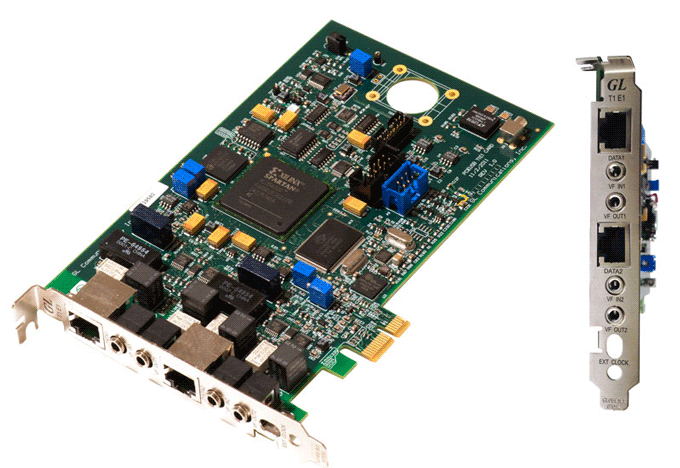
Overview
GL's Dual T1 E1 Express (PCIe) Boards are high-density dual T1 or E1 boards with newer PCIe (x1) bus interface. These cards are identical to the portable tProbe™ units, except for FXO FXS and Datacom functionality.
In addition to the other basic T1 E1 line signals monitoring applications, the Dual T1 E1 Express (PCIe) Boards also support enhanced VF drop and insert capabilities with software selectable VF Tx and Rx impedances (135Ω, 150 Ω, 600 Ω, 900 Ω, or High), Pulse Mask Compliance Testing, Jitter Generation and Measurement applications.
Increased Performance with 64-bit Support
GL’s T1 E1 analyzers supports both 32-bit and 64-bit applications. 64-bit support improves the performance of Protocol Analysers viz., ISDN, ISUP, GSM and allow users to monitor Hundreds to Thousands of Signaling Links simultaneously and continuously. Also, provides improved processing and response time for Statistics, Call Data Records, Search and other such functions.
Enhanced CCA application allows better processing and response time for multiple instances of CCA applications for long run tests. Similarly, all basic Intrusive and Non Intrusive applications such as BERT, Monitoring Applications, Oscilloscope, Spectral Display etc provide better processing and response time for multiple instances of monitoring and simulations windows.
MAPS™ Protocol Emulators are enhanced to provide improved performance for load generation and simulation of Protocols on 16 T1 E1 ports simultaneously.
Client Server commands support Thousands of Tasks simultaneously with number of successful thread creation. This helps to run Tx Rx File, Tx and Rx Tone and Tx Rx Digits on 24/31 Timeslots * 8 Ports * n (where n is the number of Dual T1 E1 Express (PCIe) Cards)
Features
- Software Selectable T1 or E1 interfacing along with Drop and Insert
- PCI Express x1 Lane/Board
- Monitor the T1 E1 line conditions such as frame errors, violations, alarms, frequency, power level, and clock (or frame/bit) slips
- TDM, ISDN, SS7 – High Density Voice
- VoIP, Frame Relay, Multilink Frame Relay, PPP and Multilink PPP, HDLC
- Physical layer analysis includes ability to send alarms and errors via SNMP Traps
- All protocol analyzers now include frame length in protocol statistics selection choice for data link layer
- Routing and Bridging emulation over Multi T1 E1 WAN interfaces using MLPPP (Multi Link PPP) and MFR (Multi Link Frame relay) protocols
- Most all "basic applications" and "special applications" are available for Dual T1 E1 Express boards
- Comprehensive Analysis / Emulation of Voice, Data, Fax, Protocol, Analog, and Digital signals, including Echo and Voice Quality testing
- Call Recording, Generation, and Monitoring for hundreds to thousands of calls in one platform
- Supports T1 E1 Pulse Mask and Jitter Generation and Measurement Analysis
- "Cross-port Through" and "Cross-port Transmit" Modes – these configurations make cabling with Drop/Insert and Fail-Safe Inline Monitoring very easy
- Enhanced VF Drop and VF Insert Capabilities using 3.5mm Balanced (Stereo), or Unbalanced (Mono) physical connections
- The VF Tx and Rx impedance for Dual T1 E1 Express (PCIe) Card analyzer supports software selectable 135, 150, 600, or 900 Ohm terminations
- Includes individual speakers (one speaker per card)
- Supports software selectable VF Tx and Rx impedances - 135, 150, 600, or 900 Ohm terminations. Additionally, the VF Rx impedance supports New High Impedance Monitor Termination (>50K Ohms), and external Microphone and Headset (Mic/HS) impedance
- VF Tx Gains ranges from -12 dB to +59.5 dB in 0.5 dB steps, and VF Rx Gains ranges from -63.5 dB to +9 dB in 0.5 dB steps
- Windows and Linux Drivers for Open Source Applications
- Supports both 32-bit and 64-bit Windows® operating system
GL offers other popular forms of T1 E1 analysis hardware such as
- tProbe™ T1 E1 Analyzer Unit - an enhanced version of USB based T1 E1 VF & Serial Data analyzer with expansion capabilities,
- Octal/Quad T1 E1 Analyzer Boards - 4 / 8 ports PCIe based cards for higher scalability and performance
- tScan16™ - a high-density T1 E1 board with 16 ports and the newer PCIe (x1) bus interface
Comparison with other PCI based GL's T1 E1 Cards
| Feature | Quad, Octal T1 E1 Boards | Dual T1 E1 Express (PCIe) Boards |
|---|---|---|
| Number of Ports | 4, 8 | 2 |
| PCI Slot Type | PCI Express x1 Bus/ Connector | PCI Express x1 Bus / Connector |
| Speaker (on board) | No speakers | Supported |
| Cross-port and Through Modes | Supported | Supported |
| Pulse Mask Application | Not Supported | Supported |
| Jitter Generation and Measurement | Not Supported | Supported |
| External Clock Mode | No clock port connector | Supported |
| Clock Offset Capability | All ports at the same time | 1 Port at a time |
| VF Interface and Impedance | Not Supported | Supported; 135/150/600/900/High |
| VF Interface for Mic/Headset | Not Supported | Supported |
| Drop and Insert (VF and T1 E1) | No VF connectors; Digital Drop/Insert supported | Supported |
| Onboard RAM | Not Supported | Supported |
Specifications
| Physical Interface | |
|---|---|
T1 E1 |
Dual RJ48c Connectors |
Audio Signal |
(4) 3.5 mm Balanced (Stereo) or Unbalanced (or Mono) Audio Jacks (TX & RX) |
PC Interface |
PCI Express x1 Lane |
External clock |
(1) MCX Coaxial Jack |
| Environmental Specifications | |
|---|---|
Temperature |
Operating: 0 to 50° C |
Relative Humidity |
Operating: 10% to 90% (non-condensing) |
Altitude |
Operating: -100 to 12,000 ft. |
| T1 E1 Line Interface | |
|---|---|
Framing Formats |
Unframed, D4 (T1) , ESF(T1), ESF(J1), CAS(E1), FAS(E1), CRC4 |
Line Code format |
AMI, B8ZS (T1) or HDB3 (E1) |
Internal Clock Specification |
Standard: +/- 3ppm Optional: +/- 1ppm |
Output Clock Source |
Internal (+/- 1 ppm or 3 ppm), Recovered, External Clock |
T1 Output Level |
T1: 3.0V Base to Peak Selectable 0-655Ft Pulse Equalization Setting; Tx Capability - DSX-1 Outputs (to 655 feet) |
E1 Output Level |
E1: 3.0V ± 0.3V Base to Peak |
Input Level |
75 mV to 6V base to peak or -30 dBsx to -6 dBsx |
Line Build-Out Selections |
0dB, -7.5dB, -15dB, -22.5dB for T1 only |
Loopback |
Normal (Outward and Inward) |
| PCM Interface | |
|---|---|
Transmit |
Synthesized Tone: 15 Hz to 3975 Hz selectable in 1Hz steps, +3.0dBm to -40dBm in 0.1 steps selectable, Frequency sweep. Signaling: DTMF/MF Dialing Digits. Special Codes: Milliwatt Codes, CSU Loop Up/Down Codes. |
Receive |
Displays for All Channels: Signaling Bits, Power Level, Frequency, & Data. Recorder: Record Full/Fractional T1 E1 Timeslots to hard disk file. |
| Transmit | |
|---|---|
T1 E1 Interface Hardware Compliance |
|
Bert Pattern Generation |
Pseudorandom patterns: (63) 2^6-1, (511) 2^9-1, (2047) 2^11-1, (32767) 2^15-1, (1048575) 2^20-1, (8388607) 2^23-1, QRSS. |
Alarm Insertion |
Blue, Yellow, Remote, Distant Multiframe, Bit 7 Zero Suppression |
Error Insertion |
BPV, Bit Error, Frame Error, CRC Errors, Burst Frames, Fixed Error Rate, Random Error Rate, auto logic from 10-2 to 10-9 for selectable 56K or 64Kps channels. |
Drop and Insert |
Any contiguous set of digital timeslots and/or audio input |
Facility Data Link |
T1 ESF Mode: Transmit/Receive Messages, Bit-Oriented Messages, and Files. |
Zero Suppression |
B7 Stuffing, Transparent, & B8ZS (T1) |
Signaling |
Robbed-Bit or Clear Channel |
Frequency Offset |
E1: +/- 615Hz |
| Receive | |
|---|---|
Input Impedance |
100 ohms for Terminate and Monitor (T1) |
Terminations |
Terminate, Monitor, Bridge |
T1 Input Frequency |
1.544MHz +/- 20KHz |
E1 Input Frequency |
2.048Mhz +/- 20KHz |
Frequency Measurement |
+/- 1ppm |
Error Detection |
Frame Error, CRC Error, BPV Error, Logic Error, Frame Alignment Error |
Alarm Detection |
T1 - D4 Yellow Alarm, ESF Yellow Alarm |
Intrinsic Jitter |
Jitter Tolerance: |
Input Range |
T1: |
| Display and Logging | |
|---|---|
BERT |
Bit Errors, Bit Error Rate, Error Seconds, Error Free Seconds, %EFS, Severely Error Seconds, % SES, Degraded Minutes, %Dmin, Loss Pattern Sync Count, Loss of Sync Seconds, Available Seconds, %Available Seconds, Unavailable Seconds, Bipolar Violations, BPV Rate, BPV Seconds, BPV Free Seconds, Frame Errors, FE Rate, FE Seconds, FE Free Seconds, with Detailed logging into disk file. |
Alarms |
Resync In Progress, Loss of Signal, Blue Alarm, Change of Frame Alignment, Bipolar Violation, Frame Error, Carrier Loss, Yellow Alarm, Out of Frame Events Counter, Error Super frame Counter, Bipolar Violations, Remote Alarm, Distant Multiframe Alarm, Signaling All Ones, CAS Multiframe Error, CRC4 Error. |
| VF Audio, Drop and Insert | |
|---|---|
Transmit |
Signal Level Measurement Accuracy: 0.0dBm +/- 0.1dBm |
Receive |
Audio Monitoring: Built-in Speaker |
Sampling Rates |
8 KHz, 16 kHz |
Datawidth (bits) |
Supports 8, 16, 20, 24, 32 Bit Data |
VF Tx Gains |
Supports -12 dB to +59 dB in 0.5dB Steps Gain (0.1 dB steps can also be accommodated) |
VF Rx Gains |
Supports -63.5 dB to +9 dB in 0.5dB Steps Attenuation (0.1 dB steps can also be accommodated) |
Connectors |
(4) 3.5 mm Balanced (Stereo) or Unbalanced (Mono) Audio Jacks (TX & RX) |
| Computer Requirement | |
|---|---|
|
Pentium IV or higher with MS-Windows® XP, 7 or 8 with PCIe expansion slots (3.3V or 5.0V) |
| Physical Dimensions | |
|---|---|
Dimensions |
6.7 inches x 4.4 inches |
* Specifications subject to change without notice.
Loopback
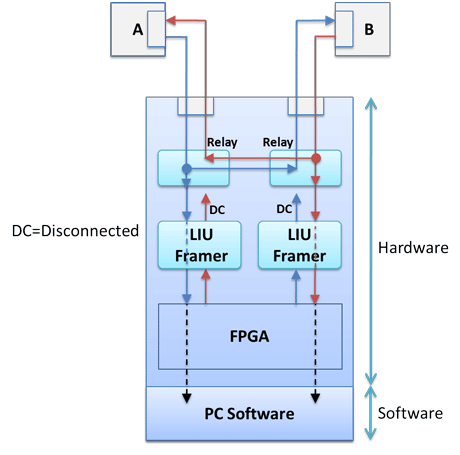
Cross-port Through Loopback
This mode is similar to the standard Outward Loopback except that the signal received on Card 1 (Port 1) is transmitted out onto Card 2 (Port 2). Likewise the signal received on Card 2 (Port 2) is transmitted out onto Card 1 (Port 1). This feature allows monitoring T1 E1 lines in-line while still being protected from loss of power to the board. This mode is effected entirely thru relays and eliminates complex cabling.
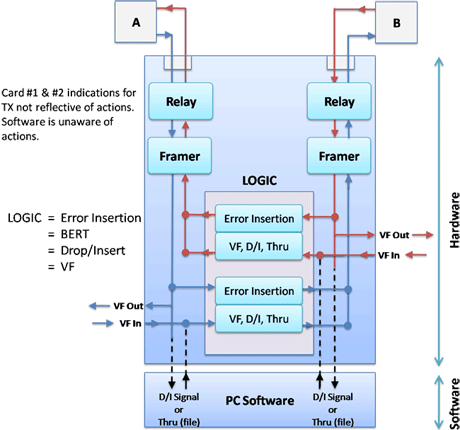
Cross-port Transmit Mode Loopback
In this mode, the data that would normally be transmitted on Card 1 (Port 1) is diverted and transmitted on Card 2 (Port 2) and the data that would normally be transmitted on Card 2 (Port 2) is diverted and transmitted on Card 1 (Port 1). The receive paths are completely unaffected. This mode is particularly useful for Drop and Insert and Error Injection applications in which the board analyzes and may insert traffic running between two pieces of T1 E1 equipment. This feature also eliminates complex cabling.
Resources
Note: PCs which include GL hardware/software require Intel or AMD processors for compliance.
Please Note: The XX in the Item No. refers to the hardware platform, listed at the bottom of the Buyer's Guide, which the software will be running on. Therefore, XX can either be ETA or EEA (Octal/Quad Boards), PTA or PEA (tProbe Units), XUT or XUE (Dual PCIe Express) depending upon the hardware.
| Brochures |
| Dual T1 E1 Express (PCIe) - Brochure |
| Frequency Calibration Procedure User Guide |
| GL Product Lists |
| Presentations |
| T1 E1 Quad/Octal Port Analyzer Presentation |
| Dual T1 E1 Express (PCIe) Analysis and Emulation Boards Presentation |
| Basic Software (tProbe™ and USB Analyzer) Presentation |
| Application Notes |
| Backhaul Network Testing Solutions |
| VF Drop and Insert Capabilities |
| Webinars |
 |
 |