Signaling and Traffic Simulation Solutions for Telecom Networks
Message Automation and Protocol Simulation (MAPS™), provides a programmable, highly flexible, script based, multi-protocol, multi-interface emulation framework and makes it easy to perform cross-domain testing and transition tests to new technologies
Request a Demo / Quote Brochure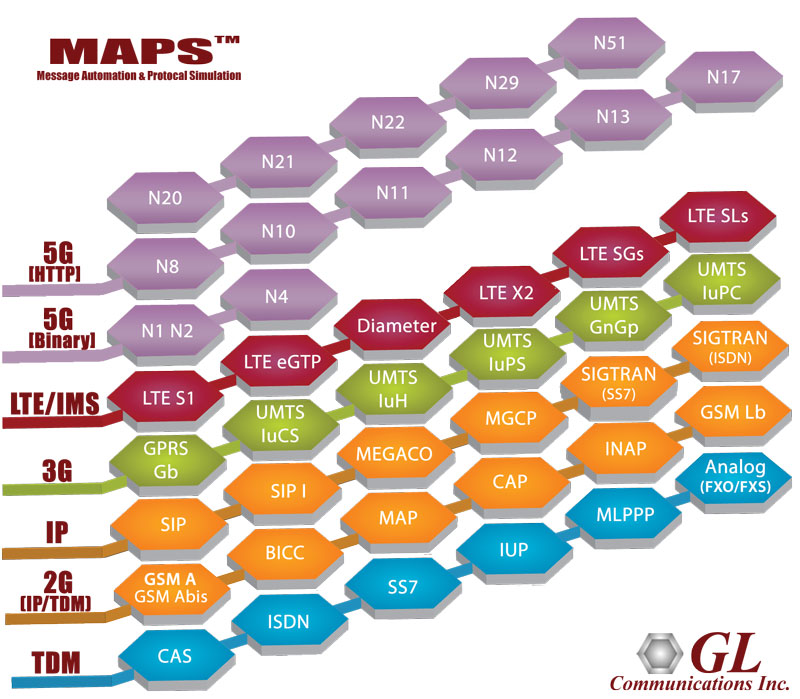
Message Automation & Protocol Simulation (MAPS™)
MAPS™ is a protocol simulation and conformance test tool that supports various protocols such as SIP, MEGACO, MGCP, SS7, ISDN, GSM, MAP, CAS, LTE, UMTS, SS7 SIGTRAN, ISDN SIGTRAN, SIP I, GSM AoIP, Diameter and others. Along with automation capability, the application gives users the unlimited ability to edit messages and control scenarios.
Key Features
- Multi-protocol, Multi-interface Simulation
- Flexible framework facilitates validation of any node functionality of any network element
- Provides complete access to user to customize any protocol IE's according to 3GPP standards
- Easily setup a test scenario within lab for educational purposes
- Powerful tool to test any element before deployment
- Supports both functionality and performance testing
- Easy to use GUI and also allows integration with Python and Java
- Runs on Virtual Machines and Containers
- Simulate negative test scenarios by impairing messages and call flows
- Script based architecture allows customization of test scenarios
- High density user plane traffic generation in any network capability
- Centralized Control and Remote Access with CLIs / APIs
- Conformance Test suites
- Customized call scenarios and test configurations
- Test Report and Statistics Generation
- Voice Quality measurements
Solutions
Support for TDM, Ethernet, and IP Interfaces
MAPS™ works on TDM, Ethernet and IP interfaces. TDM signaling protocols such as SS7, ISDN, MLPPP, CAS, MAP, CAP, GSM, INAP, and BICC operate over TDM networks, whereas VoIP protocols SIP, SIP-I, MEGACO, MGCP, SIGTRAN, Diameter, INAP, MAP, CAP, and BICC operate over IP networks.
Comprehensive 3G, 4G, and 5G Testing
MAPS™ also supports 3G & 4G mobile protocol standards for testing the rapidly evolving mobile technologies. MAPS™ can simulate radio signaling protocols such as LTE (S1, eGTP, X2) interfaces and UMTS (IuCS, IuPS, IuH), GPRG Gb,and GSM A, GSM Abis over IP transport layer.
MAPS™ framework is enhanced to simulate End-to-End 5G core (5GC) network elements - UE+gNB, AMF, SMF, UPF, AUSF, UDM, UDR, EIR, PCF along with data and voice traffic (VoLTE support) generation. GL’s MAPS™ supports emulation of following 5GC network interfaces N1N2, F1, E1 (3GPP ORAN), N4, N8, N10, N11, N12, N13, N17, N20, N21, N22, N29, N51.
ATM (ED-137) Test Solutions
GL’s MAPS™ ED-137 address the need for additional testing needs that may include simulating many endpoints and generating bulk calls (load testing) on the network.
- MAPS™ ED-137 Telephone Emulator can simulate hundreds of Ground-to-Ground calls, supporting all Telephone call types and scenarios such as Call Hold and Call Transfer
- MAPS™ ED-137 Radio Emulator can be configured as CWP and GRS to simulate outgoing and incoming messages in Air-to-Ground call
- MAPS™ ED-137 Recorder Emulator can emulate call recording functionality at CWP, GRS and Recorder interfaces, generating more than hundreds of recording sessions to verify performance and load testing
Diverse Traffic Simulation Capabilities
MAPS™ transmits and detects various traffic types over IP (RTP, GTP), ATM, GSM (TRAU), & TDM such as digits, voice files, single tone, dual tones, fax, SMS, email, HTTP, FTP, and video. MAPS™ also includes support for wide range of codec rates – visit Traffic Simulation and Voice-Codecs webpage for more details. Verify your latest mobile features over the network with various types of traffic generators and receivers. In GPRS, packet data traffic can be generated and validated with GTP traffic modules. Circuit switched traffic can be generated and recorded using RTP core module.
End-to-End Location-Based Services Testing
GL’s MAPS™ LCS test suite comprises of multiple products working in tandem to support simulation of end-to-end location based services in GSM, UMTS, and LTE networks.
IMS Core Network Simulation
MAPS™ test suite is enhanced to simulate multiple UEs and IMS core elements such as P-CSCF, I-CSCF, S-CSCF, PCRF, MGCF in IMS core network. With the help of mobile phones, and other simulated wireless networks, the VoLTE Lab setup can be operated in real-time for making VoLTE calls and also for interworking with PSTN and VoIP networks.
End-to-End Wireless (5G/4G/3G/2G) Wireless Network Lab Suite
GL’s End-to-End Communications Network Lab (EE-CNL) provides reliable integrated solutions to vendors and service providers for simulation, monitoring, troubleshooting the network using MAPS™ 5G 4G 3G 2G Wireless Lab Suite’.
High-Density Bulk Call Generator and Simulator
GL’s MAPS™ is enhanced to a High Density version and a special purpose 1U network appliance that is capable of high call intensity (hundreds of calls/sec) and high volume of sustained calls (tens of thousands of simultaneous calls/1U platform).
Network Emulation for Testing and Compliance
MAPS™ can emulate any network element in any technology including Analog, TDM, IP, ATM, and Wireless. It can be used to test and troubleshoot network infrastructure, software applications and User Equipment (UE) and ensure compliance. The following list is a sampling of the more important protocols supported, but NOT a complete list.
- Analog – R1, R2, MFC-R2, SS1/SS4, SS5, and more
- TDM – CAS, SS7, ISDN, ML-PPP, MAP, CAP, GSM, INAP, BICC, IUP, FXO-FXS, Analog, and more
- IP – SIP, SIP-I, RTP, H.323, MEGACO, MGCP, SIGTRAN, DIAMETER, INAP, MAP, CAP, MSRP, ED-137, and more
- Wireless 2G and 2.5G – Abis, A,Gb,Gn and TRAU, Lb
- Wireless 3G – UMTS – IuPS, IuCs, Iuh, Gn, IuPC
- Wireless 4G – IMS, S1, eGTP (S5, S8, S11), X2AP, SGs, SLs, SLh
- Wireless 5G – N1N2, F1, E1, N4, N8, N10, N11, N12, N13, N17, N20, N21, N22, N29, N51
Standard and optional codec support includes G.711, G.726, G.726 App 2, G.729 A/B, GSM, iLBC, Speex, G.722.2, AMR NB, AMR WB, EVRC, EVRC-B, EVRC-C, EVS, and Opus. Voice Quality Metrics such as MOS (as per ITU-T G.107), packet loss, duplicate and out of sequence can be measured. Video calls can be simulated. Fax call support includes pass through Fax and T.38 Fax.
MAPS™ for TDM Network
PSTN
2G/3G
Analog
MAPS™ for VoIP Network
-
MGCP (Media Gateway Controller Protocol) Protocol Simulation
-
ED-137 Emulator (Air Traffic Management)
-
MAPS™ ED-137 Radio Emulator (Air-to-Ground Calls Simulation)
-
MAPS™ ED-137 Telephone Emulators (Ground-to-Ground Calls Simulation)
-
MAPS™ ED-137 Recorder Emulators (Simulate Call Recording at Controller, Radio and Recorder Interfaces)
-
- IP Multimedia Services (IMS) Network Lab
MAPS™ for Wireless Network
-
5G Traffic Emulation
- N1 N2 Interface Emulator - gNodeB (also called Next Generation RAN), and AMF (Access and Mobility Management Function) nodes
- N4 Interface Emulator - Session Management Function (SMF) and User Plane Function (UPF) elements
- N8 Interface Emulator - Unified Data Management (UDM) and Access and Mobility Management Function (AMF)
- N10 Interface Emulator - Unified Data Management (UDM) and Session Management Function (SMF)
- N11 Interface Emulator - Access and Mobility Management Function (AMF) and Session Management Function (SMF)
- N12 Interface Emulator - Authentication Server Function (AUSF) and Access and Mobility Management Function (AMF)
- N13 Interface Emulator - Authentication Server Function (AUSF) and User Data Management (UDM)
- N17 Interface Emulator - Equipment Identity Register (EIR) and Access and Mobility Management Function (AMF)
- N20 Interface Emulator - Access and Mobility Management Function (AMF) and Short Message Service Function (SMSF)
- N21 Interface Emulator - Unified Data Management (UDM) and Short Message Service Function (SMSF)
- N22 Interface Emulator - Access and Mobility Management Function (AMF) and Network Slice Selection Function (NSSF)
- N29 Interface Emulator - Network Exposure Function (NEF) and Session Management Function (SMF)
- N51 Interface Emulator - Mobility Management Function (AMF) and Network Exposure Function (NEF)
- 4G Protocol Emulation
General MAPS™ Features
- Call Generation & Control
- Multi-protocol, Multi-interface Emulation
- Script based and protocol independent software architecture
- Auto generate and respond to signaling messages
- Traffic Handling Capabilities (requires additional license)
- Load Testing
- Automated Bulk Call Generation / Stress Testing with different statistical distribution patterns
- Scheduler and pre-saved configuration files for automated testing
- Bulk Call Generation (XML/CSV based Profiles or XML profiles/ CSV Profiles)
- Auto generate massive number of subscriber profiles using internal Database, and CSV methods
- Pre-processing tools
- Easy script builder for quick testing to advance testing
- Customization of test configuration profiles
- Unlimited ability to customize the protocol fields and call control scenarios
- Reports and Statistics
- Call Status, Link Status, Message Statistics and RTP Voice Quality Metrics (LMOS, CMOS)
- User Defined Statistics for RTP traffic parameters
- User-Defined Graphs generation for Signaling and RTP Statistics (Bar, Pie, Line, Point graph types)
- Capture events including errors
- Generate call reports in pdf or xml file formats
- Centralized Control and Remote Access with CLIs / APIs
- All GUI features are accessible through Command Line Interface (requires additional license)
- APIs allows for programmatic and automated control of multiple MAPS™ servers
- Supported Clients – Python and Java
- Option to send reports to database accessible via web interface
- Centralized control of multiple MAPS™ applications remotely from single client application
- Remote MAPS™ Controller
- A single Remote Client GUI to remotely control/monitor multiple MAPS™ Servers
- Client-server communication is facilitated through a Listener over TCP/IP
- Single Licensing Server option available for controlling number of MAPS™ Server and Clients (users)
- Unlimited number of remote client users can be defined at the server
- Admin has privileges to control Testbed and access to configuration files for each remote client user
- Remote Client users has privileges to perform all other functions - call emulation, edit scripts/profiles, and view statistics
Call Generation and Control
Emulate call signals and traffic using scripts. Commands in the scripts are executed in controlled way to emulate protocol and traffic behavior. Most of the commands used in the scripts are generic and independent of specific protocol.
MAPS™ application acts as either the Caller or resides at the network terminal acting as Callee. The Call Generation feature emulates an outgoing call by sending call control messages to the DUT using scripts and profiles. The profiles allow necessary parameters of call control messages to be changed during runtime. Call generated from other entity can be automatically detected in call reception window by pre-setting the required answer scripts in the Incoming Call Handler.
Message Sequence - Each call scenario provides the trace with full decoding of the messages exchanged between the MAPS™ and the DUT, and graphical ladder diagrams of the call flow with time stamps. Impairments can be applied to messages to emulate real world networks.
Event-Driven Control - Scripts execution, being event-based, allows redirection of script execution on-the-go with user-defined events. The custom parameters in the events can also be changed during script execution using event profiles.
Script Contents & Script Flow - The script flow and the contents window display the Script Name, Sub-script Name, Script line number, and script statements to be successfully executed, which help the users in troubleshooting a particular call scenario.
Traffic Emulation
The call control scripts can also automatically handle the traffic over the established call. MAPS™ supports transmission and detection of various traffic types over IP (RTP, GTP), ATM, & TDM over established calls with the support of necessary hardware. The types of traffic supported are -
- Analog and TDM Traffic (digits, voice files, single tones, dual tones, Dynamic VF, fax, sms, and IVR)
- RTP Traffic (digits, voice files, single / dual tones, fax, video, and IVR)
- Mobile Traffic (User-plane GTP and Gateway – SMS, HTTP, Email, FTP, Video)
- Short Message Service (SMS) Test Solutions.
For more information, visit Traffic Emulation webpage
MAPS™ also includes support for wide range of codec rates – visit Voice-Codecs webpage for more details.
Bulk Call Generation and Load Testing
MAPS™ supports automated stress/load testing capabilities through Load Generation and Bulk Call Generation features. Bulk Call Generation allows quick configurations to easily create multiple test entries with different scripts and profiles. Multiple tests can be run simultaneously or sequentially (queue up tasks in succession). Load generation feature further allows specifying the patterns with which the bulk calls can be generated. Load generation can be customized with different statistical distribution patterns such as Uniform, Ramp, Sawtooth, Fixed, Normal, Step, and Step-Sawtooth distribution. Load Generation supports Unique and Multi Distribution patterns. Unique Distribution pattern option allows to configure single distribution pattern for each loaded script, whereas with Multi Distribution pattern, multiple patterns can be configured for each loaded script. Call duration also can be randomized using similar statistical distribution. This feature also helps users configure Stress/Load Testing parameters such as Call per second (CPS), Max Active Call, Minimum and Maximum Call Rates, Start Call Rates, and other parameters.
To perform Bulk Call Generation, several UE/Subscriber configuration files are required. The UE/Subscriber configuration files can be created using regular Profile Editors (XML Based), using CSV based profiles, or using Auto Generation feature. With CSV based profiles, it is possible to define up to 20,000 subscriber entries with unique called number, calling number, and other subscriber specific information. . With Auto Generate Users feature, MAPS™ can dynamically generate any required number of users while assigning unique IMSI for each generated user in sequential order.
Scheduler
Emulate bulk calls at a specific start time. The pre-saved configuration files for test setup and call emulation are automatically loaded to automate the test procedure.
Customization of Test Setup Parameters
The test setup profiles (.xml files) allow users to configure the necessary parameters in order to establish communication between MAPS™ and the DUT. It includes configuring parameters of the network nodes, the network properties, and transport related configurations such as SCTP or TCP IP Address and port numbers for both MAPS™ and the DUT.
Once the transport layer is configured properly, protocol specific signaling messages and traffic can be transmitted and received successfully. All parameters setup in test setup are global and are accessible to all scripts. These parameters initialize protocol engines and the transport modules specific to the protocol.
Customization of Test Parameters, Call Flow, and Protocol Messages Using Pre-Processing Tools
- Message Editor - The Message Templates (GL’s proprietary *.HDL files) comprises of protocol encoding parameters with preset values. It is required to create a message template for every message in a protocol. The message templates are called within the scripts to perform scenario-based testing.
- Profile Editor – Profiles (*.xml files) are used to change the values of the fields in the messages (i.e. Message Template in MAPS™) during the course of a call. The multiple profiles with varying parameter values that allow users to configure call instances in call generation and to receive calls. Color coding feature to create multiple profiles, which are used to sort and group all calls associated to individual nodes during Call Reception.
- Script Editor - The script editor allows the user to create / edit scripts and to define variables for the fields in the messages. The script uses pre-defined message templates to build call flow and perform send and receive actions. Script editor provides options to run the test for multiple iterations in sequential or random flow. Commands allow retransmission of messages with specific interval.
Command Line Interface
Supports scripting through a Command Line Interface (CLI), using Python with MAPS™ client-server functionality (requires additional license)
MAPS™ can be configured as server-side application, to enable remote controlling of the application through multiple command-line based clients.
User can remotely perform all functions such as start test bed setup, load scripts and profiles, apply user events such as send digits/file/tones, detect digits/file/tones, dial, originate call, terminate call, start and stop traffic and so on. User can also generate and receive calls through commands. This client application is distributed along with MAPS™ Server application. Multiple MAPS™ CLI servers can be controlled remotely from single client application.
Call Statistics, Events, Link Status, User Defined Statistics
Call Status & Message Statistics - By default, all call handling scripts (irrespective of the type of the functions) are assessed by MAPS™ to provide statistical information about Total Calls, Active Calls, Completed Calls, Passed Calls, Failed Calls, and Calls/Sec. It is also possible to categorize the statistical information as per the call handling scripts. In addition, Call Generation and Call Reception windows provide useful call status & script execution results.
In addition, Message Stats option for any specific protocol, logs number of times the messages are being transmitted (Tx Count) and received (Rx Count), thus allowing user to monitor the occurring events.
User Defined Statistics and Graphs – Users can customize the global statistics for RTP audio and video traffic. These global parameters are defined in the call generation scripts, which are calculated and updated periodically providing call quality metrics such as Listening MOS, Conversational MOS, PacketLoss, Discarded Packets, Out of Sequence Packets, Duplicate Packets, Delay and Jitter. User can also customize scripts to create various types of graphs such as Pie graph, Line graph, Multi-Line graph, Bar graph, and Point graph to plot RTP statistical information.
Events Reporting – MAPS™ provides Event Log, Error Events, and Captured Errors windows that log the captured events and errors encountered during the progress of the call.
Link Status - Link Status window indicates transport related information of the protocol, for example, if SCTP is used as transport, it indicates if the association is Up or Down in the Link Status window.
Applications
- Location-based real-time services such as vehicle tracking, stolen assets tracking, temperature, traffic services, emergency services, etc
- SMS testing from within the wireless core infrastructure
- Insert faults and erroneous call flows - Test response of the network against protocol message modification or corruption
- Performance, load, functional, regression and conformance testing of network elements
- Inter-operability testing of networks
- Wrap-around testing (WAT)
- Automatically test Integrated Voice Response (IVR) using scripts - call establishment and traffic generation / detection process
- Monitoring IVR System for voice and data quality
- Voice Feature Testing Application for Next Generation Networks (NGNs)
- Complete Emulation of a Hybrid TDM/VoIP Network - Test Signlaing and Media Gateways
MAPS™ Working Principle
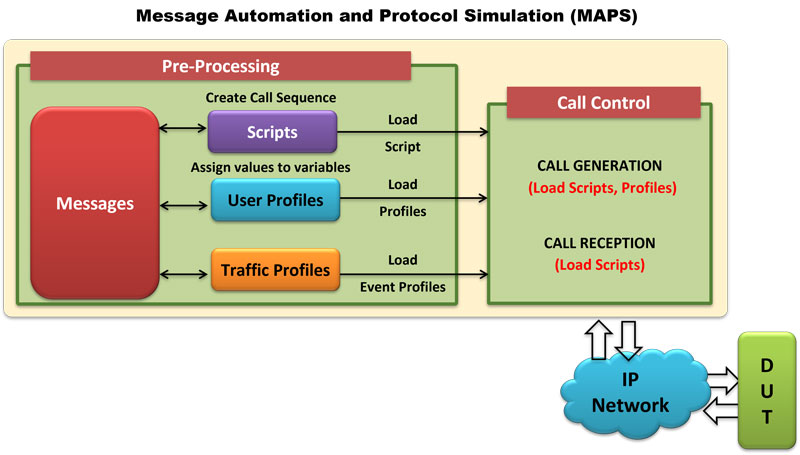
Working Principle of MAPS™ Application
Call Control (Call Generation and Reception)
- Protocol Engine
Forms the backbone of MAPS™ application that contains Message Templates, and Call Handlers to help MAPS™ encode and decode protocol messages, exchange user-defined protocol field values at run time, and generate call flows.
- Transport Handlers
Support send & receive protocol messages over various transport layers - UDP, TCP, SCTP, LAPD, MTP2, and ATM.
- Global Configurations
Handles parameter configurations that are common across different test scenarios, such as protocol timers, inter-call duration, and so on.
- Impairment and Retransmission Modules
These modules support unexpected call behaviors to test system performance under realistic network conditions. These include – tests to introducing impairments at the traffic level or at the communication protocol level, retransmission of messages at defined interval of time, and so on . - Traffic Handlers
These modules support generating and received traffic from the other network entities using different traffic type – Traffic over TDM / Analog, over IP, and encapsulation of IP traffic over GTP (Mobile Gateway / Packet Traffic)
Pre-processing Tools
Script Editor
- Allows users to build valid and invalid test cases
- Includes ready-to-run scripts for simulating important call scenarios / procedures.
- Offers ‘syntax-ready commands’ to easily build scripts
- Reusability, easy maintainability and reduced ‘time-to-market’.
Message Editor
- Allows users to modify any signaling message, message parameters, and/or information elements.
- Add, modify or remove any optional parameters depending on specific feature of interest.
- Perform packet level fault insertion by impairing any bit / byte of a message.
Profile Editor
- Allows users to create multiple user-configuration profiles to suit different testing needs
- Values from the profiles replaces the original values in the messages during run-time
CLI/API
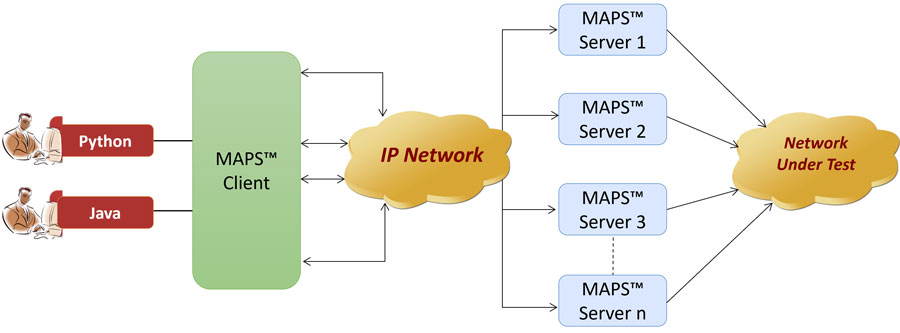
MAPS™ can be configured as server-side application, to enable remote controlling through multiple command-line based clients. Supported clients include Python and Java. Python is supported over all protocols as a standard and Java over limited protocols.
The MAPS™ APIs allows for programmatic and automated control over all MAPS™ platforms. Each MAPS™ server can receive multiple client connections and offer independent execution to each client. Likewise, a single client can connect to multiple MAPS™ servers, including servers running different protocols, permitting complex cross-protocol test cases.
Client provides a simple scripting language, with programming facilities such as looping, procedures, and variables. The Client application includes a MapsClientIfc.dll file, a packaged library that enables communication with the Server from the client environment. The advantage of such communication enables user to control MAPS™ by sending commands and receiving responses in a scripting language already familiar with many users.
Clients can remotely perform all functions such as start testbed setup, load scripts, and profiles, apply user events such as send digits/file/tones, detect digits/file/tones, dial, originate call, terminate call, start and stop traffic and so on. User can also generate and receive calls through commands. This client application is distributed along with MAPS™ Server application.
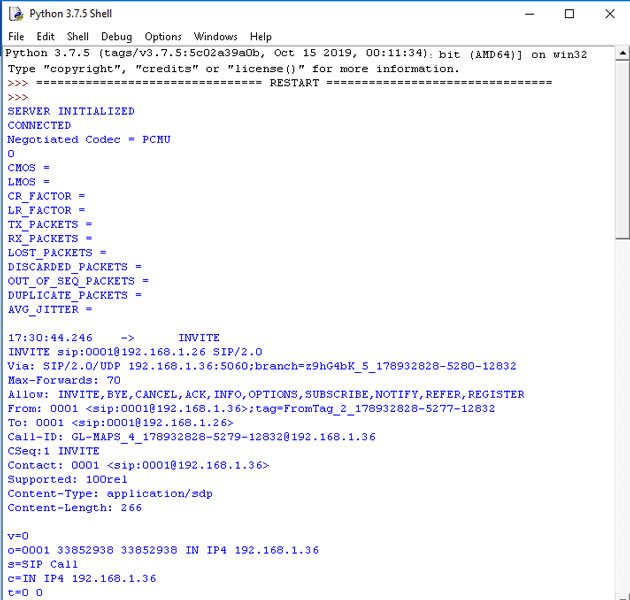
The following depicts MAPS™ Python Client Interface used to place call and handle traffic between the end terminals. Also, observe the executed commands in the MAPS™ CLI Server window after completing the call.

For more information, please visit MAPS™ APIs for Complete Automation webpage.
Single Remote Client for controlling multiple MAPS™ systems
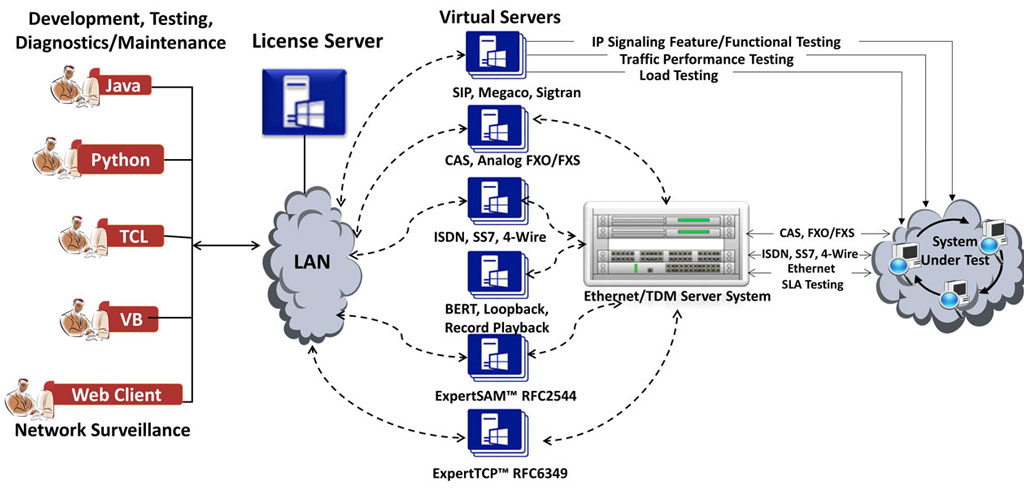
The Remote MAPS™ application is a client server module, designed for multi-node multi-interface simulation from a single client GUI. The application can remotely control multiple MAPS™ Servers running on different PCs from a single remote client application. One or more MAPS™ applications can be installed on each sever. With this practically all the nodes (network elements) associated with a protocol, including protocol standards and profiles can be remotely configured from a single client GUI. The Remote MAPS™ application communicates with the multiple MAPS™ Server via Listener over TCP/IP.
- Multi-node and multi-interface simulation from a single GUI
- Suitable for testing any core network, access network, and inter-operability functions
- Single Licensing Server controlling server and client licenses (no. of users)
- Unlimited number of remote client user can be defined at the server
- Admin privileges to control Testbed and access to configuration files for each remote client user
- Remote Client users has privileges to perform all other functions - call simulation, edit scripts/profiles, and view statistics
- Simultaneous traffic generation/reception at 100% on all servers
For more information, please visit MAPS™ Remote Controller webpage.
Traffic Simulation across IP, Analog, TDM, and Wireless Networks with MAPS™
As traffic volume increases, network infrastructure can be subject to various impairments such as errors, excessive delay, congestion, blocking, loss, and degraded quality. Simulating traffic is valuable to characterize the impairment as a function of traffic volume and type (e.g. voice, fax, data, & video).
Message Automation and Protocol Simulation (MAPS™) is a multi-protocol, multi-technology platform used to generate call signals and traffic for diverse communication protocols covering IP, analog, TDM, and wireless networks. MAPS™ can be used to test legacy networks (CAS, SS7, ISDN, PPP, etc.), newer generation IP networks (SIP, MGCP, MEGACO, SIGTRAN, Diameter, etc.), and also wireless networks (GSM, UMTS, LTE and Diameter signaling).
MAPS™ Client-Server application includes a command line interface with support for Python, Java, TCL and other scripting tools to provide remote operation, automation, and multi-site connectivity. The user can remotely perform all functions such as load scripts and profiles, send digits/file/tones, detect digits/file/tones, dial, originate calls, terminate calls, start and stop traffic and so on.
MAPS™ HD is a high density 1U network appliance that supports high call generation rates (hundreds of calls/sec) and high volume of sustained calls (tens of thousands of simultaneous calls/1U platform) for a vast array of communication protocols covering IP and wireless networks. MAPS™ HD network appliance can achieve up to 20,000 endpoints per appliance (5000 per port). This requires GL’s RTP HD traffic generation capability (PKS109) and a specialized 1U rack system with an integrated HD network interface card ( w/ 4x 1 GigE or 2x 10 GigE).
For more details, visit Traffic Simulation webpage.
Resources
Note: PCs which include GL hardware/software require Intel or AMD processors for compliance.
Please Note: The XX in the Item No. refers to the hardware platform, listed at the bottom of the Buyer's Guide, which the software will be running on. Therefore, XX can either be ETA or EEA (Octal/Quad Boards), PTA or PEA (tProbe Units), XUT or XUE (Dual PCIe Express) depending upon the hardware.
| Item No. | MAPS™ for IP Network |
| PKS122 PKS123 |
MAPS™ MEGACO Emulator MAPS™ MEGACO Conformance Test Suite (Test Scripts) |
| PKS124 | MAPS™ MGCP Protocol Emulation with Conformance Test Suite |
| PKS120 PKS121 |
MAPS™ SIP Emulator SIP Conformance Test Suite (Test Scripts) |
| PKS126 | MAPS™ SIP I Emulator |
| PKS127 | MAPS™ IMS Emulator |
| PKS130 | MAPS™ SIGTRAN Emulator |
| PKS132 | MAPS™ MAP IP Emulator |
| PKS147 | MAPS™ Lb Interface Emulator |
| PKS148 | MAPS™ SLs Interface Emulator |
| PKS153 | MAPS™ IuPC Interface Emulator |
| PKS151 | MAPS™ CAMEL IP Emulator |
| PKS135 | MAPS™ SIGTRAN ISDN over IP |
| PKS134 | MAPS GSM Abis IP Emulator |
| PKS137 | MAPS™ GSM A IP Emulator |
| PKS155 | MAPS™ BICC IP Emulator |
| PKS136 | MAPS™ SIGTRAN SS7 INAP |
| PKS152 | MAPS™ SIGTRAN ANSI MAP |
| PKS300 | MAPS™ Multi-Interface MGC |
| PKS139 | MAPS™ Diameter Emulator |
| PKS118 | MAPS™ ED-137 Radio (Includes PKS107, & PKS102) |
| PKS119 | MAPS™ ED-137 Telephone (Includes PKS102) |
| PKS117 | MAPS™ ED-137 Recorder (Includes PKS102) |
| Item No. | MAPS™ for TDM Network (requires T1 or E1 Hardware and Basic Software) |
| XX642 | MAPS™ ISDN & LAPD Conformance Emulator |
| XX648 | MAPS™ ISDN Emulator |
| XX649 | MAPS™ SS7 Emulator |
| XX647 | MAPS™ SS7 Conformance |
| XX692 | MAPS™ GSM A Emulator |
| XX693 | MAPS™ GSM Abis Emulator |
| XX651 | MAPS™ CAS Emulator |
| XX652 | MAPS™ MC-MLPPP Conformance |
| XX694 | MAPS™ MAP Emulator |
| XX696 | MAPS™ CAP Emulator |
| XX656 | MAPS™ INAP Emulator |
| XX624 | MAPS™ FXO FXS Emulator (only for tProbe) |
| Related Hardware | |
|---|---|
| FTE001 ETE001 |
QuadXpress T1 E1 Main Board (Quad Port - requires additional licenses) OctalXpress T1 E1 Main Board plus Daughter Board (Octal Port - requires additional licenses) |
| PTE001 | tProbe™ Dual T1 E1 Laptop Analyzer with Basic Analyzer Software |
| XTE001 | Dual T1 E1 Express (PCIe) Boards (requires additional licenses) |
| Item No. | Traffic Options |
| GTP Mobile Traffic Options | |
| ETH101 ETH102 ETH103 |
MobileTrafficCore - GTP MobileTrafficCore - Gateway MobileTrafficCore for Gb Interface |
| TDM Traffic Options | |
| XX610 XX620 XX646 |
File based Record/Playback Transmit/Detect digits (Place Call/ Answer Call) Multi-Channel TRAU Tx/Rx Emulation and Analysis |
| XXXFT0 XXXFT2 XXXFT3 XXXFT4 XXXFT5 XXXFT6 |
Fax Emulation Fax Port Licenses - 2 Fax ports Fax Port Licenses - 8 Fax ports Fax Port Licenses - 30 Fax ports Fax Port Licenses - 60 Fax ports Fax Port Licenses - 120 Fax ports |
| RTP Traffic Options | |
| PKS102 | RTP Soft Core (additional) |
| PKS103 | RTP IuUP Softcore |
| PKS200 PKS202 PKS203 PKS204 PKS205 PKS206 |
RTP Pass Through Fax Emulation Fax Port Licences - 2 Fax Ports, RO Fax Port Licences - 8 Fax Ports, RO Fax Port Licences - 30 Fax Ports, RO Fax Port Licences - 60 Fax Ports, RO Fax Port Licences - 120 Fax Ports, RO |
| PKS211 | T.38 Fax Simulation |
| PKS107 | RTP EUROCAE ED-137B |
| PKS108 | RTP Voice Quality Measurements |
| PKS109 | MAPS™ High Density RTP Generator |
| PKS111 | MAPS™ Remote Controller |
| PKS112 | Message Session Relay Protocol for MAPS-SIP |
| PKS170 | CLI Support for MAPS™ |
| PKS106 | RTP Video Traffic Generation |
| PCD103 | Optional Codec – AMR – Narrowband (requires additional license) |
| PCD104 | Optional Codec - EVRC (requires additional license) |
| PCD105 | Optional Codec – EVRC-B (requires additional license) |
| PCD106 | Optional Codec – EVRC-C (requires additional license) |
| PCD107 | Optional Codec – AMR - Wideband (requires additional license) |
| PCD108 | Optional Codec - EVS (requires additional license) |
| PCD109 | Optional Codec - Opus (requires additional license) |
| Item No. | Related Software |
| PKB100 PKB105 |
RTP Toolbox™ G.168 Echo Canceller Test Compliance Suite |
| Brochures |
|---|
| MAPS™ Brochure |
| MAPS™ CLI Brochure |
| MAPS™ HD RTP Traffic Generator Brochure |
| Application Solutions |
| GL Product Lists |
| Presentations |
|---|
| MAPS™ Traffic Options - Presentation |
| MAPS™ Remote Controller - Presentation |
| Automation using API MAPS™ - Presentation |
| Signaling and Traffic Simulation - Presentation |
| Supported Codecs |
| Webinar |
|---|
|
Product Videos