Automated testing solutions for LTE, VoLTE, and IMS networks
Comprehensive test solutions for LTE, VoLTE, and IMS networks, allowing telecom providers to verify the quality and reliability of their network services.
Request a Demo / QuotePacketScan™ IMS Protocol Analyzer Brochure
Overview
Long Term Evolution (LTE) is the so called 4th Generation (4G) mobile standard in the rapidly evolving mobile technologies. Its distinguishing feature is an all IP infrastructure and significantly greater air interface bandwidth to the mobile handset. It was developed as an enhancement to the existing 3G UMTS System (Universal Mobile Telecommunications System) to provide users enhanced mobile radio and internet access.
The LTE air interface is a completely new system based on orthogonal frequency-division multiple access (OFDMA) in the downlink and single-carrier frequency-division multiple access (SC-FDMA) in the uplink. The system efficiently supports multi-antenna technologies (MIMO).
Another significant feature of LTE is its high bandwidth—up to 20 MHz. The LTE can also operate in the existing 5-MHz UMTS frequency bands, or in even smaller bands, as the usable bandwidth is scalable.
However, deploying high-quality voice, video, and data services over LTE has posed significant challenges for service providers, due to backward-compatibility, inter-operability, and high quality requirements – all of which requires rigorous testing.
Automated Testing Solutions for LTE, VoLTE, and IMS Network
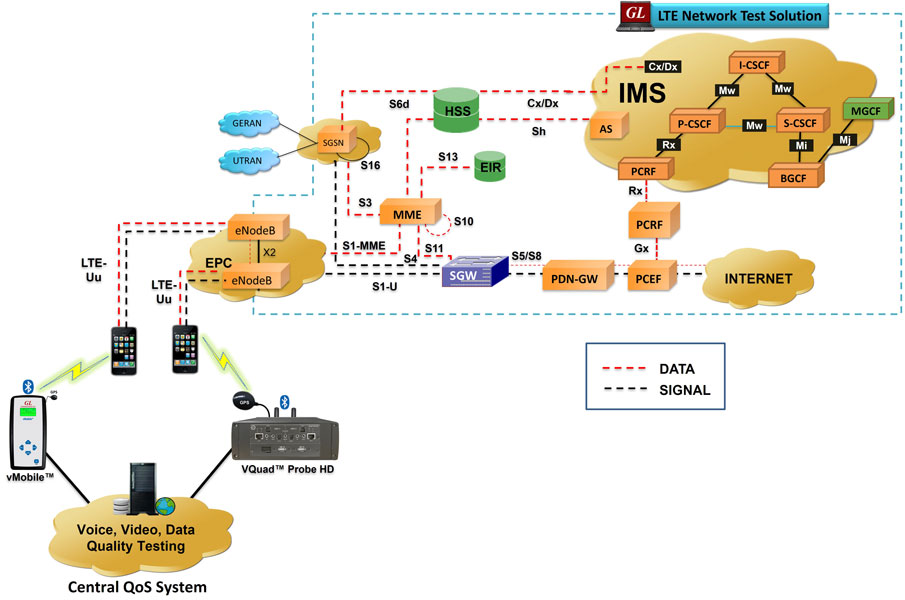
The representation of LTE–IMS network above indicates the support of most of the interfaces by GL’s test tools. In summary,
- End-to-end voice, video, and data quality testing with speech metrics such as PESQ, and POLQA. This solution combined with other metrics such as delay, packet loss, drops, and more, the true performance of VoLTE can be realized.
- All elements within LTE-IMS wireless infrastructure can be tested with GL’s protocol simulation - MAPS™ framework, which supports simulation of various interfaces of LTE (S1-u, S1-MME, X2, S3, S4, S5/S8, S6a, S10, S11, S13, S16) and IMS (Cx/Dx, Rx, Gx, Gm, SGi, Mw, Mi, Mj) interfaces using MAPS™ LTE S1, LTE eGTP, Diameter, and IMS simulators. With these, one can simulate VoLTE calls in lab, and study the network behaviour.
- GL’s PacketScan™ - an All-IP monitoring and analysis probe, along with NetSurveyorWeb™ allow centralized monitoring of entire LTE-IMS network. Wide range of codec support, including AMR WB, and extensive per-call reports
Monitoring LTE-IMS (VoLTE) Networks
GL's PacketScan™ - an All-IP Network Monitoring software offers features to capture and monitor live signaling and traffic over IP. PacketScan™ with Voice, Data, and Video QoS capability addresses customers need of call quality analysis in IP networks.
- Capable of capture, decode and perform various test measurements between any two nodes across various interfaces of the LTE-IMS network
- Support for wide-range of codec, including AMR and AMR WB – visit Voice Codec webpage for more details.
- Supports QoS parameters such as E-model (G.107) based MOS/R-Factor scores, Media Delivery Index (Delay Factor: Media Loss Rate) for video calls, Jitter, Delay, and Gap for Audio and Video traffic
- Segregates, captures, and collects statistics on VoIP and Wireless calls
- Live monitoring of traffic statistics - digits, tones, voice, video, and T.38 fax over IPv4 and IPv6 (version 4 and version 6) networks
- Monitors QoS (quality of service) on voice and video calls
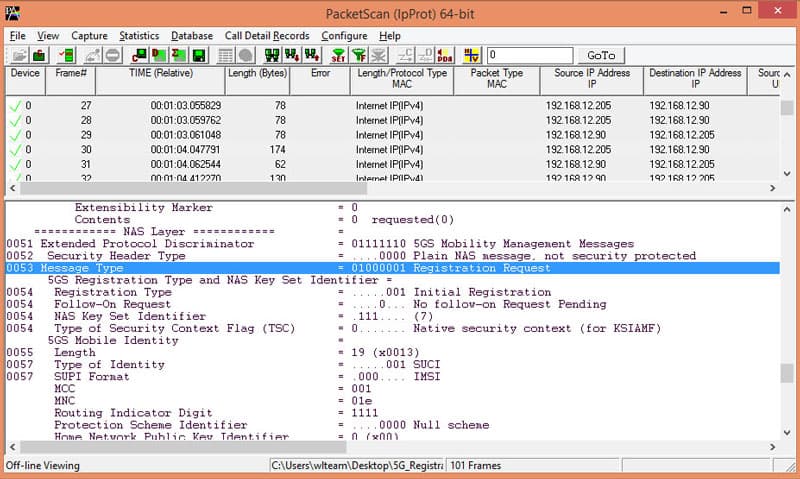
Typical VoLTE Call Captured LTE-IMS Network
- Supports both real-time and offline analysis
- Trace files for analysis can be loaded through simple command-line arguments.
- Decode and analyze full LTE protocol stack.
- Test eNodeB or UE over S1, S3, S4, S5 (or S8), S6a, S10, S11, S13 and X2 interfaces of the LTE network.
- The protocols supported for decoding across all these interfaces are NAS, S1AP, X2AP, eGTP, GTP-U, Diameter, SCTP, UDP, TCP, and IP.
- Monitor thousands of Diameter sessions over S6a, S6d, Cx, Dx, Zn, Zh, Wx, Gq, Gy, Sh, Dh, Gx, Rf, Ro, Wg, Wm, Pr, Wa, Wd, Rx interfaces.
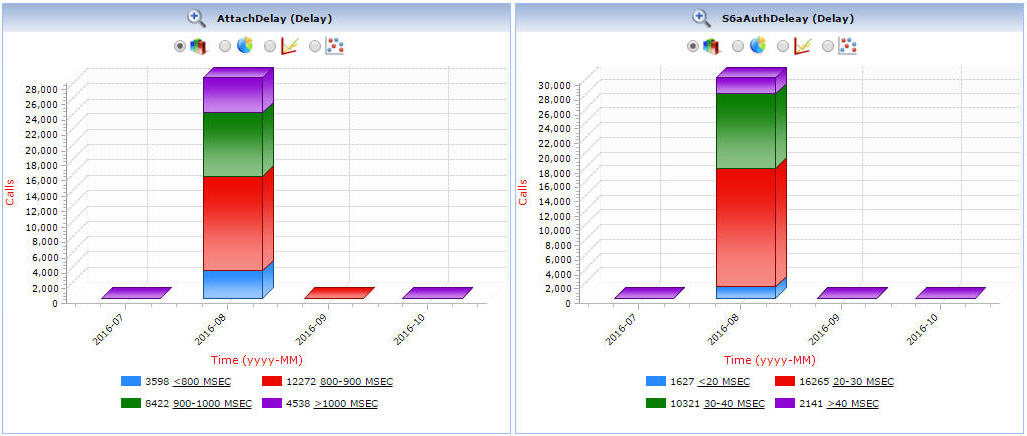
KPI and Reports
- Attach Delay
- S6a Authorization Delay
- Update Location Delay
- Session Delay
- UE Purge Delay
- Delete Session Delay
- Call Duration
Visit PacketScan™ for Wireless Networks or LTE Analyzer webpage for more details. For centralized web-based monitoring LTE Network, visit NetSurveyorWeb™ page.
Measure Voice, Video and Data Quality on LTE, VoLTE Networks
Voice, data, and video quality can be tested simultaneously on a wireless or wired network using GL’s vMobile™ / VQuad™ with the Dual UTA HD, or all-in-one VQuad™ Probe, along with WebViewer™ a centralized analytical tool.
GL’s vMobile™ / VQuad™ is a network independent solution, all Voice and Data networks are supported including 3G, WiMax, 4G LTE, and the 5G. And since the GL vMobile™ / VQuad™ solution supports both Narrowband and Wideband traffic, VoLTE testing is fully supported.
GL’s VQuad™ NetTest solution provides automated data testing on Mobile Devices (Android and iOS) and PC based internet connections. The Data Testing includes TCP, UDP, HTTP, FTP, DNS, VoIP, SMS, and Email tests.
GL’s Video Application Part (VAC) supports Video Conference testing between any two VAC Agents. GL’s VAC Agents can be installed on any Android device, Win PCs or Linux box.
GL’s Voice Quality Testing (VQT) supports automated voice quality between any two nodes within the network using latest ITU based algorithms including Perceptual Objective Listening Quality - POLQA (ITU-P.863) and PESQ (ITU-P.862). The POLQA algorithm is specifically used for testing Wideband voice over VoLTE networks.
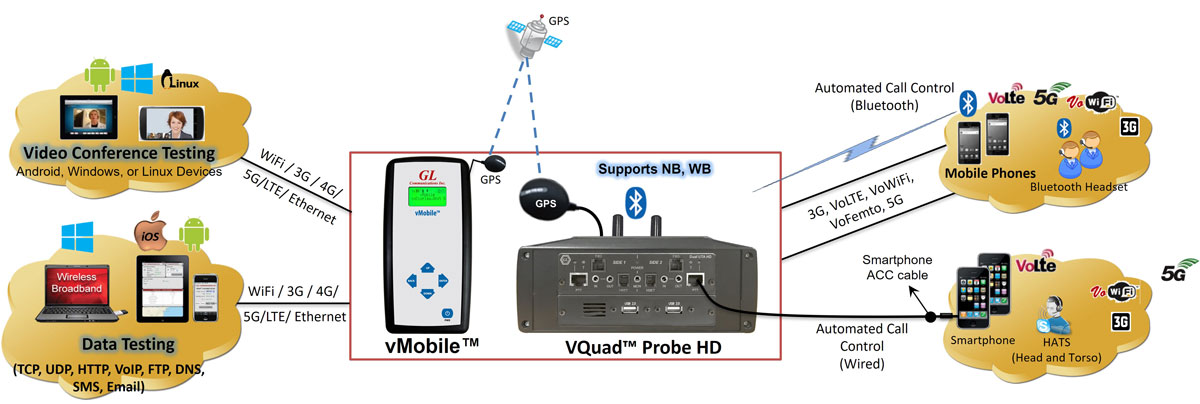
Automated Network Wide Testing for End-to-End Quality Assessment
- Complete end to end voice, data, video quality testing of LTE network-visit Automated Network Wide Testing
- Automated test statistics and results across next generation LTE network can be accessed via web interface
- Connect to Mobile Phones, Smart Phones, and Broadband Devices using GL’s portable vMobile™ / VQuad™ - Dual UTA HD system
- Test LTE devices for Voice, Data, Video quality metrics with complete automation and centrally controlled system
- Use GL’s vMobile™ / VQuad™ - Dual UTA HD to confirm quality of service during the network upgrade process
- vMobile™ / VQuad™ can remotely perform Automated Data Testing on any Android or IOS mobile devices (running the GL NetTest app), irrespective of where the phone is located, and whether the phone is on a voice call or not.
- Perform automated data testing on PC-based Broadband Internet (Broadband 3G/4G/LTE,5G, WiFi, Wired) and on Apple/Android Mobile Devices – tests includes TCP, UDP, HTTP, VoIP, FTP, DNS, SMS, UEInfo, SimInfo, and PhoneInfo
- Supported devices - Mobile Radio (PTT) & Mobile Phones (5G, VoLTE, 4G, 3G, Wi-Fi, WiMax)
- Supports both Narrowband (8k sampling rate) as well as Wideband (16k sampling rate) connections for use in VoLTE networks utilizing the AMR-WB codec
Visit Complete Voice and Data Quality webpage for more details.
As an example, the screenshot illustrates the HD voice quality measurement of VoLTE call using POLQA–
- VQT software includes industry standard voice quality analysis algorithms – POLQA and PESQ
- POLQA testing is available for VQuad™ interfaces
- VQT can be configured for fully Automated analysis of recorded voice files
- Full Reference algorithm (FR) measurements with high accuracy for dedicated tests in live networks
- POLQA analysis results include POLQA MOS, E-Model, Signal Level, Noise Level, and Jitter
- Real-time mapping of results with GPS option used in conjunction with vMobile™ / VQuad™. Results mapped in WebViewer™ using Google Maps
- The results can be accessed remotely from a database using the WebViewer™, displayed in both tabular and graphic formats
Visit voice quality testing webpage for more details.
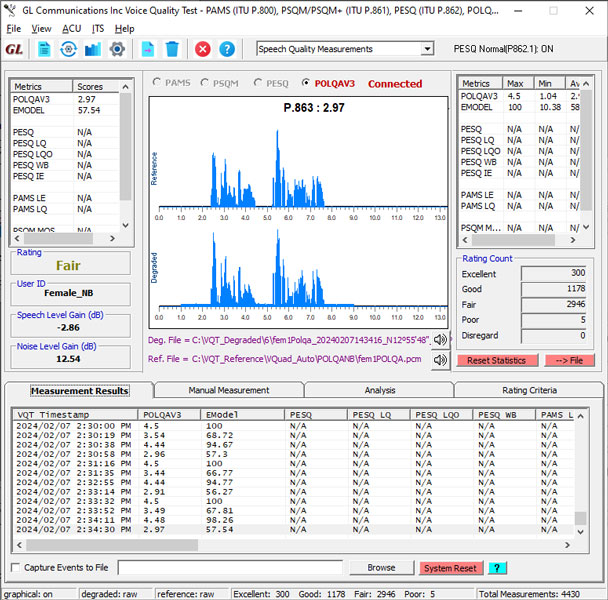
HD Voice Quality Testing for VoLTE Networks
Signaling and Traffic Simulation over LTE - IMS
MAPS™ SIP IMS test suite is capable of simulating multiple UEs and IMS core elements such as P-CSCF, I-CSCF, S-CSCF, PCRF, MGCF which provides the IMS core network. With the help of mobile phones, and other simulated wireless networks, the VoLTE Lab setup can be operated in real-time for making VoLTE calls and also for interworking with PSTN and VoIP networks. It includes ready-to-use scripts, as per IETF specification. Test scripts include general messaging and call flow scenarios for multimedia call session setup and control over IP networks.
GL’s “MAPS™ 4G Wireless Lab Suite” supports simulation of S1-MME, S11, S5/S8, and other eGTP interfaces along with Diameter interfaces.

- Supports emulation of several LTE interfaces. (S1, X2-AP, S3, S4, S5, S8, S10, S11 and S16), and IMS interfaces (Cx/Dx, Rx, Gx, Gm, SGi, Mw, Mi, Mj)
- Supports generation and verification of traffic over LTE, including VoLTE (Voice), Email, FTP, Web (HTTP), Video, and more with additional licenses - Mobile traffic core – GTP (ETH101) and Mobile Traffic Core – Gateway (ETH102)
- Supports IMS-based technologies such as VoLTE
- Simulate up to 500 Smartphones (UEs) powering up and down
- Integrate IMS core network easily with any other networks (wired or wireless) to test any call scenario It can simulate various nodes across LTE network –
- S1-MME interface - eNodeB (also called Evolved NodeB), and MME (Mobility Management Entity) nodes in
- eGTP-c interfaces - MME (Mobility Management Entity), SGSN (Serving GPRS Support Node), SGW (Serving Gateway), and PGW (Packet Data Network Gateway)
- X2-AP interface – two eNodeB (also called Evolved NodeB) end-points
- Diameter interfaces - MME (Mobility Management Entity), HSS (Home Subscriber Server), AF (Application Function), PCRF (Policy and Charging Rules Function), CSCF (Call Session Control Function), SGSN (Serving GPRS Support Node), PCEF (Policy and Charging Enforcement Function), EIR (Equipment Identity Register) and PDN GW (Packet Data Network Gateway)
- Authenticate and confirm security procedures
- QoS requests for greater or lesser bandwidth
- Temporary addressing management for mobility and security
- 4G IMS network setup for inter-networking with 2G/3G and UE roaming scenarios simulation
Standards
| Test Conformance of LTE elements to 3GPP standards | |
|---|---|
S1AP (S1 Application Protocol) |
3GPP TS 36.413 V9.0.0 |
X2 Application Protocol (X2-AP) |
3GPP TS 36.423 V9.0.0 |
NAS (Non-Access-Stratum) |
3GPP TS 24.301 V9.0.0 |
Evolved GTP (eGTP) for EPS |
3GPP TS 29.274 V8.0.0 |
S6a, S6d, S13 |
3GPP TS 29.272 V10.3.0 |
Rx |
3GGP TS 29214-b10 |
Cx/Dx |
3GPP TS 29.228 & TS29.229 |
Gx |
3GPP TS 29.212 & TS 23.203 |
Zn/Zh |
3GPP TS 29.109 & TS 33.220 |
Wx |
3GPP TS 29.234 |
Gx |
3GPP TS 29.212 & TS 23.203 |
Gy |
3GPP TS 32.29, TS 32.251 & RFC 4006 |
Gq |
3GPP TS 29.209 |
Sh/Dh |
3GGP TS 29.328 & TS 29.329 |
Rf/Ro |
3GGP TS 32.225, 3GPP TS 32.299 3GPP TS 29.061 |
Wg/Wm/Wa/Wd/Pr |
3GPP TS 29.234 |
SLg |
3GPP TS 29.172 |
SLh |
3GPP TS 29.173 |
Circuit Switched Fallback in Evolved Packet System |
3GPP TS 23.272 |
SGs Application Part (SGsAP) |
3GPP TS 29.118 |
LPP |
3GPP TS 36.355- Release 14 |
Location Services-Application Part (LCS-AP) |
3GPP TS 29.171 V14.0.0 (2016-12) |
SCTP |
RFC 4960 |
TCP |
RFC793 |
TLS |
RFC 5246 |
Use Cases
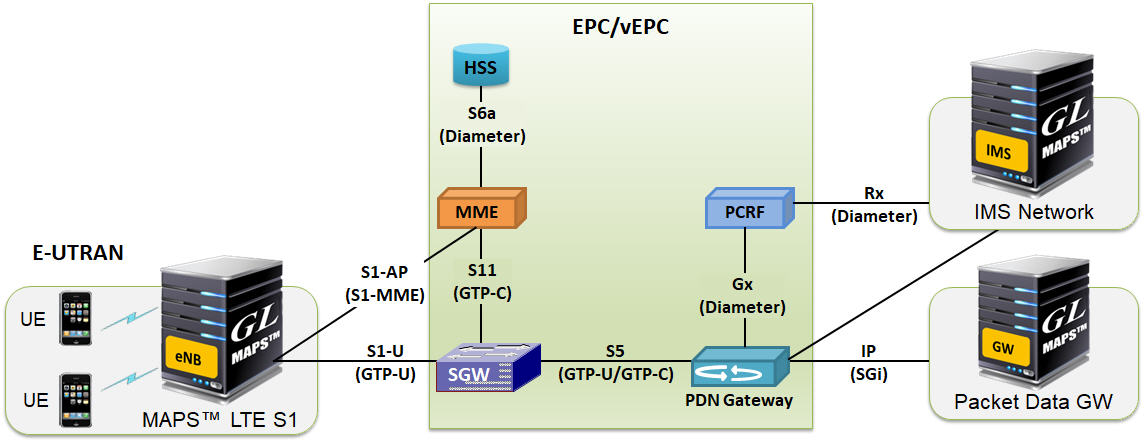
EPC Testing
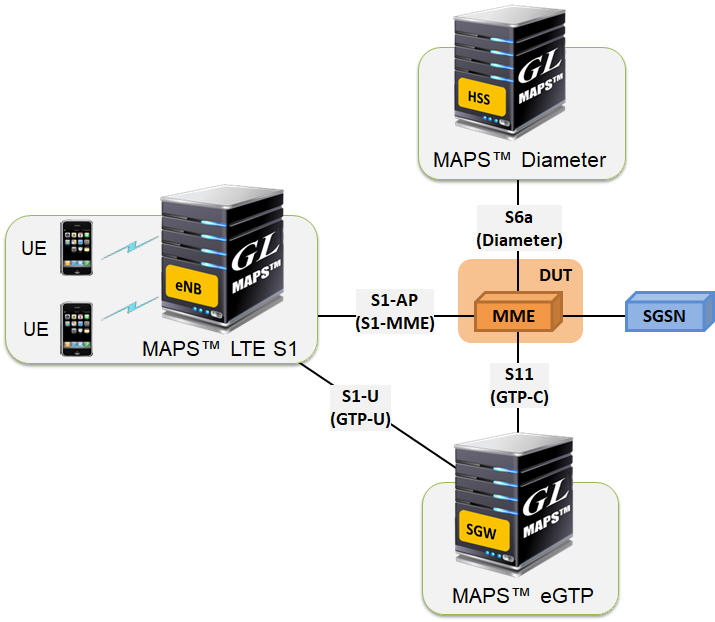
MME Testing
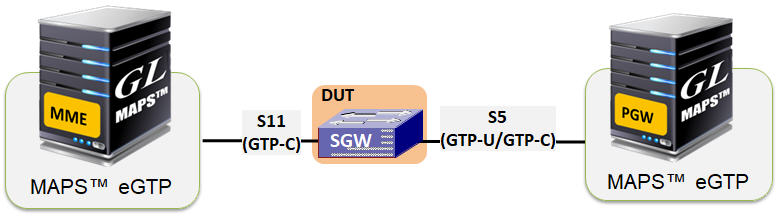
Isolated S-GW Testing w/throughput

IMS Testing
Resources
Please Note: The XX in the Item No. refers to the hardware platform, listed at the bottom of the Buyer's Guide, which the software will be running on. Therefore, XX can either be ETA or EEA (Octal/Quad Boards), PTA or PEA (tProbe Units), XUT or XUE (Dual PCIe Express) depending upon the hardware.
| Item No. | Item Description |
| PKV107 | LTE (Long Term Evolution) Analyzer (Optional with PacketScan™) |
| PKV108 | Offline LTE Analyzer (Decode / Analyze pre-captured LTE files Requires PKV101) |
| PKV112 | 5G Analyzer (Optional with PacketScan™) |
| PKV113 | Offline 5G Analyzer - Optional with PKV101 (offline PacketScan™) and PKV170 (NetsurveyorWeb™) |
| PKS127 | MAPS™ IMS Emulator |
| PKV100 | PacketScan™ (Online and Offline) |
| PKV101 | PacketScan™ (Offline) |
| PKV120 | PacketScan™ HD w/4 x 1GigE |
| PKV120p | PacketScan™ HD w/4 x 1GigE - Portable |
| PKV122 | PacketScan™ HD w/2 x 10GigE |
| PKV122p | PacketScan™ HD w/2 x 10 GigE - Portable |
PKV124 |
|
PKV124P |
|
| PKV123 | PacketRecorder™ HD & PacketRePlay HD™ |
| PKV121 | PacketScan™ FB |
| PKS139 | MAPS™ Diameter Emulator |
| PKS140 | MAPS™ LTE S1 Emulator |
| PKS141 | MAPS™ LTE X2-AP Emulator |
| PKS142 | MAPS™ LTE - eGTP-c Emulator |
| PKS146 | MAPS™ SGs Interface Emulation |
| VQT280 | VQuad™ Probe HD (with Dual UTA HD) |
| VQT281 | VQuad™ Probe HD w/o Dual UTA HD |
| VQT285 | VQuad™ Probe HD Upgrade |
| VQT601 | Mobile Device Controller Software |
| VQT006 | VQT w/ POLQA Server license (no limitations) |
| VQT007 | VQT POLQA v3, server license for 20 nodes |
| VQT600 | VQuad™ NetTest Data Server Solution (Requires annual license renewal to remain functional) |
| Related Software | |
|---|---|
| PKV170 | NetsurveyorWeb™ (Perpetual License, Unlimited Users/Nodes) – Includes Oracle 11g Standard Edition One and Standard Server-Grade Computing Platform |
| PKV169 | NetsurveyorWeb™ Lite - Probe Level WebServer, PacketScan™, and Oracle 11g Express Edition; |
| PKV171 | Network Surveillance Agent Toolkit |
| PKV105 | SIGTRAN Protocol Analyzer (Requires PKV100) |
| XX090 | HDLC Capture and Playback Software (T1 or E1) |
| XX120 | Real-time SS7 Analyzer (T1 or E1) |
| XX153 | TRAU Analyzer |
| XX155 | GPRS Protocol Analyzer |
| VQT040 | WebViewer™ |