MAPS™ ED-137 Recorder Emulator
Emulate Call Recording at Controller, Radio and Recorder Interface
Request a Demo / Quote Brochure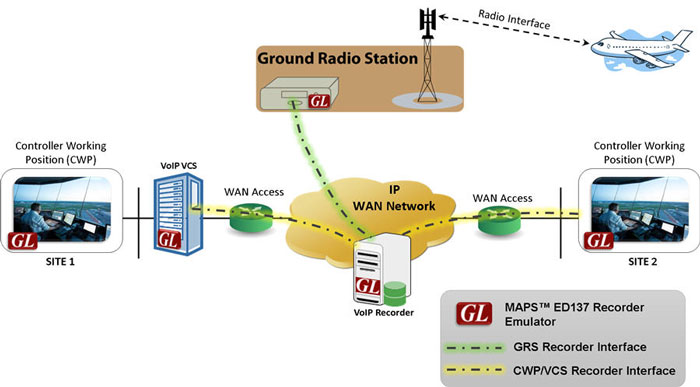
Overview
Air traffic control centers are required to provide continuous "ground/ground" and "ground/air" voice communication recordings with synchronized flight related data, for establishing “air traffic incident” chronology, replay, improving safety, audits, statistics, and training purposes.
MAPS™ ED-137 Recorder supports both ED-137/4B and ED-137/4C versions of Recorder Interface emulation. ED-137 defines inter-operability standards for the next generation VoIP Air Traffic Recorder. These next generation recorders are specially designed for all traffic control towers and centers to simplify the recording, archiving, and playback of voice communications.
GL’s MAPS™ ED-137 Recorder (PKS117) can emulate Recorder interface for both Air-to-Ground (AG) and Ground-to-Ground (GG) calls at Controller Working Position (CWP), Ground Radio Station (GRS) and Recorder endpoints as per ED-137/4B & 4C versions, as defined under EUROCAE (European Organization for Civil Aviation Equipment) Working Group 67.
MAPS™ ED137 Recorder can emulate AG/GG call recording towards Recorder and testing Recorder interface of CWP/VCS and GRS.
MAPS™ ED-137 Recorder supports Real Time Streaming Protocol (RTSP) to establish, terminate and maintain media sessions to deliver media to recording servers. Active recording requires an established session (i.e. a certain number of parameters that are exchanged between entities prior to any recording). CWP/VCS, Radio and Recorder use RTSP for such sessions. As RTSP relies on a transport layer protocol (TCP or UDP), these entities use SIP to exchange capabilities and connection information (i.e. IP address, port number, and transport protocol).
The MAPS™ profile editor feature allows users to easily configure multiple CWPs, GRS and Recorder profiles, allowing to emulate multiple CWP, GRS and Recorder entities. The product also supports transmission and detection of various RTP audio traffic such as real-time audio, voice file, digits, single tone and dual tones. The software not only provides complete control over call scenarios to be tested, but also the ability to customize the network parameters for signaling and VoIP traffic. It has the capability of generating more than hundreds of recording sessions to verify performance and load testing.
GL tools for signaling emulation and voice quality testing offer an end-to-end test solution for testing connections from the radio interfaces to the Controller Working Position (CWP) and recording voice communications over the network. GL’s Air Traffic Management Solution also includes MAPS™ ED-137 Telephone Emulators and MAPS™ ED-137 Radio Emulators.
Main Features
Signaling and Traffic Emulation
- Emulates recording interface at CWP, VCS, GRS and Recorder end points
- Supports all the features as per ED137C_Volume_4_Recorder Change 1 and Change 2 recommendations
- Supports both IPv4 and IPv6
- Supports all three media transport methods: Embedded Binary Data, RTP over TCP and RTP over UDP
- Emulates Recorder interface on multiple CWPs and Radios from single instance of MAPS™
- Emulates Recorder interface for both Air-to-Ground and Ground-to-Ground calls
- Supports emulating multiple recording servers from single instance of MAPS™
- Validated against VOTER Version 4.1.33.4 BASELINE SPECIFICATION Volume 4 - Recorder ED-137/4C compliance
- Recorder node records the voice on sessions to audio files and saves Call Record Data to CSV files
- Customization of each CWP/GRS profile to emulate an AG/GG call
- Up to 500 RTSP sessions can be generated or recorded simultaneously
- Highly flexible architecture for custom testing scenarios
- Custom Properties and Operations can be included
ED137/4B Recorder
- Scripts to automate PTT and Squelch operations on AG recording sessions
- Emulates Voting operation with two or more users (GRS)
- Simultaneous Call Transmission (SCT) with Squelch ON
- User can configure multiple users (radios) to emulate voting and simultaneous squelch operation
- Emulates call intrusion, call transfer and call hold operations on GG call
- Options to easily add custom call record data properties (like Caller, Callee, Frequency) and operations (like PTT, Squelch, Call Hold)
ED137/4C Recorder
- All RTSP requests and response WG67-Version header updated to 'recorder.02'
- Supports recording 2-byte base R2S header and R2S header extensions (R2S-TLV)
- Recording client supports RTSP session keep alive
- Supports checking Recorder Server liveliness
- Emulation of proprietary CRD metadata
- Recorder Server supports RTSP session time out if no requests are received within timeout value
- Emulates Caller Rejected calls, Attended Call Transfer, Joining conference etc.
- Additional call properties include Call Type, Client Type, ClientId and Disconnect Reason
- New Operations includes ConfRef, Radio Access Mode, R2S and R2S-TLV
Traffic
- Supports various traffic actions on the call such as Talk using Microphone, Playback to Speaker and Send & Record audio file
- Supports user-defined and automated traffic actions on the call
- Supports all standard codecs, including G.711 (Mu-Law and A-Law) and G.729
Applications
- On field testing and troubleshooting by technicians
- In-the-field installation, system configuration and commissioning
- Functionality testing of nodes in next generation VoIP ATM
- Centralized recording of Air Traffic
- Real-time and/or historical data analysis
Frequently Asked Questions
- What is MAPS™ ED-137 Recorder?
- MAPS™ ED-137 Recorder is a software-based recorder emulator used to validate ATM voice recording systems.
- What problem does MAPS™ ED-137 Recorder solve?
- MAPS™ ED-137 Recorder verifies that voice communications are recorded, stored, and retrieved correctly.
- Which standards does MAPS™ ED-137 Recorder support?
- MAPS™ ED-137 Recorder supports ED-137B and ED-137C Recorder specifications.
- What recorder functions can MAPS™ ED-137 Recorder emulate?
- MAPS™ ED-137 Recorder can emulate recording subscriptions, recording sessions, and playback validation.
- Can MAPS™ ED-137 Recorder record radio and telephone communications?
- Yes. MAPS™ ED-137 Recorder supports both radio and telephone communication recording validation.
- Does MAPS™ ED-137 Recorder support IPv4 and IPv6?
- Yes. MAPS™ ED-137 Recorder supports both IPv4 and IPv6.
- Can MAPS™ ED-137 Recorder emulate large numbers of recording sessions?
- Yes. MAPS™ ED-137 Recorder supports hundreds of simultaneous recording sessions.
- Can MAPS™ ED-137 Recorder be used for interoperability testing?
- Yes. MAPS™ ED-137 Recorder validates interoperability between recorders and ATM communication systems.
- How does MAPS™ ED-137 Recorder verify recording performance?
- MAPS™ ED-137 Recorder verifies recording establishment, continuity, media delivery, and playback.
- Does MAPS™ ED-137 Recorder support automation?
- Yes. MAPS™ ED-137 Recorder supports automated testing through scripts and APIs.
- How does MAPS™ ED-137 Recorder help troubleshoot recording issues?
- MAPS™ ED-137 Recorder provides recording session traces, SIP analysis, and RTP diagnostics.
- What are the key benefits of MAPS™ ED-137 Recorder?
- MAPS™ ED-137 Recorder enables recorder compliance validation, interoperability testing, and deployment readiness assessment.
Emulation of Use Cases
MAPS™ ED-137 Recorder supports emulation of the following Use Cases–
| CASE 1: emulate AG call recording towards Recorder | |
|---|---|
 Emulate AG call recording towards Recorder |
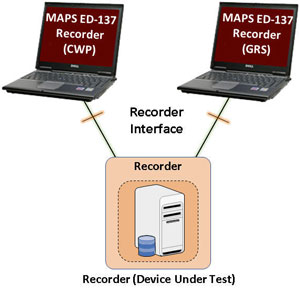
MAPS™ ED-137 Recorder can be configured as CWP or GRS to emulate AG recording sessions towards the Recorder (device under test) to test its recording interface as per ED-137 volume 4. |
| CASE 2: Emulate GG call recording towards Recorder | |
|---|---|
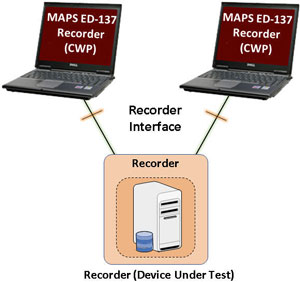 Emulate GG call recording towards Recorder |
MAPS™ ED-137 Recorder can be configured as CWPs to emulate GG recording sessions towards the Recorder (device under test) to test its recording interface as per ED-137 volume 4. |
| CASE 3: Testing Recorder interface of CWP/VC | |
|---|---|
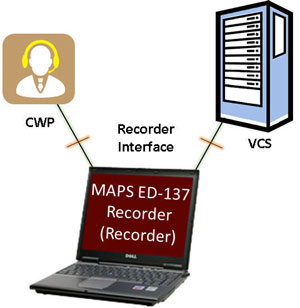 Testing Recorder interface of CWP/VCS |
In this test case, CWP or VCS vendors can use MAPS™ ED-137 Recorder (emulating Recorders) to test the Recorder interface of their equipment. |
| CASE 4: Testing Recorder interface of GRS | |
|---|---|
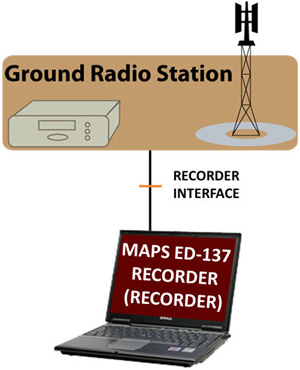 Testing Recorder interface of GRS |
In this test case, MAPS™ ED-137 Recorder is emulating Recorder server to receive recording sessions from GRS thus testing Recorder interface of GRS. |
Typical AG, GG and Recorder Interface Calls Recording
A typical ED-137 Recorder session between CWP-to-Recorder and GRS-to-Recorder emulation is as shown below.
MAPS™ ED-137 Recorder emulates complete call flow and provides message decodes for each session. The PTT, and Squelch (Record) events are also updated to the call graph indicating the time at which the event occurred.
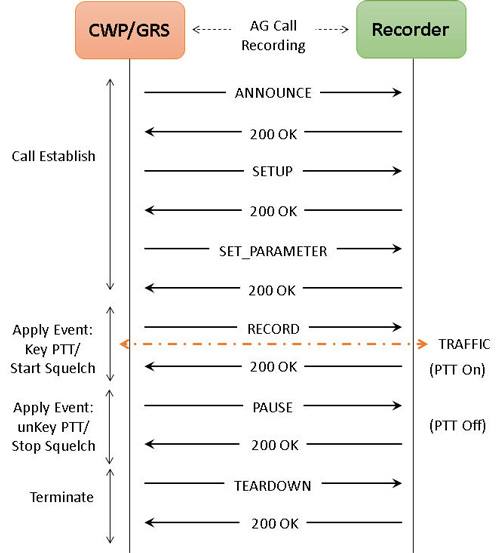
Typical AG Call Recording Scenario
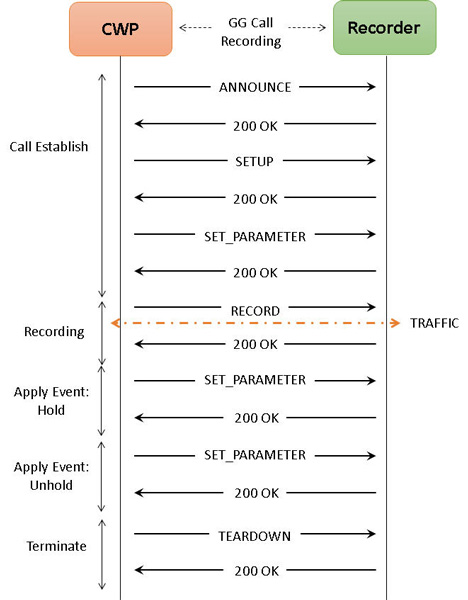
Typical GG Call Recording Scenario
Emulation of AG/GG call recordings as per ED137-4B version
MAPS™ ED-137 Recorder can be configured as CWP and RECORDER to emulate AG calls recordings. MAPS™ supports performance and automated stress/load testing capabilities emulating hundreds of recording sessions over the Recorder interface. All the recorded files are automatically saved at Recorder terminal in GL's proprietary file format (*.glw).
The following events are supported at CWP/GRS during the call emulation -
- Voting – this event can be applied on a session to send RTSP messages indicating Rx stream selected by the voting algorithm.
- Simultaneous SQU – if applied on a session, emulates recording simultaneous SQU received at VCS on different frequencies
- Start Squelch – this event can be applied to indicate squelch detection (at VCS) to recorder.
- Call Intrusion – if this event is applied on a session then RTSP messages are sent to emulate call intrusion scenario on GG call.
- Call Transfer – if this event is applied on a session then RTSP messages are sent to emulate call transfer scenario on GG call.
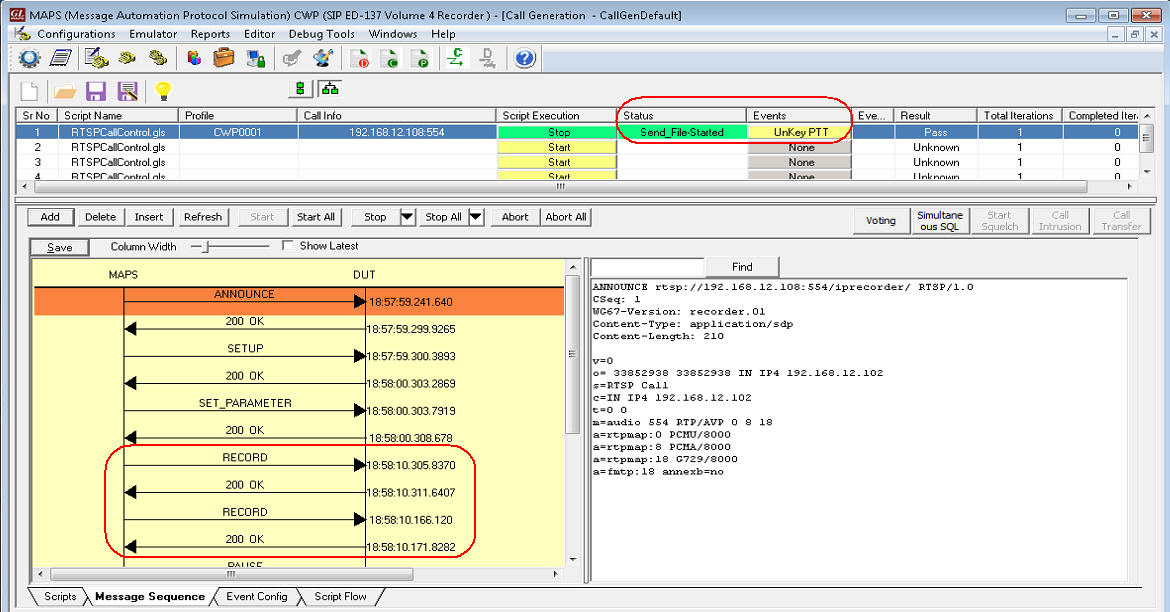
MAPS™ ED-137 Recorder (CWP) Call Generation
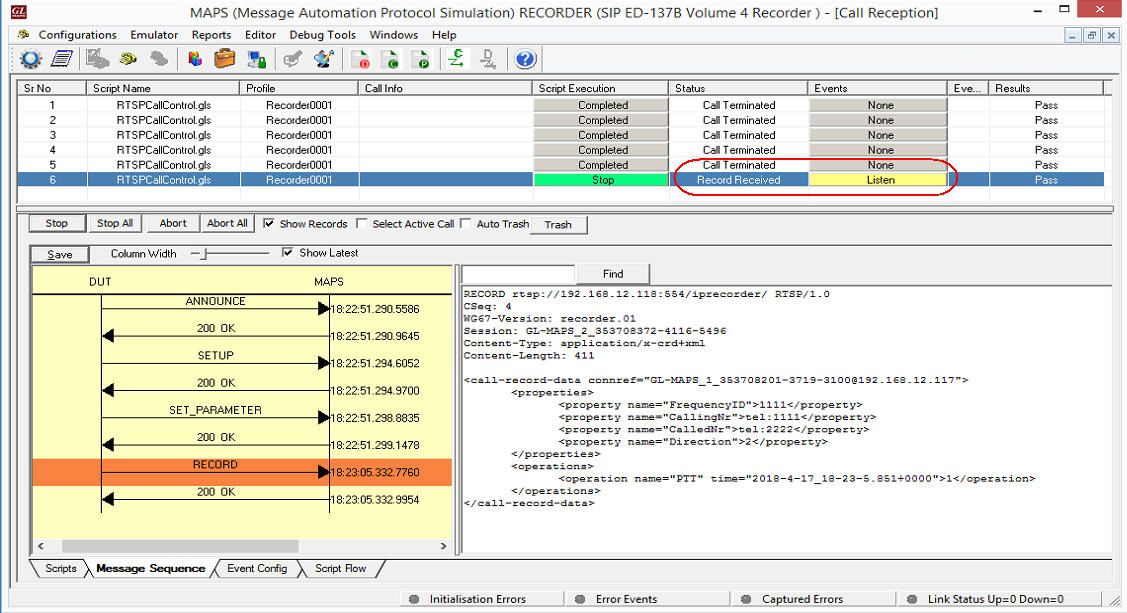
MAPS™ ED-137 Recorder (RECORDER) Call Reception
The Call Record Data for AG and GG calls are saved in CSV file format. Call Record Data entry for each recorded call in the CSV file will also contain the recorded audio file. These audio files are in GL's proprietary format (GLW). All audio files in GLW file format can be automatically converted to PCM/WAV files using GL's Audio File Conversion Utility, and playback these audio files using utilities such as Goldwave or Adobe Audition.
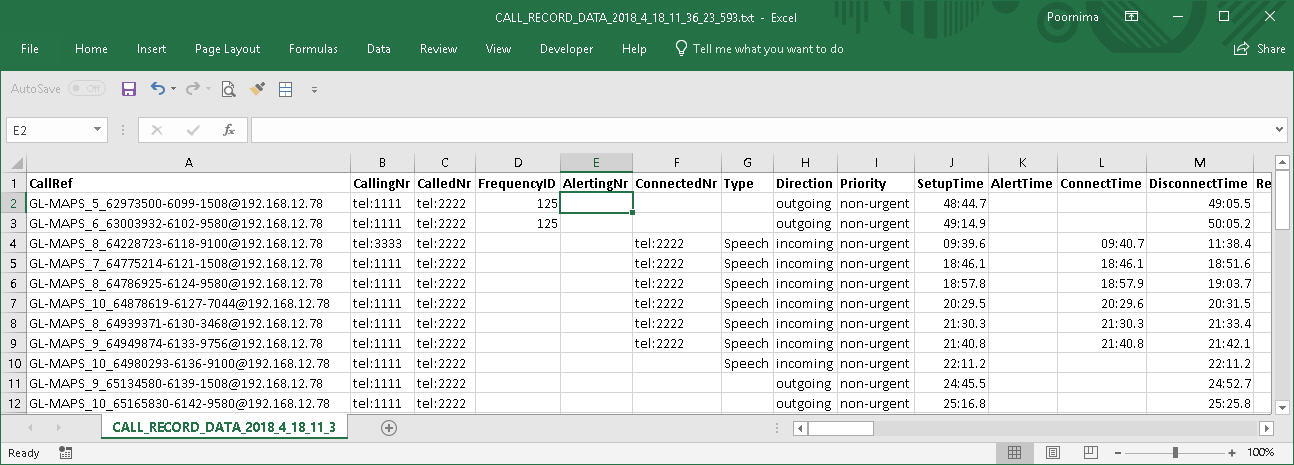
Call Record Data CSV File
Emulate AG/GG call recordings as per ED137-4C version
MAPS™ ED-137 Recorder is enhanced to emulate AG /GG call recordings as per ED137-4C recorder interface version. MAPS™ supports performance and automated stress/load testing capabilities emulating hundreds of recording sessions over the Recorder interface.
The following events are supported at CWP/GRS during the call emulation -
- RTSP Session Keep Alive - Recording Client assures RTSP session keep alive by sending RTSP GET_PARAMETER request periodically to Recording Server
- Recorder Server Liveliness - checks whether the server is available or not to process and respond to the RTSP requests
- Recording 2 Byte Base R2S Header and R2S Header Extensions (R2S-TLV) - R2S operation values are sent with RECORD and PAUSE messages for PTT/SQUELCH
- Caller Rejected Calls – this event allows caller to reject the call before sending SETUP or TEARDOWN messages
- Attended Call Transfer operations - This event is used to emulate Attended Call Transfer on GG call, where minimum 2 users need to be configured with proper Called Number (User 2 is considered as third-party number)
- Joining Conference operations - This event is used to emulate the conference call while adder the user to the conference (Join Conference option) or removing user from the conference (Exit Conference option)
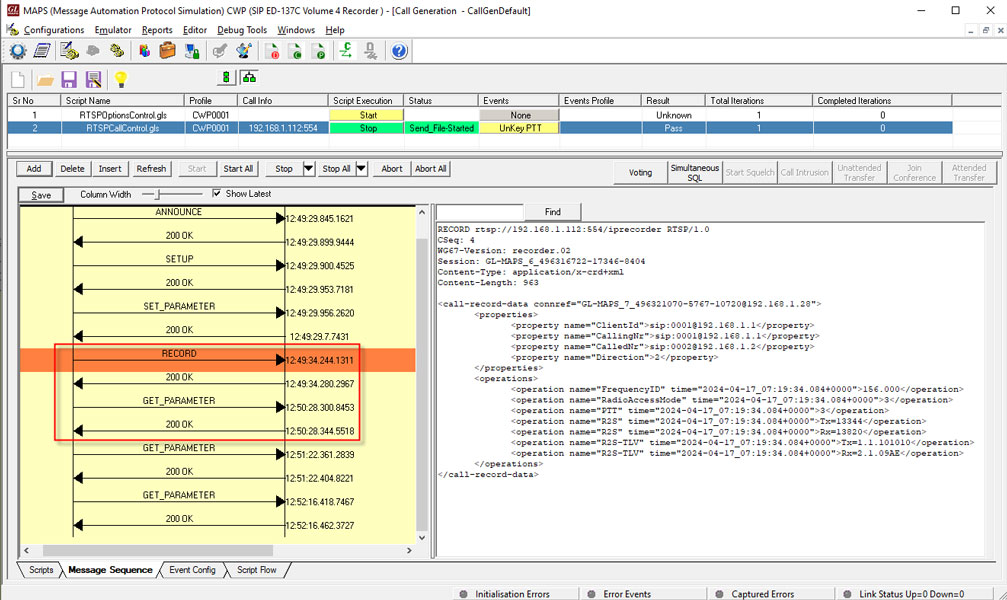
Emulate AG Call Recording
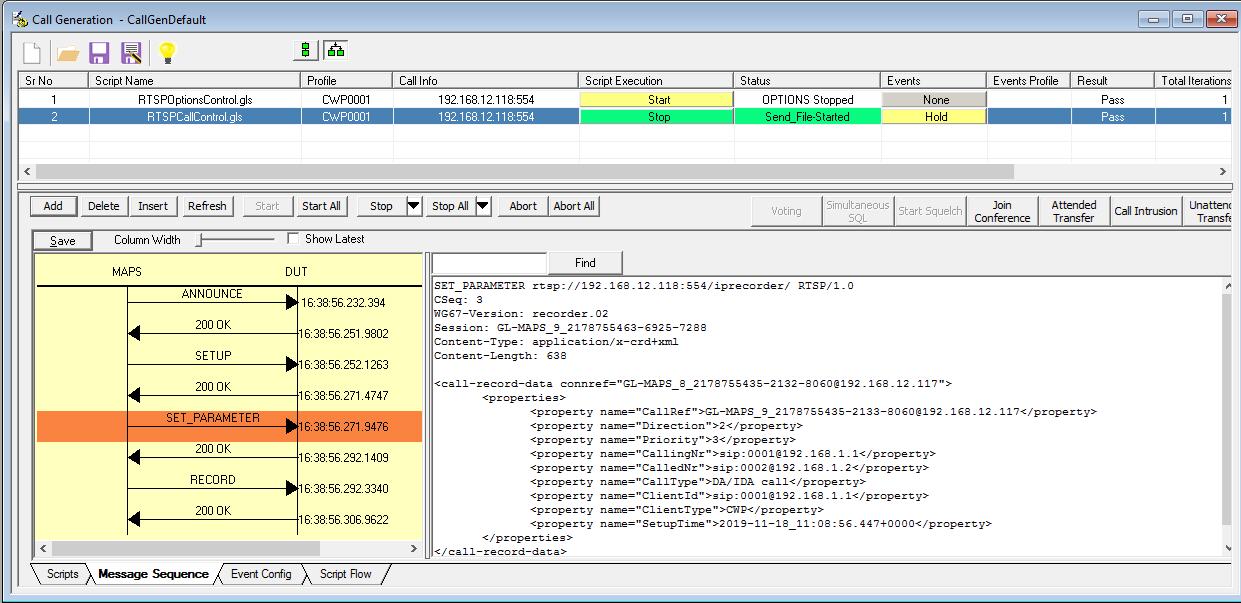
Emulate GG Call Recording
Resources
Note: PCs which include GL hardware/software require Intel or AMD processors for compliance.
| Item | Air Traffic Management |
|---|---|
| PKS118 | MAPS™ ED-137 Radio (Includes PKS107, & PKS102) |
| PKS119 | MAPS™ ED-137 Telephone (Includes PKS102) |
| PKS117 | MAPS™ ED-137 Recorder (Includes PKS102) |
| PKS102 | RTP Soft Core for RTP Traffic Generation |
| PKS107 | RTP EUROCAE ED137 |
Webinars
ED-137 Radio Testing and ED-138 Monitoring

Air Traffic Management Test Solutions

VoIP ATM Test Solutions
Workshop 1 : MAPS™ ED-137 Radio Emulator
Workshop 2 : MAPS™ ED-137 Telephone Emulator
ED-137B Test Solutions
Testing VoIP Air-to-Ground Calls per ED-137C Radio
Enhanced Test Tools for ED-137B VoIP Air Traffic Control