GL Communications Inc.


Home >  Analysis (T1/E1/T3/OC-3/STM-1) >  Software Applications


Protocol Analysis

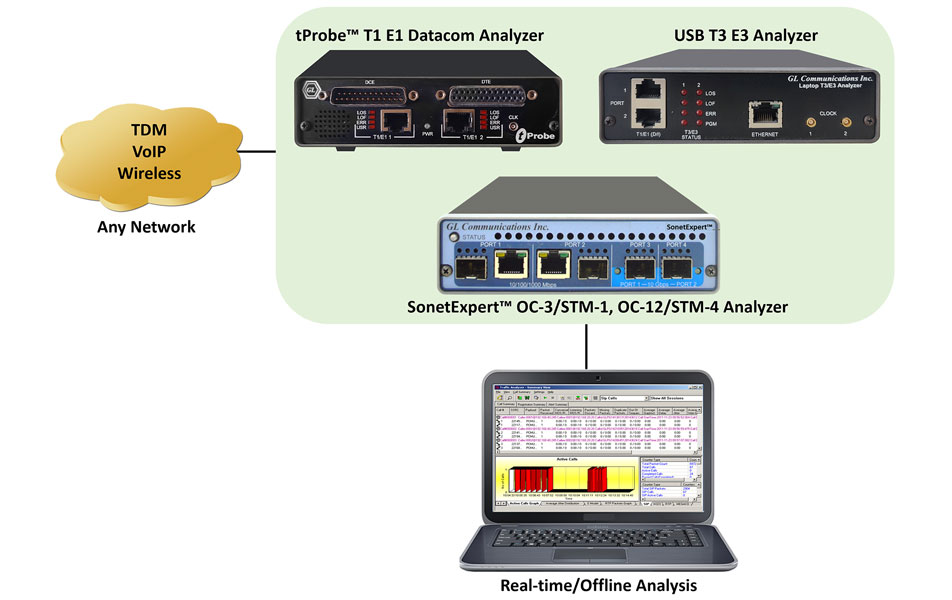
GL carries the widest array of protocol analyzers for TDM, Wireless, and Packet networks. Based on a uniform architecture with identical features and functions, they can be used flexibilly for a wide variety of tasks, including

  • as independent standalone units for simple interface analysis
  • as remote or offline analyzers
  • as "probes" integrated with a network surveillance systems
  • as network elements for advanced traffic collection and processing

Typical examples include, continuous recording of protocol exchange on an SS7 interface, limited only by hard disk or network storage space; or triggering, collecting and filtering for unique subscriber information and relaying such information to a back end processor; or collecting CDR information for billing.

TDM Protocol Analyzers   Packet and Frame Protocol Analyzers   ATM and Wireless Protocol Analyzers
 Channel Associated Signalling (CAS)    PPP    ATM
 ISDN    MLPPP    UMTS
 SS7(C7)    Frame Relay    CDMA 2000
 HDLC    UMTS    GPRS
 GR-303    CDMA 2000    TRAU
 V5.X    SIGTRAN    GSM
 PPP and MLPPP    SIP/H.323/MGCP/Megaco/RTP/RTCP/Video    Over Air GSM
 T1 Faciltiy Data Link Analysis    Network Surveillance    Network Surveillance
 E1 Maintenance Data Link        
 DCME Test and Analysis        
 Network Surveillance        


CDMA 2000 Protocol Analyzer

GL's CDMA analyzer is used to analyze and view protocols across A, Ater, Aquinter, & Aquater signaling interfaces. CDMA analyzer uses GL's proven T1/E1 internal cards or Laptop T1/E1 external units.


UMTS Analyzer

GL's UMTS analyzer is capable of capturing, decoding and performing various test measurements across various interfaces i.e. Iub, Iur, IuCs and IuPs interfaces of the UMTS network. In addition, it supports ATM as the transport layer. It helps in fault diagnosis and troubleshooting UMTS network.


MC-MLPPP Analyzer and Emulator

ML-PPP has wide application for access lines to Internet Service Providers (ISPs) and enterprises that need "single pipes" greater than one T1 but less than 28 T1s. ML-PPP is similar to IMA (Inverse Multiplexing over ATM), in the sense that larger bandwidth is derived by aggregating smaller physical channels. The protocol allows splitting, recombining, and sequencing datagrams across multiple data links into a single logical pipe or bundle.

GL’s flexible and versatile applications in T1E1 Analyzer allow complete PPP, MLPPP, & MC-MLPPP Analysis & Emulation. The T1E1 Analyzers are available as powerful HD PCI cards as well as portable USB based units. For more details, please visit the following links:

  • MC-MLPPP Emulator – For Automated Testing of PPP, MLPPP, & MC-MLPP using Client Server

    Automated testing can be accomplished using client-server based PPP, MLPPP, & Multi-Channel (MC) MLPPP Emulation and Analysis (MLPPPTerr) module. The application permits traffic generation and verification over PPP links and may be accessed through a GUI or through command line scripts.

  • ML-PPP Analyzer (GUI Based)

    GL's ML-PPP Analyzer can be used to capture a host of PPP protocols exchanged between the two nodes over T1/E1 link. User can obtain detailed analysis of the protocol and can perform various statistics measurements.


ATM Analyzer

GL's ATM Analyzer is used to analyze and view ATM protocols across the U-plane for both NNI and UNI interface. ATM analyzer uses GL's field proven Ultra E1 or T1 internal cards or Dual Laptop E1 or T1 external products.


GPRS Protocol Analyzer

General Packet Radio Service (GPRS) permits continuous data connectivity over wireless GSM networks. The GPRS Analyzer performs real time (and offline) analysis across the Gb (T1/E1) and Gn (Ethernet) interface.


TRAU Emulation and Analysis

GL's T1/E1 Analyzer can be equipped with TRAU Toolbox™, TRAU Traffic Playback, and TRAU Analyzer applications for emulation and analysis of traffic at A-bis interface. The following TRAU applications are supported that further help in transmitting and capturing pre-defined TRAU frames.

  • TRAU Analyzer

    GL's TRAU Analyzer is used to non-intrusively monitor TRAU frames at the Abis interface (between the BTS (CCU) and the TRAU node at BSC/MSC).

  • TRAU Traffic Playback

    The TRAU Traffic Playback is an application used to generate TRAU traffic on T1/E1. The tool provides the ability to playback the recorded TRAU file(s) using TRAU Analyzer on selected/all subchannels of T1/ E1 lines.

  • TRAU Toolbox™ (Emulation)

    TRAU Toolbox™ is an ideal tool to test network elements at A-bis interface. The tool can be used to create, monitor, and terminate multiple TRAU/GSM traffic (TRAU sessions).

  • Automated TRAU Testing using Client-Server (requires additional licenses)

    The File based TRAU Record/Playback (Traufunc) module is an optional application that allows Capture/Playback of TRAU traffic.


SS7(C7) Protocol Analysis

GL's SS7 (C7) Analyzer performs SS7 analysis in real-time, as well as off-line. The real-time mode of operation is used to capture and analyze stream of frames on the SS7 Links. Captured information can be saved to disk for later off-line analysis. MTP2 is parsed according to ANSI-ITU standards and the higher SS7 layer information parsing depends on the user's selection of TUP, ISUP, SCCP, TCAP, GSM-MAP, IS-41, INAP, etc., according to national and international variants.


GSM Protocol Analysis

The GSM Analyzer is used to view and analyze GSM protocols using GL's field proven Ultra E1 or Ultra T1 internal cards or Laptop E1 or T1 portable external products. The GSM Analyzer is connected in a monitoring mode to an A-interface and/or an A-bis interface. Features include real time as well as offline analysis, summary view displays of MTP2, MTP3, and higher layer GSM Message types, and detail views and decodes of user selected frames.


ISDN Protocol Analysis

GL's ISDN Analyzer is used to capture and analyze streams of frames on the contiguous or non-contiguous, fractional or full, T1/E1. Captured information can be saved to disk for later off-line analysis. LAPD is parsed according to Q.921 and the ISDN information parsing depends on the user's selection of ITU Q.931, AT&T/Lucent switch 4ESS and 5ESS (TR41449, TR41459 and 235-900-342), Nortel's switch DMS-100 and DMS-250 (NIS-A2111-1 and NIS-A211-4), Bellcore National ISDN-2 (NI-2), Euro ISDN (ETS-300 102-1), etc.


HDLC Analysis/Playback/Simulation

GL's HDLC Analysis and Playback Software provides the capability to record, analyze, and transmit HDLC data on a full duplex T1 or E1 lines. The HDLC frames may be contained in one or n x 64 kbps or n x 56 kbps data channels. The following variations are accommodated in the software: inverted or non-inverted data, byte reversal or non-reversal. Multiple instances of the program may be invoked to analyze HDLC data in multiple channels.

In addition the following HDLC applications are supported that further help in transmitting and capturing pre-defined HDLC frames:

  • HDLC Playback

    The HDLC Playback application is used to transmit HDLC frames in the pre-recorded files over T1/E1 channels.

  • HDLC Impairment Utility

    The HDLC Link Impairment Utility (HLIU) offers various options to "impair" (inject errors) specific HDLC frames of a real time HDLC frame stream.

  • HDLC TxRx Test Application

    The HDLC Automated Test System consists of two applications: Transmitter application and Receiver application. Each application has real-time and off-line features.

  • Automated Testing of HDLC Frames using Client -Server (requires additional licenses)

    GL provides client –server based HDLC capture, playback, emulation, analysis & remote capture modules.


GR-303 Protocol Analysis

GL's GR-303 Protocol Analyzer offers testing for all aspects of GR-303 systems: monitoring the T1 line, monitoring the TMC/CSC control channel, viewing robbed ABCD signaling and dialed digits, listening to voice channels, and thorough tests for the physical layer. The GR-303 Analyzer troubleshoots signaling problems between the switch and remote terminal: to determine call status, monitor for any dropped calls, detect any abnormal conditions, and identify when service was unavailable. With these extensive GR-303 protocol analysis tools, you can analyze call setup and monitor communications between network elements and resolve problems as new network challenges emerge.


V5.x Protocol Analysis

GL's V5.x Analyzer is used to view and analyze the V5.X protocol between an Access Network (AN) and a Local Exchange (LE) which operates only on E1 circuits. Using the real-time mode of operation, the V5.x Analyzer can be used to capture and analyze a stream of frames from the link between the LE and the AN. The user can select the ETSI or ITU-T standard from the main menu of the V5.x Analyzer GUI to view the decode according to the corresponding standard.


E1 Maintenance Data Link Analysis (SA Bits HDLC Decode /Store)

The SA HDLC Analyzer performs HDLC protocol analysis on E1 timeslot 0 both during real time and off-line using saved files with high level data link (HDLC) frames. The real-time mode of operation is used to capture stream of HDLC frames on the selected even or odd frames of the E1 multiframe on timeslot 0. Captured information can be saved to disk for later off-line analysis. Both real-time and off-line analysis presents summary view and detailed views of HDLC decode information. Captured Frames can later be used for traffic simulation using the SA Bits HDLC transmit application.


T1 Facility Data Link Analysis

GL's Facility Data Link Analyzer performs FDL decode and analysis on T1 channels in both real time and off-line using saved files with high level data link (HDLC) frames and bit-patterned extended super frame (ESF) data link messages. The real-time mode of operation is used to capture streams of HDLC frames on the selected cards and also embedded bit-patterned ESF data link messages. Captured information can be saved to disk for later off-line analysis. HDLC frames are parsed according to Q.921, FDL messages are decoded based on the AT&T TR54016, ANSI T1.403, T1.408, I.431, G.963 and G.704.


Frame Relay Analysis

GL's Frame Relay Analyzer performs frame relay analysis in real time and off-line. The real-time mode of operation is used to capture and analyze streams of frames on the, contiguous or non-contiguous, fractional or full, T1/E1. Captured information can be saved to disk for later off-line analysis. HDLC frames are decoded according to Q.921, LAPF according to Q.922 and the frame relay information parsing depends on the user's selection of Q.933, Q.933 Annex A, T1.617, T1.617 Annex D, Frame Relay Forum (FRF.x) or Consortium LMI. Multiple Protocol Encapsulation analysis is based on ITU TR9577 (Rec. X.263 ), RFC2427.


CAS (Channel Associated Signalling) Analysis

A variety of protocol analysis tools are provided for analysis of CAS protocols. These include


DCME Test and Analysis

GL's DCME Analyzer is ideal for DCME testing, analysis, and verification. The DCME Analyzer connects non-intrusively to the bearer side of DCME equipment. Both real-time and post-processing of the bearer signal is possible. In real-time mode, the status of the bearer including synchronization, bearer loading, fax loading and other statistics are easily monitored. In post processing mode, the entire DCME bearer signal is captured to the PC's hard disk, so the captured file can then be post-analyzed. The data can be displayed to permit bit level analysis and verification of channel mapping and implementation timing of the DCME protocol.


Network Surveillance System

GL's Surveillance System is designed using Open Distributed Architecture. The system is scalable, so that it can be used for various applications like Billing Verification, Fraud Detection, Protocol Analysis, Traffic Engineering, QoS, Call Recording etc. T1/E1 Probes are deployed in the field to monitor various protocols, which are collected at a central site into a database. Various client applications can be developed to interrogate database records. ISDN, SS7, GR-303, V5.x, IS-41, GSM, GPRS, INAP etc. are all supported. The client can access database information remotely, including through Web Browsers.


MobNetMon™

GL's MobNetMon™ can monitor "off-air" GSM network signals as one drives through a GSM service area. Any of the world's GSM bands can be monitored with the included "quad-band" wireless phone and accompanying software. MobNetMon™ can determine weak points in a wireless network by generating calls, identifing primary and surrounding GSM base stations, decoding GSM protocol messages, including call traces and protocol analysis.


Home Page Sitemap Global Presence Email