Voice, Video, and Data Quality Test Solutions


Latest Software
- VQuad™ Software Ver 11.4.4
- Voice Analysis Tool (VAT™) Ver 1.2
- VQT Software Ver 8.3
- WebViewer™ (ORACLE & MySQL) Ver 7.0
- AutoVQT™ Software Ver 2.3
Request a Demo / Quote
Brochures
Overview
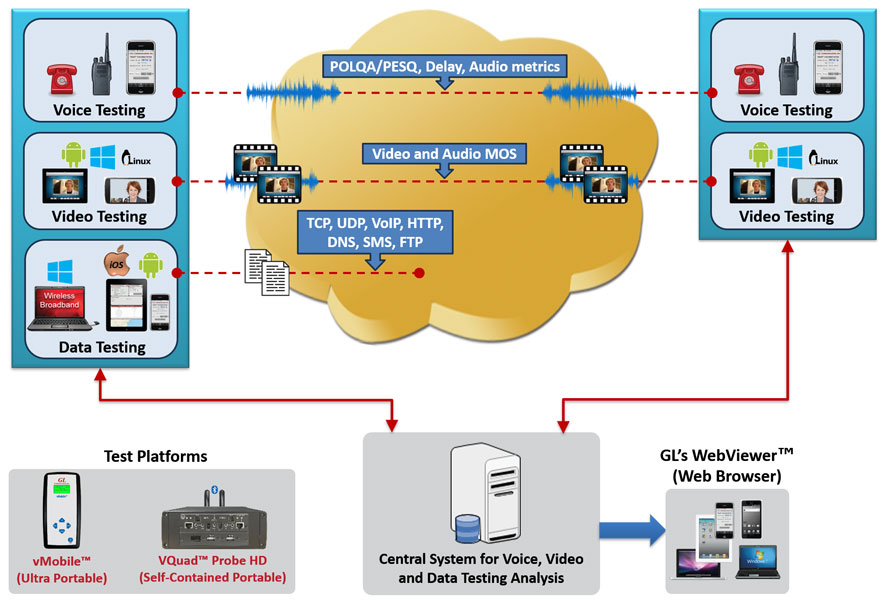
VQuad™ - Dual UTA HD, or the all-in-one VQuad™ Probe HD forms the central point of control for performing automated tests for voice, data, and video to and from Wireless devices (WiFi, Bluetooth®, 3G, 4G LTE, 5G), Broadband Internet (3G, 4G, 5G), VoIP devices, PSTN, and TDM circuits assessing performance, quality and reliability of practically any network. Various associated applications (Voice Quality, Video Quality, Data tests, Echo and Delay tests, Fax tests, VBA) works with VQuad™ to provide "end-to-end assessment" with additional test and measuring capabilities. All the applications work in conjunction with the VQuad™ for automatically and remotely analysing the captured data and sending the test results to the central database. You can query results remotely or control the tests using web-based WebViewer™.
Enhanced VQuad™ with Dual UTA HD supports two methods of automated testing of mobile devices, Bluetooth and Wired Headset using GL’s new cable, Smartphone with Automated Call Control (ACC). Through the VQuad™ script (or manual operation), calls can be setup and send messages using iPhone SIRI or Android Google Voice available on mobile devices. VQuad™ includes Text-to-Speech technology for automatically creating the necessary voice prompts required to work with Siri or Google Voice.
Further, VQuad™ scripting provides for automation, mobility, remote accessibility, along with centralized analysis and data retrieval, which are just a few attributes of GL’s next generation Voice, Video, and Data Testing solution.
The vMobile™ handheld device supports fully automated audio testing for mobile phones (any phone, any carrier, any network) including Voice Quality using POLQA, Delay measurements, Audio Dropout analysis, and full call control with Call Fail and Call Drop metrics. The audio content within any PCM audio files can be analyzed using GL's Voice Analysis Tool (VAT™) application and generates a variety of audio metrics.

Associated applications with VQuad™ includes:
- vMobile™ - Portable VQT Test Solution is a handheld device which can support full audio testing for mobile phones and mobile radios, as well as providing data testing for mobile phones
- Voice Quality Testing (VQT) software for analysis according to widely accepted ITU (International Telecommunications Union) voice comparison algorithms (POLQA, PESQ LQ/LQO/WB)
- AutoVQT™ - Automated POLQA Voice Quality Testing Software using POLQA ITU-T P.863 version 2.4 algorithm
- Voice Analysis Tool (VAT™) application is used to analyze the audio content within any PCM audio files and generates a variety of audio metrics. VAT™ has a user-friendly interface to perform manual and automated analysis of multiple tests using a single PCM audio file received from the VQuad™, vMobile™, or any other applications
- WebViewer™ for web based controlling and monitoring VQuad™ nodes over the entire network
- Drive Testing solution for plotting all results and call control information along with co-ordinates using GPS receiver option in VQuad™, and Google Maps option within WebViewer™
- Data Quality Testing (NetTest™) application for performing automated data testing on a wireless or wired network; tests include TCP, UDP, VoIP, Route, HTTP, FTP, DNS, SMS, Email, SIMInfo, Phone Info, and UEInfo
- Video Quality Testing (VAC™) application for performing fully automated Video Conference testing and get Audio and Video MOS QoS results along with several analytical metrics. Optionally, GLNetTest app on mobile devices can initiate, control, and perform the entire video conferencing testing with the support of a Video Controller/Server and Video Clients (Agents)
- Echo Measurement Utility (EMU) for echo and delay measurements, including RTD, OWD, ERL, EPD, and more
- Voice-band Analyzer (VBA) for monitoring voice band traffic (Speech Level, Activity Factor, RMS Factor, DC Level, Noise Level, Jitter, Echo Return Loss, Echo Delay, and Echo Dispersion)
- Fax Quality Testing for emulation and analysis of T.30 faxes (GLInsight™ or FaxScan™)
Thus, GL provides the complete solution for Voice, Video, and Data Testing and Analysis. Listed below are the GL’s hardware / software platforms used for voice quality testing solutions across various networks.
The VQuad™ provides the one box solution for sending/recording voice/video/data over a variety of network interfaces in an automated and synchronized manner. The VQuad™ requires a universal adapter hardware such as Dual UTA HD that provides multiple interfaces for connecting to any communication device on a network.
Dual UTA HD (High Density) is a portable USB based hardware that supports Bluetooth® Wideband, FXO Wideband and SIP Wideband (ex: AMR WB), with which you can easily interface with any Mobile Device, FXO, or SIP devices supporting HD Voice.
The VQuad™ works with any of the above hardware to perform end-to-end testing of variety of networks, including Wireless (Bluetooth®, Wi-fi, 3G, 4G LTE, 5G, PTT Mobile Radio), VoIP, Analog, and TDM, practically allowing any end-point interfaces to be tested for voice, data, and video quality. Various associated applications (Voice Quality, Video Quality, Data tests, Echo and Delay tests, Fax tests, Voice Band Analysis) works with VQuad™ to provide "end-to-end assessment" with additional test and measuring capabilities.
The VQuad™ supports automated call control for establishing calls and verifying the call is up prior to sending/recording voice. A GPS option permits time synchronization between two geographically separated systems as well as location information for Drive Testing. Thus the test results as well as the call control information can be plotted to local street maps (almost all countries supported). The VQuad™ ITS (Indoor Tracking System) provides the means to add location information to the VQuad™ results when GPS is not available (i.e. Underground Train systems).
With Dual UTA HD, VQuad™ supports following connections:
- Wireless communication devices (Mobile phones, Smart phones (iPhone, Android), Military/Mobile radio, Bluetooth®, WiMax, WiFi, Broadband 3G, 4G LTE, 5G)
- WB 2-wire Analog Simulation (FXO port) using Dual UTA HD for connecting to ATA, PSTN, Gateways
- WB 4-Wire Analog interfaces supporting Tx/Rx Headset including HATS, Mobile Phone Headset, and any Handset Phone (RJ22 connection)
- Wireless radio (PTT supported) - Provides radio keying and sends/records audio
- Phone Handset for connecting to VoIP phones, Digital phones, Analog phones
- VoIP User Agent Simulation (supports both SIP and H.323 protocols)
- T1 E1 Simulation (supports both CAS and PRI ISDN protocols)
- GPS and ITS location tracking with results overlay
- Supports next-generation voice quality testing for fixed, mobile and IP networks using POLQA (ITU-T P.863)
Full support is also available for remote access of the VQuad™ and an SDK directly to the Dual UTA HD hardware (VQuad™ not required to be running).
A central databased stores the real-time and historic results from connected VQuad™ Probes.
Various associated applications (Voice Quality, Video Quality, Data tests, Echo and Delay tests, Fax tests, VBA) works with VQuad™ Probe to provide "end-to-end assessment" with additional test and measuring capabilities. All the applications work in conjunction with the VQuad™ for automatically and remotely analysing the captured data and sending the test results to the central database. GL's WebViewer™ facilitates display of these test results, query and filter all results/events/errors from connected VQuad™ Probes using a simple web browser. All the nodes, and associated applications (Command Center, VQuad™, VQT, File Monitor, VBA, EMU, FAX, and VAC) can be accessed or controlled remotely through this web interface. The associated application status and the test results with GPS co-ordinates can be plotted on google maps. WebViewer™ also supports user-defined statistics and events configuration for both tabular and graphical outputs.
For more details, please visit Web Based Client for Voice and Data Quality Testing webpage.
The VQuad™ provides the one box active QoS solution for sending/recording voice over a variety of network interfaces in an automated and synchronized manner. Using the GL VQT, analysis of the recorded voice files can automatically be executed from the VQuad™ in an intrusive manner. The VQT utilizes the ITU algorithms POLQA and PESQ LQ/LQO/WB. In addition to sending/recording voice, the VQuad™ also supports automated call control for establishing calls and verifying the call is up prior to sending/recording voice. VQuad™ now supports next-generation voice quality testing for fixed, mobile and IP-based networks using POLQA (ITU-T P.863) standard.
The GL Passive Quality of Service testing allows one to monitor voice anywhere within a network (using the desired VoIP/TDM/Analog Network probe) and gather statistics and quality of service measurements. The various network probes utilize GL hardware and software applications to support T1 E1, Analog, and VoIP networks. All network probes are non-intrusive and require no active testing on either side of the call. Rather, the non-intrusive Passive Monitoring utilizes the metrics from the voice or VoIP RTP and provides statistics, analytical measurements, and in certain cases MOS results.
For more details, please visit Passive Voice Quality Testing webpage.
The Global Network VQT system can be achieved using multiple VQuad™ systems (nodes) at various locations, accessing the network as wireless, analog, VoIP, and TDM. A central VQuad™ Command Center will provide full control of all nodes by running user-defined scripts for all desired tests. The VQT software will provide the voice analysis of all nodes along with additional analytical metrics, round trip delay measurements, jitter, clipping, and call control statistics. Finally, the WebViewer™ is used to remotely control the entire system, display real time statistics and status of the entire system, and query the VQT results and display in both tabular and graphical formats.
The WebViewer™ is a web application that can control the VQT, Command Center and individual VQuad™ applications and is capable of creating configurations/scripts, loading configurations/scripts, and starting/stopping the tests remotely. The WebViewer™ can also remotely query the VQT database and display the results both in tabular and graphical format. The WebViewer™ can access the VQT central database from a web interface for querying the results and displaying in both tabular and graphical formats.
Click here to see the live demo
For more details, please visit Intrusive Speech Quality Assessment PESQ POLQA webpage.
The Network Voice Quality Testing Monitoring solution from GL Communications provides a complete intrusive testing solution for any desired network including Wireless, VoIP, Analog, and TDM. This GL solution consists of 5 parts: Distributed VQuad™ Probes, VQuad™ Command Center, array of analysis applications (VQT, VBA, VAC, MDC, & EMU), central location database, and Remote Client web-browsers. Many VQuad™ nodes (termination points) are supported, each VQuad™ Node supporting up to 8 interfaces, mobile or static. The Central Location includes the database (all analytical results and call progress events), Command Center for a more flexible control/scheduling of the Network tests, and the Analysis algorithms for Voice Quality and Echo Measurements. The WebViewer™ application provides user-defined querying of the central location database over the internet or local network.
For more details, please visit Automated Network Voice Quality Testing webpage.
This system provides real-time voice quality measurement across a diverse set of networks. Voice calls are automatically placed between end points; quality is measured and provided for display at an NMS. Voice measurements include MOS (Mean Opinion Score), round trip delay (RTD), jitter, clipping, voice levels, etc. The essential elements of this system are Wireless / Wireline / VoIP Nodes to establish calls and send / receive voice files in real-time, and the Regional Command Center (RCC) to control the nodes. It also includes Remote Client WebViewer™ to remotely control the RCC, access, sort, and display all data collected by the RCC.
For more details, please visit Intrusive Speech Quality Assessment PESQ POLQA webpage.
The GL VQT software provides the voice quality measurement and analysis tools for all types of networks carrying voice traffic. The VQT provides the analysis of the recorded voice files using ITU specifications POLQA (ITU-T P.863), PESQ (P.862.1), PESQ WB (P.862.2). The VQT is an intrusive quality of service algorithm that can be executed in an automated fashion along with the VQuad™. Degraded voice files automatically transferred from VQuad™ nodes to VQT analysis via File Monitor Utility. For more call density, the software can be used with MAPS™ or T1 E1 Analysis products. Results are saved to a database that may be queried using the remote WebViewer™ application.
For more details, please visit Voice Quality Testing PESQ POLQA webpage.
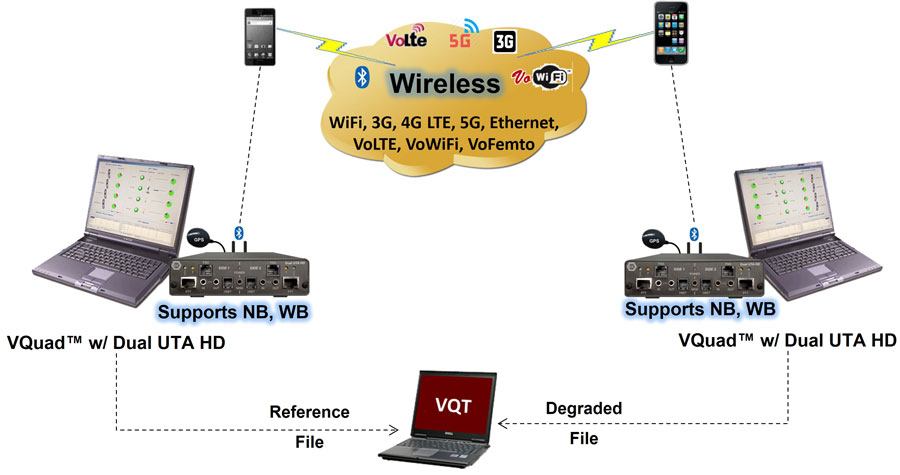
GL's VQuad™ Probe (combined with VQT) supports voice quality testing solution for Wireless with various interfaces such as Bluetooth®, WiFi, 3G, 4G LTE and 5G. These products allow wireless network providers and equipment manufacturers to quantify impairments in a consolidated, unified, and "end-to-end" manner. Impairments to voice quality such as poor mobile phone quality, voice compression and decompression algorithms, delay, loss and gain in speech levels, noise, acoustic and landline echo, and other distortions are easily accessed and accurately measured. Automatic synchronization, automation, remote access, GPS, and time-stamping features provide added flexibility.
Independent locations connected to the wireless network via mobile phones can be easily configured for sending reference voice files and recording the received degraded file, thus allowing end-to-end path analysis.
Military Applications of Voice Quality Testing
- Test Voice Quality of Military Radios in dynamic tactical environments
- Assess frequency management strategies and their effects on Voice Quality
- Assess "radio net" performance
- Test robustness to spectrum jamming and other interference
- Easy interface to any Military Radios, i.e. PTT (Push to Talk)
Wireless
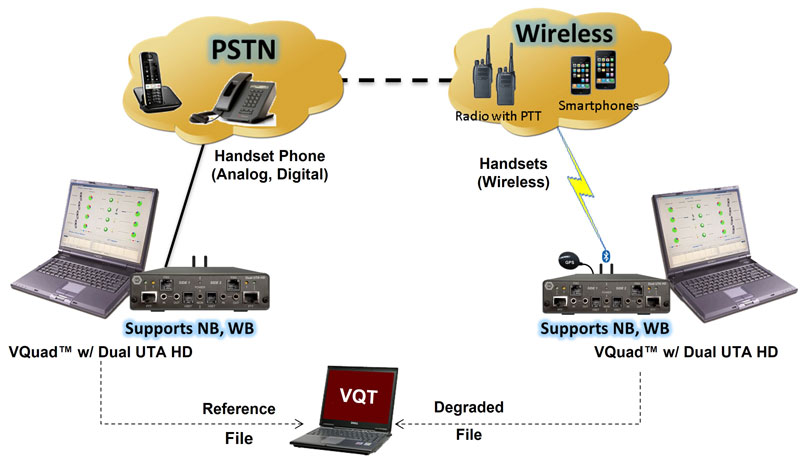
Landline to Wireless
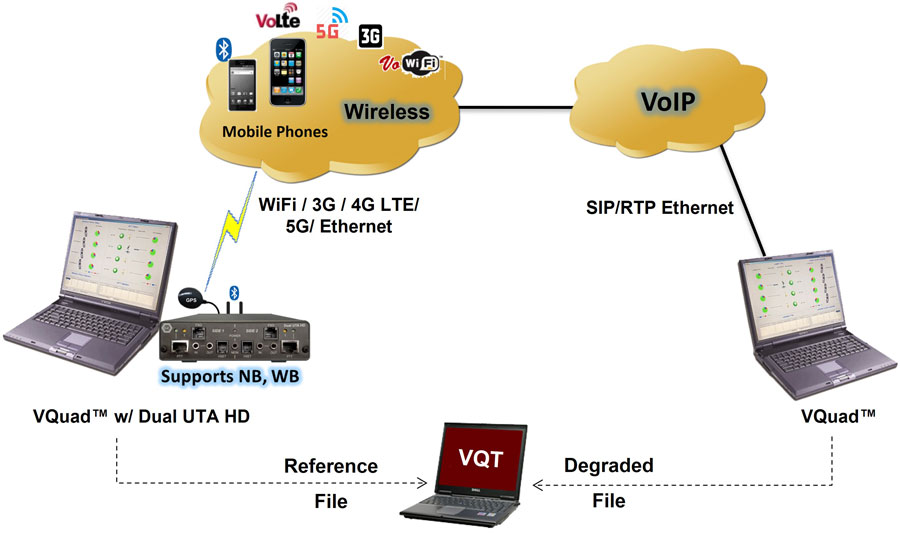
Wireless to VoIP
Additional Information:
Voice transmission over packet networks present challenging quality of service issues - including echo, delay, voice clipping, and other impairments due to lost or jittered packets. These problems are exacerbated even further during high loads or high degree of voice compression. Consequently, testing voice quality over VoIP has become increasingly important. Adequate tools for creating stress conditions and characterizing and measuring impairments are also essential.
All VoIP Codec supported including - G.711, G.711 App II with VAD, G.729, G.726, G.726 with VAD, GSM, AMR NB and WB, EVRC, SMV, iLBC, SPEEX NB and WB, G722, and G722.1.
Fore more information visit Voice Codecs.
GL’s VQuad™ with the optional VoIP package provides a complete voice quality testing solution
for VoIP network elements.
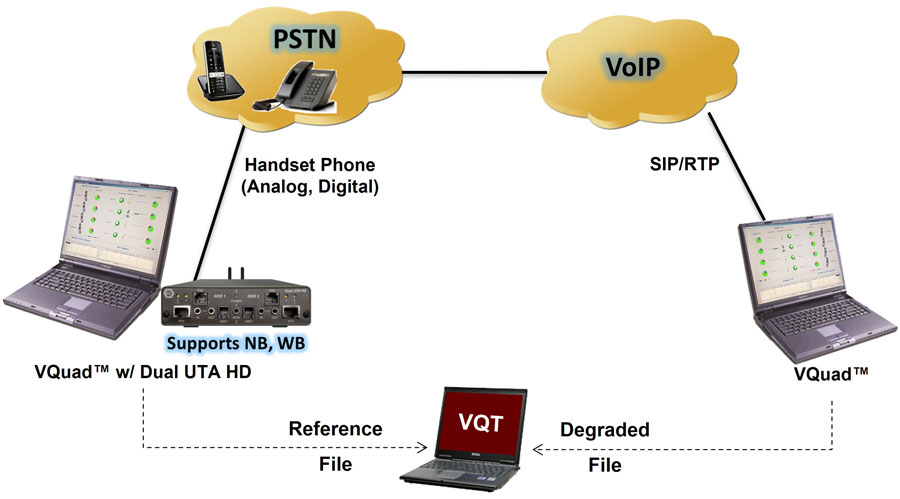
Landline to VoIP
Wireless to VoIP
Additional Information:
GL's voice quality testing solution for PSTN (testing analog 4-wire, 2-wire FXO interfaces) includes GL's VQuad™ with the optional FXO (2-wire analog) interface. 4-wire Analog interface connects to Balanced - headset (mic/speaker), RJ22 –phone Handset, PTT (Push to Talk), and Mobile. The VQuad™ provides for automatic call establishment and teardown, sending and recording of voice files, and automatic analysis of voice quality with VQT software.
Landline to VoIP
Landline to Wireless
Additional Information:
GL's voice quality testing solution for TDM network includes GL's VQuad™ with the optional T1 E1 interface. The T1 E1 interface is supported using GL’s USB based T1 E1 Analyzer unit. The VQuad™ provides for automatic call establishment and teardown, sending and recording of voice files, and automatic analysis of voice quality with VQT software. VQuad™ can generate and receive up to 12 simultaneous CAS or PRI ISDN or No Call Control (NOCC) calls on T1 or E1 trunks.
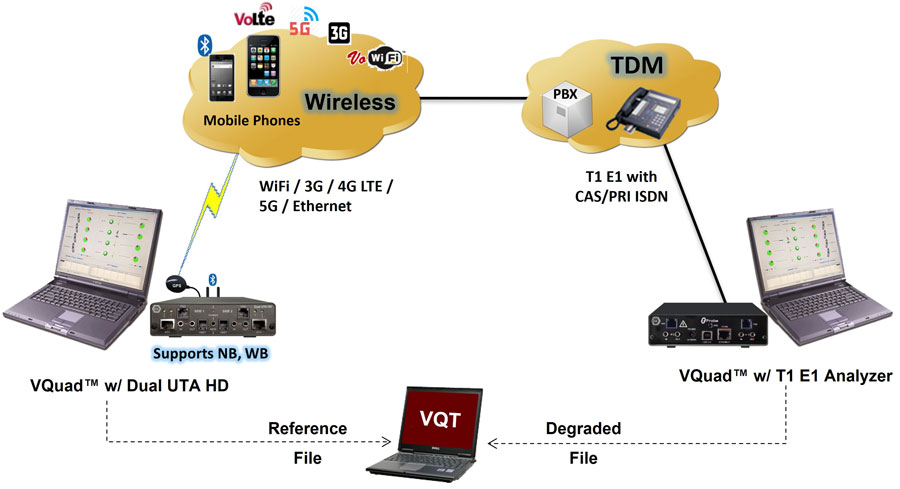
Wireless to T1 E1 Testing
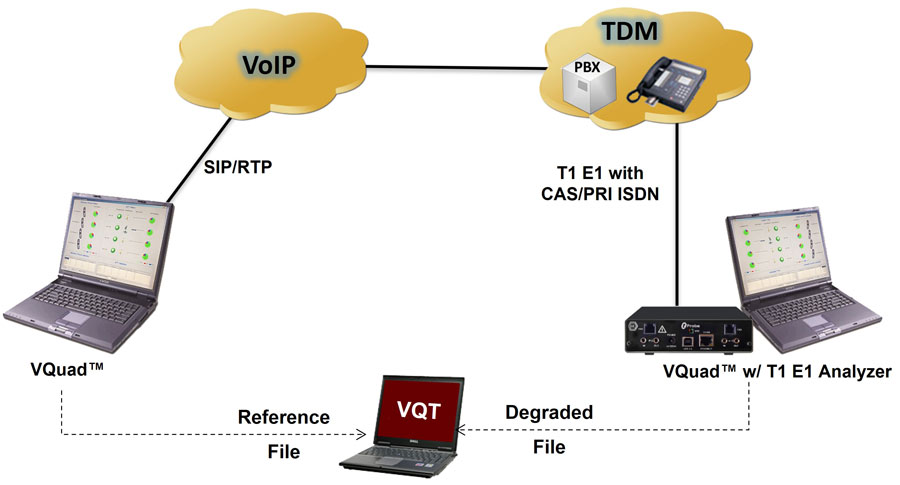
VoIP to T1 E1 Testing
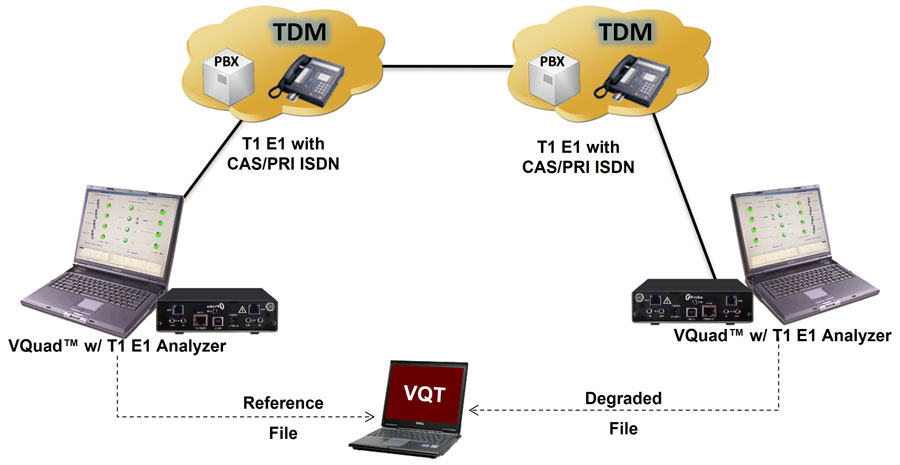
T1 E1 to T1 E1 Testing
Additional Information:
Satellite communication networks are tested to monitor, analyze, troubleshoot, and manage their performance. These networks face challenges due to their unique characteristics, such as variable channels, limited bandwidth, and propagation delay. Effective testing tools are essential for the monitoring, analysis, troubleshooting, and management of satcom networks.
GL's Communications Inc.'s Voice Quality Testing (VQT) solutions are designed to ensure the clarity and reliability of voice communications in satellite networks. Utilizing advanced algorithms like POLQA and PESQ, these solutions measure and analyze audio quality while addressing challenges such as variable channels, limited bandwidth, and propagation delays involved in satellite communication.
The versatile VQT suite allows users to send and receive simulated voice and data traffic in real-time over satellite networks, performing quality of service measurements using ITU-T standards. All these capabilities are provided in a portable, single-box solution that offers flexibility for connecting to and between any network, service, and interface.

Voice Quality Testing over Satellite using PTT

Voice Quality Testing over Satellite using Mobile
Additional Information:
Additional Applications
GL offers numerous utilities to further aid the VQT solutions. Among these is, Text-to-Speech technology included within VQuad™ for automatically creating the necessary voice prompt for placing call over Siri or Google Voice.
Also available is a stand-alone Speech Transcription Server (VQT009), an automated PC-based software that monitors for new PCM or WAV files in the directory, and transcribes short speech files into text. These applications can be used to verify announcement prompts of various voice networks and aid in Interactive Voice Response (IVR) system testing.
For more details, please visit Voice Quality Testing PESQ POLQA webpage.
Data Testing Solutions
Data Quality Testing (NetTest) on Wireless and IP Networks
GL’s VQuad™ solution is enhanced to support Data Testing using the NetTest application from PC and from mobile device (using MDC).
Using the VQuad™ product along with a standard PC internet connection, automated tests including TCP, UDP, HTTP, VoIP, Route, FTP, DNS, SMS, Email, PhoneInfo, SimInfo, and UEInfo are supported. The PC internet connection can be wired Ethernet, WiFi, or even Broadband card (both LTE and 3G fully supported).
Also available is the GL’s NetTest package for Data Testing on any supported Mobile Device. This feature uses downloadable apps for both Apple and Android devices and is remotely controlled via the GL Mobile Device Controller (MDC) system. Using VQuad™ one can remotely and automatically perform these same Data Tests on Apple and Android devices when connected to 3G, 4G and 5G networks or over a WiFi network.
- Automated Data Testing (NetTest) for Apple/Android Mobile Devices and for PC Internet connection (Broadband 3G, 4G, 5G, WiFi, Wired) including TCP, UDP capacity, VoIP, Route, HTTP, FTP, DNS, SMS, Email, PhoneInfo, SimInfo, and UEInfo.
- Data Testing supports remotely deployed GL Data Server target points for end-to-end testing.
- Statistics and complete results are available through the WebViewer™ for both Mobile Device NetTests and PC based NetTests.
Video Test Solutions
Video Quality Testing on Wireless and IP Networks
Video Quality Test Solution is used to determine the performance of a video call over a given network. It provides support for Android, PC and Linux based clients (end points) for active Video Quality Testing. Video Tests can be configured between any two active agents with flexibility on specifying the characteristics of the Video test. Tests can be run directly from the VQuad™ interface, or from the Android phones using the GLNetTest app configuring end points (Agents) and the test plan for the test.
The test plans are pre-configured on the VAC server and the list of available test plans is visible in both VQuad™/MDC, as well as GLNetTest application. A test can run between android to android, android to PC and PC to PC. Both manual and automated tests are supported using the flexible and versatile VQuad™ scripts.
Once the testing is complete, the results are sent to the central database, which can be viewed using WebViewer™.
- Single or multiple (consecutive and/or concurrent) test IP video calls between licensed Agents
- Supports Android, Windows, and Linux video end client devices
- Unlimited test plans configurations with Codec, Frame Rate, GoP (Group of Pictures) Structure and Video Image Size
- Video conferencing test results include end point details, Video Quality (Relative MOS-V), Audio Quality (Relative MOS-A), Audio Video Quality (Relative MOS-AV), IP Network condition parameters, Signaling Performance, and Call Config Info
Resources
| Item No. | Description |
|---|---|
| VQuad™ Network Options | |
| VQT010 | VQuad™ (Automated File Transceiver Base Software) |
| VQT251 | Dual UTA HD Next generation Dual UTA with FXO Wideband support |
| VQT280 | VQuad™ Probe HD (with Dual UTA HD) |
| VQT281 | VQuad™ Probe HD w/o Dual UTA HD |
| VQT285 | VQuad™ Probe HD Upgrade |
| VQT291 | vMobile™ - Portable Voice Quality Test Solution |
| VQT008 | Voice Analysis Tool |
| Item No. | Related Software |
| VQT013 | VQuad™ with SIP (VoIP) Call Control |
| VQT251 | Dual UTA HD Next generation Dual UTA with FXO Wideband support |
| VQT252 | Dual UTA HD – Bluetooth Option |
| VQT461 | Dual UTA HD Smartphone ACC Cable |
| VQT601 | Mobile Device Controller Software |
| VQT600 | VQuad™ NetTest Data Server Solution (Requires annual license renewal to remain functional) |
VQT650 |
Video Application Controller (VAC) |
| VQT022 VQT022a |
VQuad™ Fax Emulation (2 simultaneous ports) VQuad™ Fax Emulation (8 simultaneous ports) |
| VBA038 | FaxScan™ for PCM |
| PKV104 | FaxScan™ for SIP and Fax over IP (T.38) |
| VQT002 | Voice Quality Testing (PESQ only) |
| VQT006 | VQT w/ POLQA Server license (no limitations) |
| VQT007 | VQT POLQA v3, server license for 20 nodes |
| VQT014 | AutoVQT™ |
| VQT014U | Upgrade from VQT POLQA to AutoVQT™ |
| VBA032 | Near Real-time Voice-band Analyzer |
| EMU037 | Echo Measurement Utility (EMU) Software |
| VQT040 | WebViewer™ |
| Webinar |
|---|

|