Voice, Fax and Modem Decode & Analysis over PSTN, TDM and IP
Analyze and emulate Fax and Modem transmissions with customizable content and protocol headers.
Request a Demo / Quote Brochure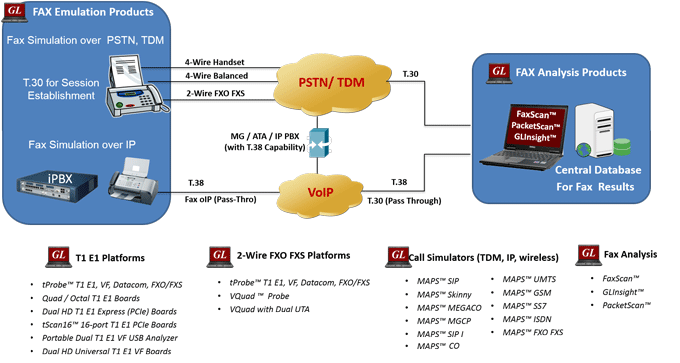
Overview
Fax and modem-based data transmission is still used throughout the modern world. Networks and endpoint equipment must be thoroughly tested in transmitting and receiving these data flows. GL offers a wide range of test equipment which can interface to the Public Switched Telephone network (PSTN), Time Domain Multiplexing (TDM) and Internet Protocol (IP) networks. The solutions include software and hardware as needed. GL's solutions have an easy-to-use graphical user interface where users can configure test parameters, send and receive Fax and Modem traffic and perform analysis on the calls. The calls are fully customizable in terms of content and protocol headers. Furthermore, GL offers Python and JAVA scripting capability for repetitive testing or executing complex testing scenarios. These solutions have been used by Service Providers and Equipment Manufacturers worldwide to test compliance for Fax and Modem traffic.
Fax Analysis Products
Fax Analysis (FaxScan™ for 2-Wire, 4-Wire, & IP)
FaxScan™ is GL's command-line Fax decoder/demodulator application used to analyze the recorded voice band traffic (PCM streams & PCAP files) for Fax traffic. It provides analysis of the T.38 packets, T.30 frames, general call-flow indicators and decodes the fax image in TIFF-F format. FaxScan™ is also available as a licensed module along with GL's Voice Band Analyzer (VBA) for processing 2-Wire or 4-Wire captures.
Fax over PSTN Call Capture and Analysis
GL Insight™ with FAX for PSTN is a powerful and feature rich offline software tool that analyzes pre-recorded PSTN fax calls. The software demodulates the PCM stream, decodes the fax protocol between the endpoints, and provides the results in a user-friendly textual and graphical format. V.34HD, V.17, V.33, V.29, V.27, V.21, T.30, and T4/T6 are all supported along with Tiff image reconstruction.
Fax over IP Call Capture and Analysis
GL Insight™ with FAX for IP is a powerful and feature rich offline software tool that analyzes PCAP captures of IP fax calls. The software handles both IP G.711 fax calls and IP T.38 fax calls. In IP T.38 calls, complete decoding and anlaysis of T.38 packets, T.30 frames, T.4 / T.6, and ECM is performed. IP G.711 fax calls are handled similarly to PSTN fax calls. Complete Tiff image reconstruction is provided for both. GL's PacketScan™ can be used to capture and filter specific IP fax calls.
Modem over PSTN Call Capture and Analysis
GL Insight™ with MODEM for PSTN analyzes modem recordings by appropriate signal analysis, demodulation, phase analysis, error correction and data decompression. Startup protocols V.8, V.8bis, and V.8 short are supported. Modulations V.92, V.90, V.34, V.32bis/V.32, V22bis/V.22, V.21, V.23, and Bell 103/ Bell 212 are supported. V.42, V.42bis, V.44, MNP2-4, MNP5, and V.14 are the supported error correction and data compression protocols.
Modem over IP Call Capture and Analysis
GL Insight™ with MODEM for IP analyzes modem traffic recordings within IP packets, by depacketization of the PCM signal, appropriate signal analysis, demodulation, phase analysis, error correction and data decompression. Startup protocols V.8, V.8bis, and V.8 short are supported. Modulations V.92, V.90, V.34, V.32bis/V.32, V22bis/V.22, V.21, V.23, and Bell 103/ Bell 212 are supported. V.42, V.42bis, V.44, MNP2-4, MNP5, and V.14 are the supported error correction and data compression protocols.
2-Wire Voice/Data Capture
The GL Voice Recorder is used to manually capture the voice/data over a 2-Wire Analog interface. Using the 2-Wire Phone Tap adaptor, one can non-intrusively 'tap' into the analog 2-Wire line via the RJ11 interface and capture the bi-directional voice/data. The recorded voice/data is automatically saved into a single highly accurate PCM file required for analysis.
T1 E1 Traffic Classifier
GL's T1 E1 Traffic Classifier provides non-intrusive, real-time monitoring and classification of T1 and E1 traffic. It can classify one or more T1 E1 lines located locally or remotely. The traffic is monitored in real-time for 16 different traffic types including silence, voice, a variety of data modulations, fax modulations, DTMF digits, and call progress signals. Classification can be done on selected timeslots across multiple T1 E1 lines. A multi-channel strip chart display shows traffic types and durations using a configurable color scheme. An off-line feature can playback or fast forward through previously recorded and classified traffic data.
Fax Emulation Products
Fax Call Emulation over 2-Wire and TDM
GL has recently introduced single and bulk (up to 120) call Fax Simulator. This software is capable of transmitting and receiving fax over many T1 E1 timeslots or through two-wire FXO and FXS lines. The software can emulate many "virtual fax machines" - transmitter as well as receiver. All variations are supported. Fax Simulator can be used with any GL Protocol Emulation tools such as MAPS™ CAS, MAPS™ ISDN, and MAPS™ SS7 emulator to simulate complete real time Fax calls. MAPS™ supports fully automated fax testing using scripts and remote access.
Fax Call Emulation over IP
GL’s RTP Fax Simulator (PKS200) simulates multiple Pass-Through fax calls. It can transmit pre-recorded Tiff image to DUT (Real-time Fax machine), receive Pass-Through fax from DUT, and record complete fax call messages as log file along with a Tiff image. Typical applications of our RTP Fax Emulation software are load testing of fax servers, qualification testing of T.38 Gateways, testing of ATAs (Analog Terminal Adapters), testing of internet-aware fax machines, and many more.
GL’s MAPS™ simulation test tool also supports Fax over UDPTL transport carrying T.38 data units. T38 protocol is compliant with ITU-T T.38 (03/2002). T.38 Fax Relay protocol is a much robust approach, with redundancy, re-transmission, and efficiency. It is recommended to use T.38 method in FAX calls as opposed to normal voice codecs because voice codecs are lossy and are therefore unreliable for data transition. The T.38/V.17 configuration operates at the maximum 14.4 kbps speed, whereas the T.38/V.34 operates at the maximum 33.6 kbps speed.
Fax Simulator can be used with any GL Protocol Emulation tools such as MAPS™ SIP, MAPS™ SIP-I, MAPS™ GSM, MAPS™ UMTS IuCS, and many more to simulate complete real time Fax calls. MAPS™ supports fully automated fax testing using scripts and remote access.
Fax Call Emulation using VQuad™ (2-Wire and 4-Wire)
The VQuad™ Fax emulation provides fax emulation using the Dual UTA's (Universal Telephone Adapter) 2-Wire analog (FXO) and 4-Wire analog interfaces. One can send and receive simultaneous faxes. The user can configure the Tx and Rx fax rate from 2400 baud up to 33600 baud with V.34 fully supported. Interfaces supported for fax generation include 2-Wire FXO and 4-Wire analog. Fax emulation is fully automated using VQuad™ scripts and can be initiated remotely such that one VQuad™ can control both sides of the fax.