PRI-ISDN Protocol Analyzer
Overview
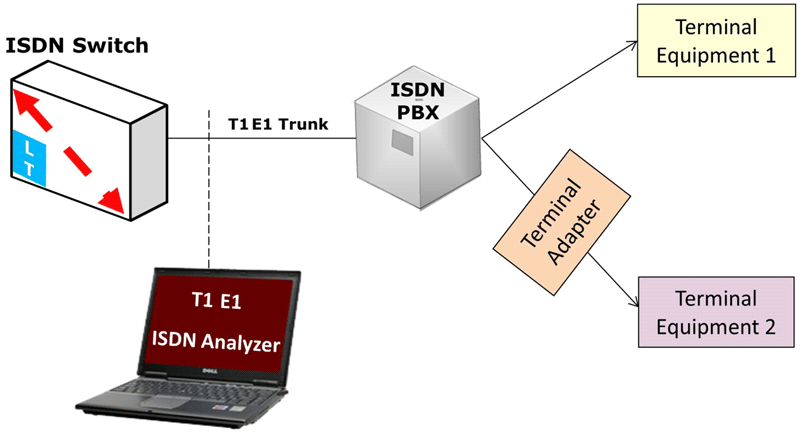
The Integrated Services Digital Network (ISDN) system allows voice, data and video to be transmitted simultaneously across the world using end-to-end digital connectivity. ISDN, based on the telephony network, was conceived of to provide multiple voice and non-voice services over a single network, and a digital user network interface over regular phone lines, instead of dedicated and isolated user-network interfaces.
ISDN is an integrated solution for providing basic telephony and data services, whilst offering more telephony services such as supplementary services. ISDN services are grouped in three service categories:
- Bearer service
- Teleservice
- Supplementary service
The user-to-network interface is provided in two flavors:
- Basic interface structure (BRI) - two B-channels and one 16 kbit/s D-channel (2B+D)
- Primary rate B-channel interface structure (PRI) - 30 thirty B-channels and one 64 kbit/s D-channel (30B+D)
GL's ISDN analyzer can capture and analyze stream of frames on an ISDN PRI link. It decodes LAPD according to Q.921, while, the ISDN information parsing is done based on the user's selection of ITU Q.931, ISDN ANSI, AT&T/Lucent switch 4ESS and 5ESS (TR41449, TR41459 and 235-900-342), Nortel's switch DMS-100 and DMS-250 (NIS-A2111-1 and NIS-A211-4), Bellcore National ISDN-2 (NI-2), Euro ISDN (ETS-300 102-1), ARINC 746, ETSI 300-102, QSIG ETSI/ECMA, National ISDN PRI CPE, DPNSS, and DASS2.
ISDN analyzer collects physical and line level status and performance information, voice, data, protocol, statistics, and transmit information to a central / distributed Network Management System (NMS).
These probes now supports Packet Data Analyzer with recording capabilities. Packet Data Analysis (PDA) is an outstanding tool for live monitoring of signaling and traffic over TDM. Allowing users to monitor live TDM networks including capture, analysis, and reporting of every call-in detail.
GL’s NetSurveyorWeb™ (PKV170) a central system comprised of a database engine and web server monitoring systems facilitate real-time analysis, historical storage, retrieval, querying, and display of Call Detail Records (CDRs) by non-intrusively connecting to TDM, Optical, or IP networks.
It also offers NetSurveyorWeb™ Lite (PKV169) a cost effective, simple Plug & Play connection, which is an integrated and simplified web-based system that is distributed at probe level.
GL Communications supports the following types of ISDN analyzers:
- Real-time ISDN Analyzer (Pre-requisites: GL's field proven E1 or T1 internal cards or USB Laptop E1 or T1 external units, required licenses and Windows 7 (or higher) Operating System)
- Remote/Offline ISDN Analyzers (Pre-requisites: Hardware Dongle and Windows Operating System)
Both real-time and off-line analysis presents the following information
- Raw ISDN Frame data as a hexadecimal and ASCII octet dump - Physical Layer
- LAPD information (Layer 2)
- ISDN information (Layer 3)
Also, visit GL's SIGTRAN protocol decode and ISDN SIGTRAN protocol decode web page for a description of SIGTRAN - used to carry Q.931 or SS7 ISUP messages between IP nodes such as a Signaling Gateway and Media Gateway Controller or Media Gateway.
In addition the following ISDN applications are supported that further help in emulating ISDN protocol:
- ISDN Emulation using GUI
- ISDN Emulation using Client-Server
- Scripted ISDN Emulation using MAPS™
- High Capacity ISDN Emulation using MAPS Central Office Switching Simulator
- Scripted ISDN SIGTRAN Emulation using MAPS™
Main Features:
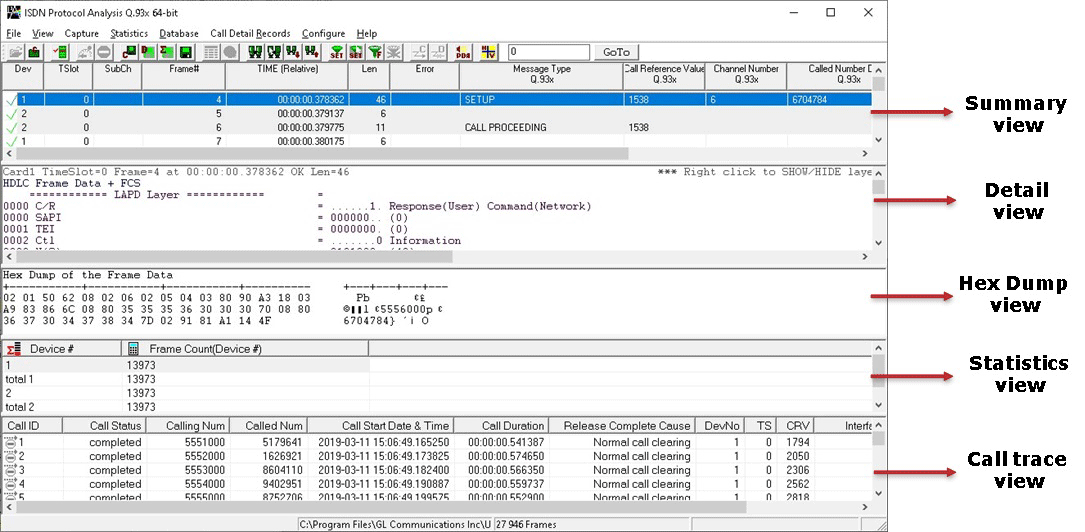
- Displays Summary, Detail, Hex-dump, Statistics, and Call Detail Views.
- Summary View displays Dev #, Time Slot, Frame #, LAPD information, ISDN Message types, and etc in a tabular format.
- Detail View displays decodes of user-selected frames from the Summary View; the contents of this view can also be copied to clipboard.
- Hex dump View displays the frame information in HEX and ASCII format; the contents of this view can also be copied to clipboard.
- Statistics View displays statistics based on frame count, byte count, frames/sec, bytes/sec etc for the entire capture data
- Call trace isolates call specific information i.e. status of each call (i.e. Active/Completed), duration of completed call, Device No, Timeslot, CRV, Called and Calling Party number.
- Call Detail Recording feature includes data link groups that help in defining the direction of the calls in a given network and form logical groups comprised of unidirectional (either 'Forward' or 'Backward') data links.
- Supports filtering and search based on SAPI, TEI, C/R, N(S), N(R), P/F, Supervisory Functions, and ISDN message types.
- Any protocol field can be added to the summary view, filtering, and search features providing users more flexibility to monitor required protocol fields.
- Exports Summary View information to a comma delimited file for subsequent import into a database or spreadsheet.
- Capability to export detail decodes information to an ASCII file.
- Remote monitoring capability using GL's Network Surveillance System.
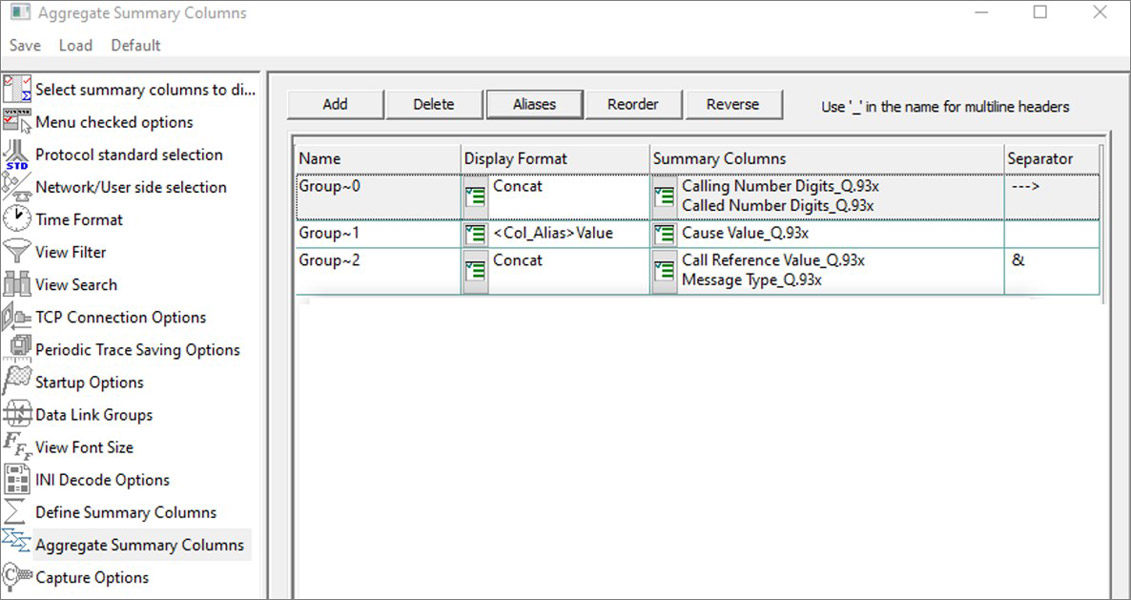
- Option to create multiple aggregate column groups and prioritize the groups as per the requirement to display the summary results efficiently
- Allows the user to create search/filter criteria automatically from the current screen selection
Additional feature supported by Real-time/Remote ISDN Analyzer:
- Real-time filter and search on C/R, SAPI, TEI, CTL, P/F, N (S), N (R) and FUNC and so on
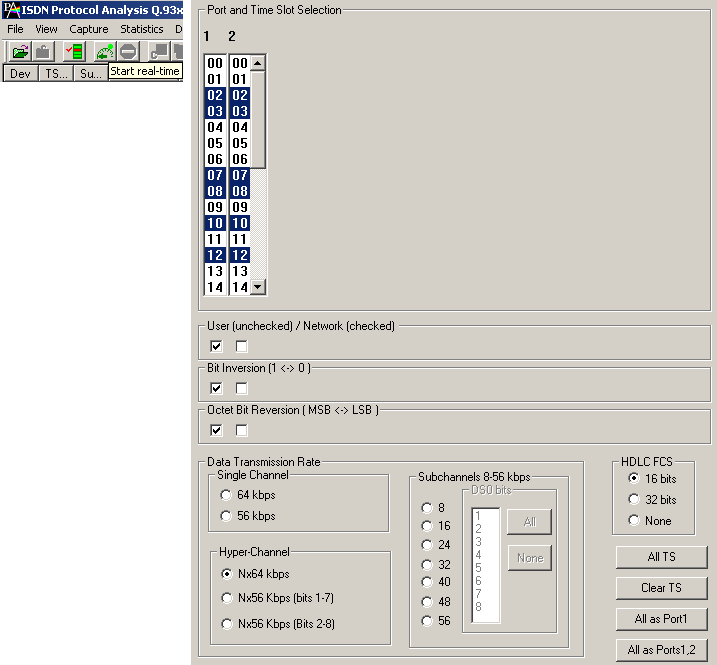
- Streams can be captured on the selected time slots (contiguous or non-contiguous), sub-channels or full bandwidth
- Frames can be transmitted/captured in either n x 64 kbps, or n x 56 kbps data channels (hyper-channels)
- Sub Channel and Nx56 hyper channel enables user to analyze data captured by fractional DS0 and DS1 link
- Multiple streams of ISDN traffic on various T1 E1 channels can be simultaneously decoded with different GUI instances
- Supports decoding of frames with FCS of 16 bits and 32 bits, or none
- Variations accommodated in the software include inverted or non-inverted data, and byte reversal or non-reversal
- Recorded trace files can be played back using HDLC Playback application
- Multiple remote clients may access a single T1 E1 serverAlso, the T1 E1 server.Also, the T1 E1 server is fully functional while being accessed as a server. Thus, a user may perform T1 E1 operations locally on the server while a remote client is accessing the same server, in real time. For Remote Analyzers only)
Additional features supported by Offline ISDN Analyzer:
- Trace files for analysis can be loaded through simple command-line arguments
- Multiple trace files can be loaded simultaneously with different GUI instances for offline analysis
Packet Data Analyzer (PDA) features:
- Provides options to capture voice, digits, tones or FAX traffic.
- Segregates, captures, and collects statistics on TDM calls.
- Provides graphical representation of call analysis, such as ladder diagrams of protocols
Supported Protocols
Following is a description of the protocols supported by GL's ISDN analyzer:

The ISDN analyzer supports following protocols under Q.93x, 4ESS, 5ESS, ETSI 300-102, Bell NI2, DMS-100, DMS-250, QSIG ETSI, ISDN ANSI, DPNSS, DASS2, ARINC 746, QSIG ECMA, and National ISDN PRI standards
| Supported Protocols | Specification Used |
| LAPD | CCITT Q.920/921 |
| Q.931 | ITU-T Q.931 / Q.932(Facility IE) / Q.955.3 (MLPP Procedures) |
| 4ESS | ISDN PRI (TR-4144,TR41459 and 235-900-342) |
| 5ESS | ISDN PRI (Lucent Tech - 5ESS 2000) |
| ETSI (Euro ISDN) | ETS 300-102 |
| BELL NI2 (Bellcore National ISDN-2) | ISDN PRI (Bell Core SR-NWT-002343) |
| QSIG-ETSI | ETS 300 196-1: August 1993 / ETS 300 102-1: December 1990 |
| ANSI | ANSI T1.607-1998, ANSIT1.619-1992 (R2005) and T1.619a-1994(R2007(MLPP Procedures) |
| DASS2 | BTNR 190:June 1992 |
| DPNSS | ND1301:2001/03 |
| ARINC-746 | ARINC CHARACTERISTIC 746-5 |
| QSIG ECMA | Standard ECMA-143 4th Edition - December 2001 |
| Nortel's switch DMS 100 | NIS-A2111-1 |
| Nortel's switch DMS 250 | NIS-A2111-4 |
| National ISDN PRI | Telcordia - SR-4994 |
For more information, visit Protocol Glossary webpage.
Summary, Detailed, and Hex dump Views
The ISDN analyzer application is invoked from the main menu of GL's T1 E1 Analyzer for real-time analyzer. The remote/offline ISDN analyzer is invoked from the installation directory of the remote ISDN Analyzer. The analyzer displays Summary, Detail and Hex dump Views in different panes. The Summary View displays Direction, Frame Number, Time, Length, Error, Type of Frame, N (S), N(R), Type of ISDN Messages, and more. User can select a frame in Summary View to analyze and decode each frame in the Detail View. The selected frame is analyzed and decoded according to user selected ISDN specifications (switch). The Hex dump View displays the frame information in HEX and ASCII formats. The contents of Detail and Hex Dump view the contents of this view can also be copied to clipboard
Summary, Detailed and Hex dump View
Real-time/Remote and Offline Analysis
Users can capture and analyze D-Channel using either real-time or remote analyzers and record all or filtered traffic into a trace file. The recorded trace file can be used for offline analysis or exported to a comma-delimited file, or ASCII file. Real-time capturing requires user to specify timeslots, bit inversion, octet bit reversion, user/network side, FCS, and data transmission rate. Recorded trace file can be transmitted back on T1 E1 using the HDLC File Playback application.
Timeslot Selection
Filtering and Search
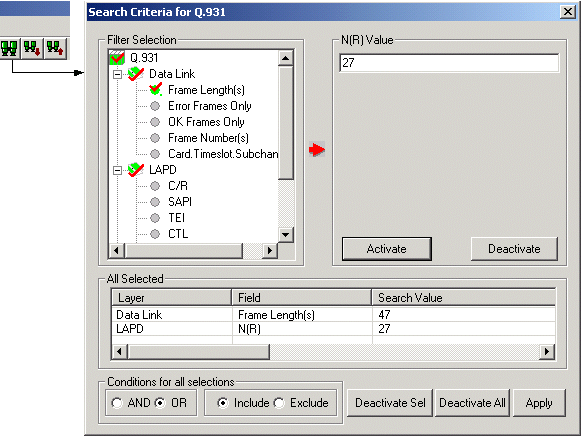
User can record all or filtered traffic into a trace file and also can create search/filter criteria automatically from the current screen selection. The filter and search options add a powerful dimension to the ISDN Analyzer that isolates required frames from the captured frames in real-time/remote/offline.
Users can specify custom values for frame length to filter frames during real-time capture. The frames can also be filtered after completion of capture according to SAPI, TEI, C/R, N (S), N(R), P/F, Supervisory Function and Type of ISDN Message. Similarly, search capability helps user to search for a particular frame based on specific search criteria.

Filtering and Search
Aggregate Column Group
The enhanced feature of the protocol analyzer is aggregate column groups. The user can also create multiple aggregate column groups and prioritize the groups as per the requirement to display the summary results in an efficient way.
Aggregate Summary Column Group
The updated results are as shown below. Here the root aggregate group~0 summary columns are displayed first and then Group~1 and Group~2 as per the assigned priority.
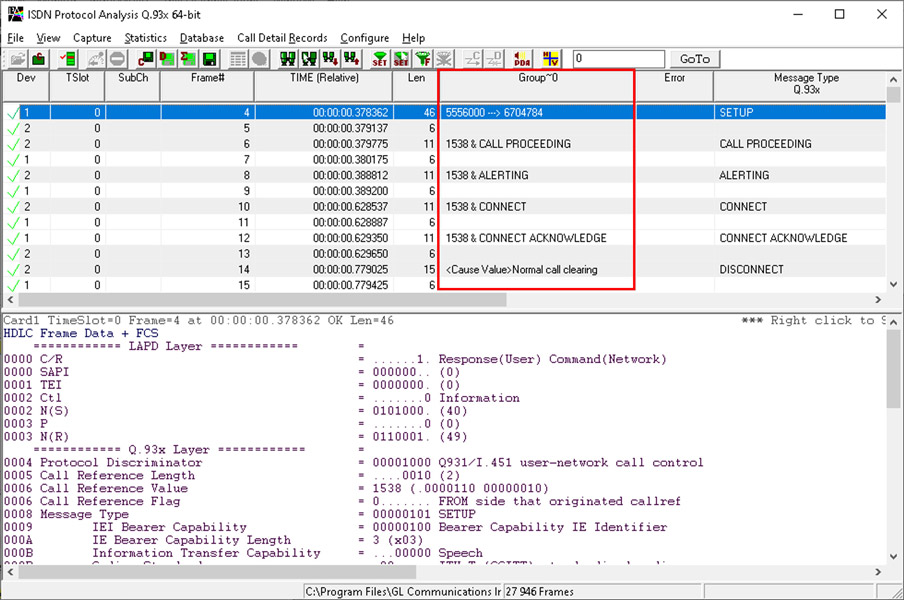
Display of Aggregate Summary Column Group
Call Detail Record and Statistics View
Important call specific parameters like. status of each call (i.e. active/completed), duration of completed call, called and calling party number, call reference value (CRV) etc., for each individual call from the captured data are displayed in the Call Detail Record View. Call Detail Recording feature includes data link groups that help in defining the direction of the calls in a given network and form logical groups comprised of unidirectional (either 'Forward' or 'Backward') data links. Additionally, users are provided with the option to search for a particular call detail record from the captured traces.
Statistics is an important feature available in ISDN analyzer and can be obtained for all frames both in real-time as well as offline mode. Numerous statistics can be obtained to study the performance and trend in the ISDN network based on protocol fields and different parameters.
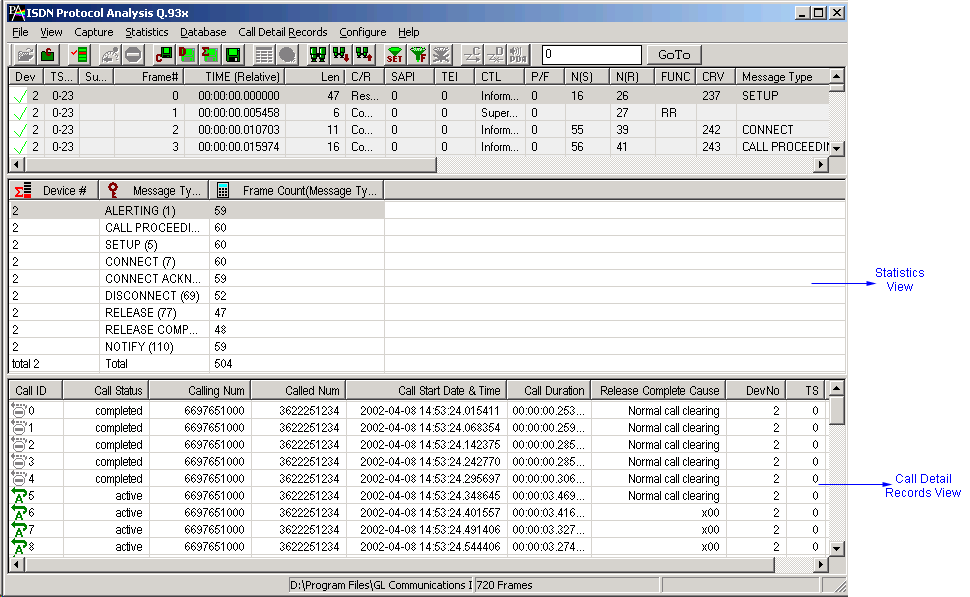
Statistics and Call Detail Record View
Enhanced Trace Saving Options
Users can control the captured trace files by saving the trace using different conventions such as trace files with user-defined prefixes, trace file with date-time prefixes, and slider control to indicate the total number of files, file size, frame count, or time limit. This feature also allows the captured frames to be saved into a trace file based on the filtering criteria set using display filter feature.
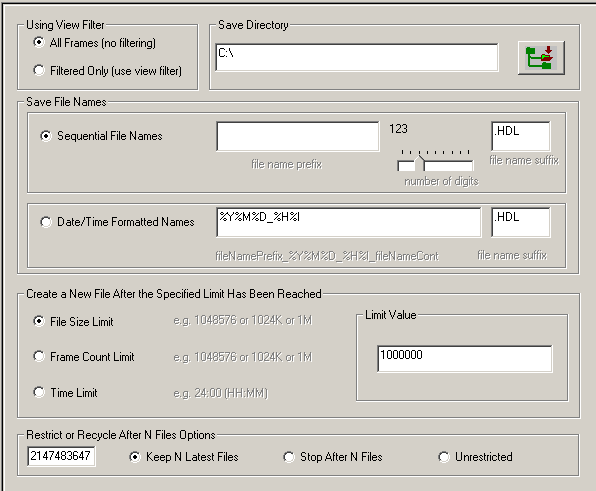
Enhanced Trace Saving Options Window
Save/Load All Configuration Settings
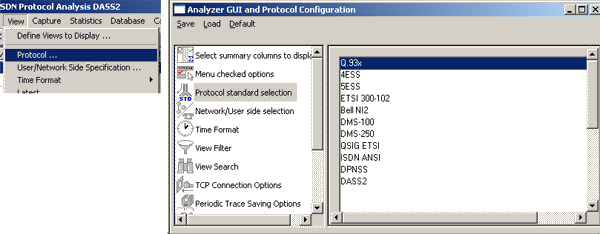
Protocol Configuration window provides a consolidated interface for all the important settings required in the analyzer. This includes various options such as protocol selection, startup options, stream/interface selection, filter/search criteria and so on. Any protocol field can be added to the summary view, filtering, and search features from this GUI providing the users more flexibility to monitor required protocol fields.All the configuration settings done in any of these options can be saved to a file, loaded from a configuration file, or user may just revert to the default values using the default option.

Save/Load All Configuration Setting Window
Sample Screenshots
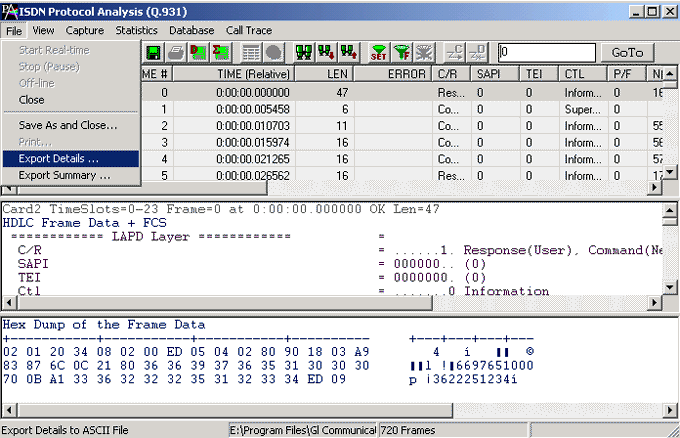 Exporting to ASCII File and Trace Savings Capability
 Real-Time and Off-Line Search Capability
 Detailed Status Display
  Selecting ISDN Protocol Standard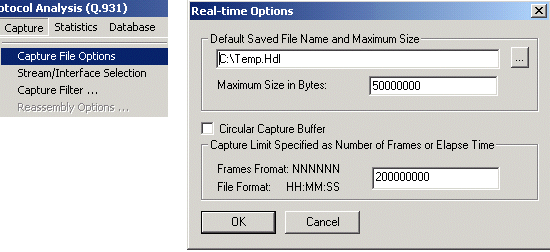
Setting Real-Time Capturing Options
ISDN Emulation Tools
GL's ISDN Emulator for T1 E1 network is available as GUI based application through which the various ISDN configurations can easily be created, thereby allowing the ISDN Emulator to be fully functional within a few minutes. This ISDN configuration includes selection of various ISDN standards, variants & NFAS, etc. The ISDN Emulator also incorporates the flexibility to modify ISDN call parameters & message content. This flexibility ensures that the ISDN emulator will communicate with the system under test. It's even possible to emulate a complete ISDN connection (switch to subscriber) all in the same PC with a dual interface card. For more details, visit ISDN Emulation webpage.
ISDN Emulation using Client-Server
The client-server based ISDN Emulator emulates ISDN calls over T1 E1 links. It also allows configuring the ISDN layer parameters, called/calling numbering plan/type, ISDN service type, place or accept call for each timeslot or for the whole trunk, switch and subscriber emulation, simple NFAS setup for T1, and performs various other tasks on remote clients. For more details, visit ISDN Emulation using Client-Server webpage.
Scripted ISDN Emulation using MAPS™
GL's MAPS-ISDN is an advanced protocol simulator/tester for ISDN simulation over TDM (T1 E1) and generates high volumes of ISDN traffic. The tester can simulate ISDN signaling as defined by the ITU-T standards. Currently this test tool is used to perform testing using ISDN protocol messages over T1 E1, and offers a complete solution for testing, troubleshooting, and maintenance of devices and networks implementing PRI ISDN. It is useful to test ISDN products designed for either U or S/T interface, including network terminations, Type 1 terminating equipment, and terminal adapters. For more details, visit ISDN Emulation using MAPS™ webpage.
Scripted ISDN over IP (ISDN SIGTRAN) Emulation using MAPS™
MAPS™ ISDN SIGTRAN is an advanced protocol simulator/tester used for ISDN simulation over IP. The tester can simulate a complete ISDN connection between SG (Signaling Gateway) to MGC (Media Gateway Controller), where ISDN signaling are as defined by the ITU-T Q.921 / Q.931 standards. The application is built with ready-to-use scripts, which generates and processes all ISDN messages including Setup, Connect, Release messages, and others. For more information, please visit MAPS™ ISDN SIGTRAN webpage.
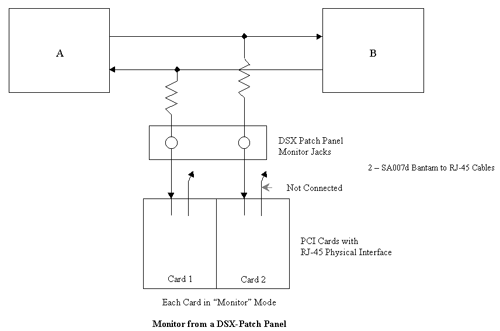
Bridge and Monitor Connections
Monitor from a DSX-Patch Panel
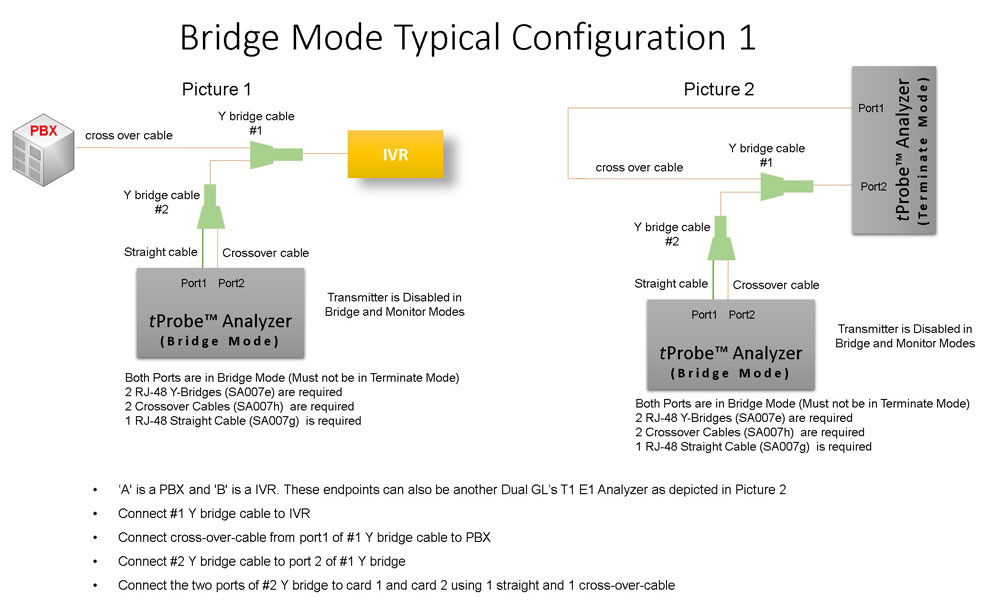
Bridge Mode Connections for Monitoring T1 E1 Signals for RJ-45
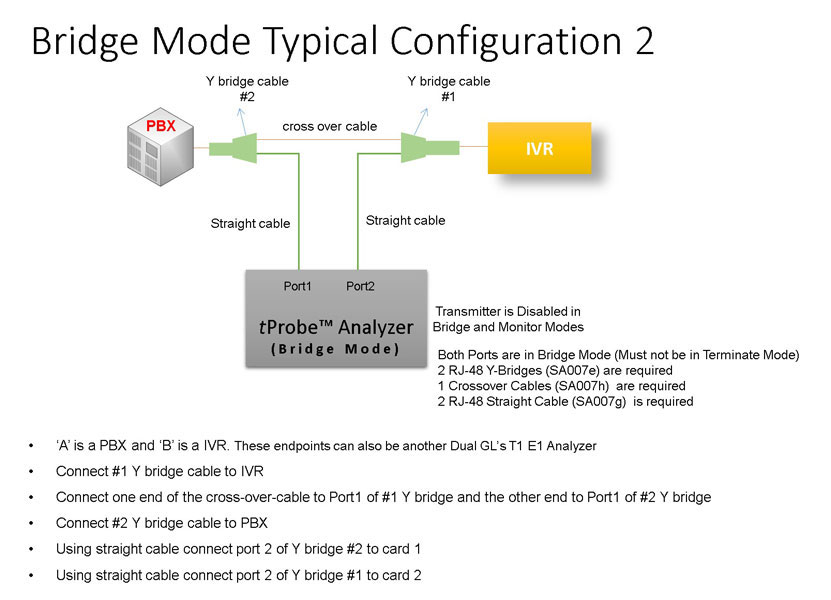
Bridge Mode Connections Alternative Method
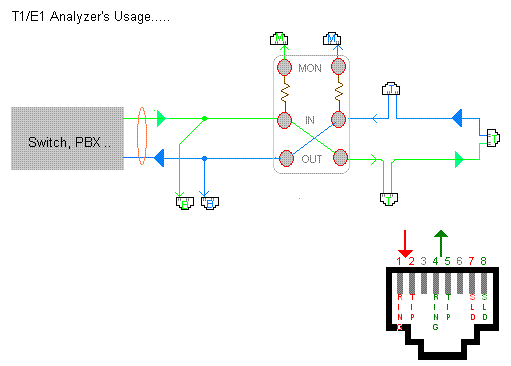
RJ-45 Connections
Resources
Note: PCs which include GL hardware/software require Intel or AMD processors for compliance.
Please Note: The XX in the Item No. refers to the hardware platform, listed at the bottom of the Buyer's Guide, which the software will be running on. Therefore, XX can either be ETA or EEA (Octal/Quad Boards), PTA or PEA (tProbe Units), XUT or XUE (Dual PCIe Express) depending upon the hardware.
Specifications are subject to change without notice.
 Back to Protocol Analysis Index Page