Glossary of Protocol Standards
ISDN | PPP | LTE | SA HDLC | SS7 | SIP | UMTS | Miscellaneous
ATM
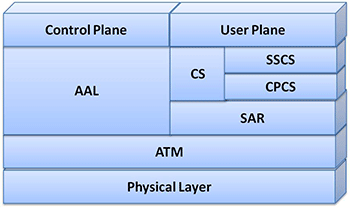
- ATM Layer- B-ISDN ATM LAYER SPECIFICATION, ITU-T Recommendation I.361
- ATM Adaptation Layer (AAL)
- SSCS (Service Specific Convergence Sublayer): ITU-T Recommendation I.366.2
- SSSAR (Service Specific Segmentation and Reassembly Sublayer) : ITU-T Recommendation I.366.1
- UNI Interface Types
- ITU-T Standard Interfaces(UNIQ.2931) :
- ATM Forum Standard Interfaces (UNI 3.0, UNI 3.1, UNI 4.0):
- Classical IP and ARP over ATM (CLIP)
- IP over ATM is supported with Classical IP over ATM (CLIP, defined in RFC 2225 (formerly 1577 ) ), LAN Emulation (LANE, defined in [lanev1] and [lanev2]) and Multi-Protocol Over ATM. GL's ATM analyzer supports decoding of Classical IP over ATM as per IETF RFC 2225.
ATM layer is responsible for transporting the information in the form of a fixed length cells (53 bytes) across the network using several virtual connections identified by VPI/VCI values. The connection isn't assigned a dedicated bandwidth. Depending on the QoS of involved parties, the connection is assigned a bandwidth and traffic is actually sent.
ATM adaptation layer performs the necessary mapping between higher layer protocols and ATM layer. It multiplexes the higher layer info in the fixed length ATM cells. Because of different quality of service parameters, different types of AAL starting from AAL0 to AAL5 are defined. AAL0 is nothing but ATM cells itself. Different classes of service are mapped to individual AAL type.
Among these, GL's ATM analyzer supports AAL0 (raw cells), AAL2, and AAL5 as specified below:
AAL0 is nothing but ATM cells itself
AAL 2- Class B (ITU-T Recommendation I.363.2)
AAL 5- Class C & D (ITU-T Recommendation I.363.5)
AAL includes the following sublayers :
It uses AAL2 connection for transporting different narrowband traffic like Voice, CAS bits, DTMF digits, circuit mode and frame mode data etc.
It multiplexes frame mode data in an AAL2 connection. It fragments very large amount of data of a frame and packed in an AAL2 connection thus can assure assigned QOS for the service.
GL's ATM analyzer can be configured to support following UNI interfaces:
Q.2931 based UNI signaling is an ITU-T UNI signaling standard used to establish and release of SVC. SVC is switched virtual channel created using signaling protocol when it is needed and then later on released. Various variants of UNI signaling are available.
Similar to Q.2931, ATM forum has defined it's own recommendations for establishment and release of SVC across ATM User-Network interface. The procedures described in these recommendations apply to both public UNI as well as private UNI.
CDMA
- IOS* Application for A1 (3GPP2 A.S0014-A, Version 2.0.1, Date: July 2003)
- A1 Interface (ITU-T Standard Interfaces)
- A1 Interface (ANSI)
- IOS* Application for A3 and A7(3GPP2 A.S0015-C, Version 1,0 Date: February2005)
- IOS* Application for A9 and A11 (3GPP2 A.S0016-C, Version 1,0 Date: February 2005 & 3GPP2 A.S0017-A, Version 2.0.1, Date: July 2003):
A1 interface carries signaling information between the Call Control (CC) and Mobility Management (MM) functions of the MSC and the call control component of the BS* (BSC) and the specified IOS application describes about the functional capabilities, including services and features, across the A1 interface. GL's CDMA A1 interface supports:
The A7 interface carries signaling information between a source Base Station (BS)* and a target Base Station. The specified IOS application describes about inter-BS* soft handoff procedures. The A3 interface carries coded user information (voice/data) and signaling information between the source BS* Selection/Distribution Unit(SDU) function and the channel element component (BTS) of the target BS*. These interfaces are provided using ATM cells over T1/E1 and SONET transmission links.
The A9 interface carries signaling information between the BSC and the PCF and where as A11 interface
carries signaling information between PCF and PDSN. They are used for establishing link for transfer of user traffic.
*Inter-Operability Specification
*Base Station (BS) is an entity in the public radio telecommunications system used for radio telecommunications with mobile
stations; Base Transceiver Station (BTS) is a channel element component of a base station that includes radio equipment, while, Base
Station Controller (BSC) is the control portion of the base station that includes call control logic and interconnections to the MSC.
Frame Relay
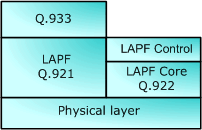
- LAPF (Link Access Procedure/Protocol) - This protocol is version variation of LAPD (Q.921). LAPF is defined in the ITU Q.922
- Multi-protocol encapsulation, FRF.12, FRF12.1, FRF.15, SNAP, PPP over Frame Relay, link control protocol RFC 1661
- Q.933, SVC, and LMI signaling standards
- IP, TCP, UDP, SMTP, POP3, STUN, DNS, DHCP, HTTP, FTP, SNMP, RIP
GPRS
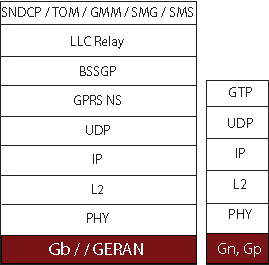
- Gb Interface
- Frame Relay
- Network Service
- BSSGP Pdu (Base Station System GPRS Protocol)
- LLC (Logical Link Control)
- SNDCP (Subnetwork Dependent Convergence Protocol)
- GMM (GPRS Mobility Management)
- SM (Session Management)
- Gn Interface
- MAC (Medium Access Control) Layer
- LLC (Logical Link Control)
- IP
- UDP (User Datagram Protocol)
- GTP (GPRS Tunnelling Protocol)/GTP'
The Gb interface is a GPRS interface which is located between the SGSN (Serving GPRS Support Node) and the PCU (Packet Control Unit).
GPRS Gb interface supports decoding of the following Interfaces:
Gn Interface is the interface between GPRS Support Nodes (GSNs) within a PLMN (Public Land Mobile Network).
GPRS Gn interface supports decoding of the following Interfaces:
GR-303
- GR-303 LAPD: Telcordia, Telcordia GR-303-IMD (formerly TR-TSY-000303)
- Series X (Data networks and open system communication): X.208, X.209, X.219, X.229, X.710, X.711
- TMC & CSC: GR-303-CORE Issue 3 December 1999 and GR-303-CORE Issue 3 December 1999
- EOC: GR-303-CORE Issue 3 December 1999
GSM
- A Interface (variants GSM 900, DCS 1800, PCS 1900) - MTP2, MTP3, SCCP, BSSMAP, MM, CC, SMS, GCC, BCC, DTAP
- Abis Interface (variants GSM 900, DCS 1800, PCS 1900) - LAPD, BTSM, RR, MM, CC, SMS, GCC, BCC
- Gs Interface (variants GSM 900, DCS 1800, PCS 1900) - MTP2, MTP3, SCCP, BSSAP+
- Lb, Ls, Lp Interface - RRLP, BSSLAP, SMLCPP, LLP, BSSAP-LE (BSSMAP-LE/DTAP-LE), SCCP, MTP3, MTP2
- Up Interface - UMA protocols, TCP, UDP, IP, MAC
- Mobis Interface (requires additional license) - Mobis, LAPD, RR, MM, CC, SMA, GCC, BCC
HDLC
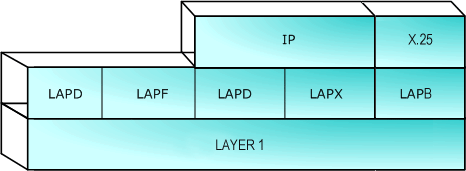
- LAPD: Decodes Layer 2 as Link Access Protocol on the D-channel (LAP-D) as defined in the ITU Q.921
- LAPF: Decodes Layer 2 as Link Access Procedure/Protocol (LAPF) as defined in the ITU Q.922, an enhanced LAPD (Q.921) with congestion control capabilities, is for Frame Mode Services in the Frame Relay network
- LAPD+IP: Decodes Layer 2 as Link Access Protocol on the D-channel (LAP-D) as defined in the ITU Q.921 & Layer 3 as Internet Protocol (IP)
- LAPX+IP: Dumps Layer 2 Link Access Protocol data & decodes Layer 3 as Internet Protocol (IP)
- Cisco HDLC (cHDLC) - Decodes Layer 2 similar to LAPD (address, control and protocol code) with encapsulated higher level protocol decodes (Internet Protocol etc.).
ISDN

- Layer 2: Conveys user information between Layer 3 entities across ISDN using the D-channel. LAPD is parsed according to Q.921
- Layer 3: ISDN information parsing depends on the user's selection of the following ISDN Standards
- Bell NI2 (Bellcore National ISDN-2): It is used in USA (Bellcore). It includes components to communicate information between ISDN user equipment, and the ISDN switch
- AT&T/Lucent switch 4ESS and 5ESS (TR41449, TR41459 and 235-900-342): It is an ISDN variant adopted in USA by AT&T
- ETSI 300-102 (Euro ISDN): This variant is adopted in all European countries
- QSIG (Q-reference point Signaling System) ETSI: QSIG is inter-private PABX signaling system
- Q.93x: It is an ITU implementation of ISDN
- Nortel's switch DMS-100/250(NIS-A2111-1 and NIS-A211-4): It is a Northern Telecom's implementation of National ISDN
- ISDN ANSI decode: T1.607 (Specification)
- MLPP (Multi-Level Precedence. and Preemption) procedures are supported for
- ISDN ANSI decode - T1.619 and T1.619a (Specifications)
- ITU implementation - Q.955.3 (Specification) and
- Facility Information Element - Q.932 (Specification)
- DASS2 - Digital Access Signaling System No 2 (DASS 2) has been evolved from DASS 1 to incorporate changes arising from the need to give PBXs ISDN access. DASS 2 is intended for use between the customer's equipment (PBX) and an ISDN local exchange. British Telecom (BT) defines it in Specification BTNR 190
- DPNSS - Digital Private Signaling System No 1 (DPNSS 1) is used between switching nodes (eg PBXs) in digital private networks, it is defined in ND1301:2001/03
- ARINC 746 - Aeronautical Radio, INC is a signaling protocol based on Q.931, but with a few modifications. It is intended to use for communication between Cabin Telecommunications Unit (CTU) and Bearer Radio Systems.
- QSIG ECMA (Q-reference point Signaling System) - It is defined in Standard ECMA-143 4th Edition - December 2001
PPP
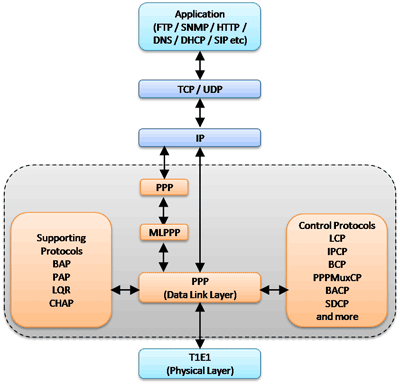
- LCP (Link control Protocol)
- Authentication Protocol
- PAP - Password Authentication Protocol is used by the peer entity to establish its identity in PPP session. It usually occurs just after the link establishment phase
- CHAP - Challenge Authentication Protocol is used to periodically verify the identity of the peer. It can be initiated at any time during a ongoing PPP session
- Link Quality Report (LQR)
- Bridging PDU (BPDU)
- MLPPP
- MC-MLPPP
- NCP
- IPCP (Internet Protocol Control Protocol):
- BCP (Bridging Control Protocol):
- PPPMuxCP (RFC 3153):
- SNMP
- DNS
- DHCP
- STUN
- HTTP
- FTP
- ICMP
- SMTP
- POP3
- VJ Compressed TCP/IP (RFC: 1144)
- IPHC (IP Header Compression: RFC 2507)
- CRTP (Compressed RTP : RFC 2508)
LCP is responsible for establishment, release and maintenance of PPP link between two PPP nodes. LCP also helps in selection of encapsulation format while exchanging layer3 information, selection of authentication protocol for the peer entity, determining the packet size limit etc.
PPP provides two types of authentication protocol.
LQR helps in monitoring the quality of PPP link. Packets are sometimes dropped or corrupted because of noise and equipment problem. LQR helps in sorting out such links so that traffic can be re-routed to alternate links if necessary
BPDU encapsulates other higher layer protocol e.g IP based protocols. This protocol enables the interconnection between two remote LANs via PPP link.
MLPPP bundles multiple link-layer channels into a single network-layer channel. Data sent through this channel will be distributed among all the links in Get queued Bytes Fashion.
The Multi-Class Extension to Multi-Link PPP allows a sender to fragment the packets of various priorities into multiple classes of fragments. This allows high-priority packets to be sent between fragments of lower priorities.
Network control protocol enables the selection of specific options and control protocols at connection time across LAN-WAN connection. This means that network administrators do not have to statically configure the router interface for remote interfaces. Rather, remote interfaces negotiate the link at connection time. NCP supports two types of protocols, namely, IPCP and BCP.
The IP Control Protocol (IPCP) is responsible for configuring, enabling, and disabling the IP protocol modules on either ends of the point-to-point link. IPCP uses the same packet exchange mechanism as the Link Control Protocol (LCP).
The Bridging Control Protocol (BCP) is responsible for configuring, enabling and disabling the bridge protocol modules on both ends of the PPP link. BCP uses the same packet exchange mechanism as the Link Control Protocol (LCP).
PPP mux cp is responsible for configuring the PPP link for enabling PPP Multiplexing. Multiplexing feature sends multiple PPP encapsulated packets in a single PPP Multiplexed frame, and each PPP encapsulated frame within a multiplexed frame is called a PPP sub-frame. And sub-frames are concatenated to a make a single PPP multiplexed frame by inserting a delimiter before the beginning of each sub-frame, and as a result, the PPP encapsulation overhead per packet is reduced.
Enables the administrator to collect the different management information from any network node in a network. Each node maintains a MIB (Management information Base) and SNMP agent. The later collects the MIB information from the device and make them available to network management system (NMS) via SNMP protocol. GL's MLPPP Analyzer supports SNMPv1 and SNMPv2.
The Domain Name System (DNS) is a distributed internet directory service. DNS is used mostly to translate between domain names and IP addresses, and to control email delivery. The DNS system consists of three components: DNS data (called resource records), servers (called name servers), and Internet protocols for fetching data from the servers. The billions of resource records in the DNS are split into millions of files called zones. Zones are kept on authoritative servers distributed all over the Internet, which answer queries based on the resource records stored in the zones.
The Dynamic Host Configuration Protocol (DHCP) is an Internet protocol for automating the configuration of computers that use TCP/IP. DHCP can be used to automatically assign IP addresses, to deliver TCP/IP stack configuration parameters such as the subnet mask and default router, and to provide other configuration information such as the addresses for printer, time and news servers.
The STUN protocol enables a SIP client to discover whether it is behind a NAT, and to determine the type of NAT. The STUN proposal defines a special STUN server in the public address space to inform the STUN-enabled SIP client in the corporate (private) address space of the Public NAT IP address and port being used for that particular session.
Application protocol for distributed, collaborative, hypermedia information systems and involves MIME like communication between user agent (UA) and origin server identified by URI. GL's MLPPP Analyzer supports HTTP 1.1 and HTTP 1.0
FTP, enables the data transfer between one user (PC) to another remote user (PC) over IP. It defines a set of commands and replies exchanged between the two users over control connection. A separate full duplex data connection is opened between the two communicating user for actual data transfer.
FTP, enables the data transfer between one user (PC) to another remote user (PC) over IP. It defines a set of commands and replies exchanged between the two users over control connection. A separate full duplex data connection is opened between the two communicating user for actual data transfer.
SMTP (Simple Message Transfer Protocol) is mail transfer protocols that transport the mail reliably and efficiently via Internet. When a SMTP client has a message to transmit, it opens a duplex connection with the server and transfers the message using IP/TCP.
SMTP (Simple Message Transfer Protocol) is mail transfer protocols that transport the mail reliably and efficiently via Internet. When a SMTP client has a message to transmit, it opens a duplex connection with the server and transfers the message using IP/TCP.
Van Jacobson TCP/IP header compression helps improve TCP/IP performance over slow serial links. The compression works by saving the state of TCP/IP contexts at both ends of the connection and only sending the differences of the header field changes.
IPHC compression mechanism supports both TCP and UDP transport protocol headers over IP. Headers of typical UDP or TCP can be compressed down to 4-7octets including the 2 octet UDP or TCP checksum.
CRTP compresses IP/UDP/RTP headers to reduce the overhead on low-speed serial links. In many cases, all three headers can be compressed to 2-4 bytes. CRTP compression scheme fits within the framework specified in RFC 2507 i.e. IPHC. It creates IP/UDP/RTP as a third class extracted from the non-TCP class of IPHC.
LTE
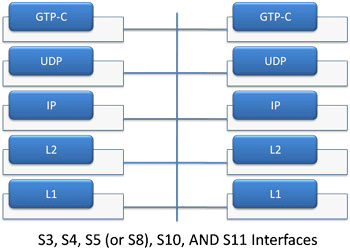
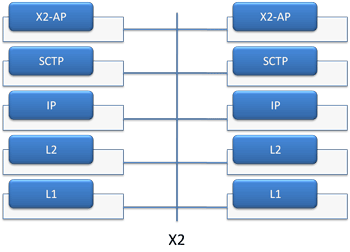
GL's LTE analyzer is capable of capturing and decoding various interfaces i.e. S1, S3, S4, S5 (or S8), S6a, S10, S11, S13 and X2 interfaces of the LTE network. The protocols supported for decoding across all these interfaces are NAS, S1AP, X2AP, eGTP, Diameter, SCTP, UDP, TCP, IP.
- S1 Interface
- S3 Interface
- S4 Interface
- S5 Interface
- S8 Interface
- S10 Interface
- S11 Interface
- S6a Interface
- S13 Interface
- X2 Interface
S1-U - Reference point between E-UTRAN and Serving GW for the per bearer user plane tunneling and inter eNodeB path switching during handover.
S1-MME - Reference point for the control plane protocol between E-UTRAN and Mobility Management Entity (MME). The MME is responsible for authentication and critical management for mobile devices.

It enables user and bearer information exchange for inter 3GPP access network mobility in idle and/or active state.
It provides related control and mobility support between GPRS Core and the 3GPP Anchor function of Serving GW. In addition, if Direct Tunnel is not established, it provides the user plane tunnelling.
It provides user plane tunnelling and tunnel management between Serving GW and PDN GW. It is used for Serving GW relocation due to UE mobility and if the Serving GW needs to connect to a non-collocated PDN GW for the required PDN connectivity.
Inter-PLMN reference point providing user and control plane between the Serving GW in the VPLMN and the PDN GW in the HPLMN. S8 is the inter PLMN variant of S5.
Reference point between MMEs for MME relocation and MME to MME information transfer.
Reference point between MME and Serving GW
It enables transfer of subscription and authentication data for authenticating/authorizing user access to the evolved system (AAA interface) between MME and HSS.
It enables UE identity check procedure between MME and EIR.

Interface between eNodeBs supports load management and handover coordination between eNodeBs.
SA HDLC
- LAPD - Decodes Layer 2 as Link Access Protocol on the D-channel (LAP-D) as defined in the ITU Q.921
- LAPF - Decodes Layer 2 as Link Access Procedure/Protocol (LAPF) as defined in the ITU Q.922, an enhanced LAPD as defined in the ITU Q.921 with congestion control capabilities
- LAPD+IP - Decodes Layer 2 as Link Access Protocol on the D-channel (LAP-D) as defined in the ITU Q.921 & Layer 3 as Internet Protocol (IP)
- LAPX+IP - Dumps Layer 2 Link Access Protocol data & decodes Layer 3 as Internet Protocol (IP)
- Cisco HDLC (cHDLC) - Decodes Layer 2 similar to LAPD (address, control and protocol code) with encapsulated higher level protocol decodes (Internet Protocol etc.)
SS7
SS7 ANSI/ITU/ETSI/CHINA/UK
- MTP2: Q.704, ITU-T Blue Book / ANSI T1.111-1996
- MTP3: MTP2: Q.703, ITU-T Blue Book / ANSI T1.111-1996
- SCCP: Q.713, CCITT (ITU-T) Blue Book / ANSI T1.112-1996
- MAP (MAP R99 and MAP R4):
- 3GPP TS 09.02 V7.14.0 (2003-09)
- 3GPP TS 29.002 V4.18.0 (2007-09)
- INAP CS1 (Capability Set 1): Q1218 (10 / 95) and ETSI ETS 300 374 1, Sept, 1994
- INAP CS2 (Capability Set 2)
- INAP CS2: ITU recommendation Q.1228
- INAP CS2 (ETSI): EN 301 140-1 Specification
- CAMEL (Version 6 and Version 3):
- 3GPP TS 29.078 V3.15.0 (2003-03)
- 3GPP TS 29.078 6.3.0 (2004-09)
- ISUP : Q.763, CCITT (ITU-T) Blue Book / ANSI T1.113-1995 / EN 300 356 -1 V3.2.2 (1998-08) Part I and Q763 / ND1007:2007/01 TSG/SPEC/007
- TUP : Q.723, CCITT (ITU-T) Blue Book
- Test & Network Mgmt Messages :- Q.703, Q.704, ITU-T Blue Book / ANSI T1.111-1996
- TCAP (IS 41): Q.773, CCITT (ITU-T) Blue Book / ANSI T1.114 -1996/ TIA/EIA/IS-41.5-C
- Interconnect User Part (IUP)
- ND1006:2005/02 PNO-ISC/SPEC/006 - Interconnect User Part (IUP)
- ND1104:2004/11 PNO-ISC/INFO/004 - Proprietary Extensions To C7 Interconnect User Part (IUP)
- BICC : T-REC-Q.1902.1-200107, T-REC-Q.1902.2-200107, T-REC-Q.1902.3-200107, T-REC-Q.1902.4-200107 (pl-080r1)
- BISUP : Q.2763, Q.2931, Q.2933, Amendment 2 of Q.2931, Q.2941.1 etc
Note: INAP decoding for ITU and ETSI are same in INAP CS1, but different in case of INAP CS2
SIP
- Session Initiation Protocol (SIP) - RFC 3261
- SIP is normally used in conjunction with other protocols in order to provide complete services to the users
- Media Gateway Control Protocol (MGCP) - RFC 2705/3435 (3991)
- Media Gateway Control (MEGACO) - RFC 3525 and 3015
- H.323
- Session Description Protocol
- RTP/RTCP
SIP is an application-layer control protocol that can establish, modify, and terminate multimedia sessions (conferences). These sessions include Internet multimedia conferences, Internet (or any IP Network) telephone calls and multimedia distribution
MGCP is a protocol for controlling Voice over IP Gateways (or Call Agent endpoints) from external call control elements. It assumes a call control architecture where the call control "intelligence" is outside the gateways and handled by external call control elements. The Call Agent can create, modify and delete connections in order to establish and control media sessions with other multimedia endpoints. Also, the Call Agent can instruct the end points to detect certain events and generate signals. The endpoints automatically communicate changes in service state to the Call Agent.
Megaco is also known as H.248 is a signaling protocol, used between Media Gateway and Media Gateway Controller (Call Agent). Megaco/H.248 uses a series of commands to manipulate terminations, contexts, events, and signals. Megaco/H.248 is architecturally quite similar to MGCP, however Megaco/H.248 supports a broader range of networks.
H.323 provides the foundation for audio, video and data communication on packet based IP network. H.323 is not a single protocol rather a protocol suite, which performs all the functions necessary to establish and maintain real time audio/video/data conferencing sessions over IP data networks.
SDP is a session description protocol for multimedia sessions. SIP generally uses SDP to convey session information. SDP is carried as the message body in a SIP message.
The RFC 1889 defines RTP as the service, which provides end-to-end delivery services for data with real-time characteristics, such as interactive audio and video. Those services include payload type identification; sequence numbering, time stamping and delivery monitoring. RTP is mostly used in conjunction with RTCP, the protocol used to monitor the quality of service and to convey information about the participants in an on-going session.
UMTS
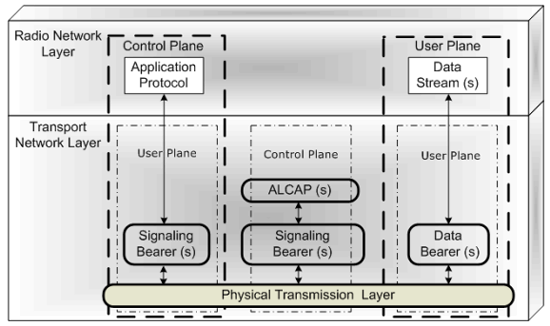
- Iub Interface - RNC to Node B interface
- ATM (ITU-T I.361)
- AAL-5 (ITU-T I.363.5)
- AAL-2 (ITU-T I.363.2)
- SSCOP (ITU-T Q.2110)
- SSCF for UNI (ITU-T Recommendation Q.2130 (07/94))
- MTP-3b (ITU-T Q.2210)
- ALCAP (ITU-T Q.2630.1)
- NBAP (3GPP TS 25.433 V6.3.0 (2004-09))
- FP (3GPP TS 25.427 V6.1.0 (2004-12) and 3GPP TS 25.435 V6.1.0 (2004-03))
- MAC (3GPP TS 25.321-610)
- RLC (3GPP TS 25.322-610
- RRC (3GPP 25.331)
- MM/GMM/CC/SM ( 3GPP 24.008)
- IuPS Interface - The UTRAN interface between RNC and the packet-switched domain of the GSM Phase
2+ CN interface
- AAL-5 ((ITU-T I.363.5))
- SSCOP (ITU-T Q.2110)
- SCCP (Q.713, CCITT (ITU-T) Blue Book / ANSI T1.112-1996)
- SCTP (RFC 2960)
- GTP-control (GTP-C), GTP-user (GTP-U)
- IP (RFC 791)
- UDP (RFC 768)
- RANAP (3GPP TS 25.413 V6.3.0 (2004-09))
- GMM/ SM ( 3GPP 24.008)
- IuCS Interface - The UTRAN interface between RNC and the circuit-switched domain of the GSM Phase
2+ CN interface
- ATM (ITU-T I.361)
- AAL-5 (ITU-T I.363.5)
- AAL-2(ITU-T I.363.2)
- SSCOP (ITU-T Q.2110)
- SSCF UNI (ITU-T Recommendation Q.2130 (07/94))
- MTP-3b (ITU-T Q.2210)
- ALCAP (ITU-T Q.2630.1)
- SCCP (Q.713, CCITT (ITU-T) Blue Book / ANSI T1.112-1996)
- RANAP (3GPP TS 25.413 V6.3.0 (2004-09))
- MM/CC ( 3GPP 24.008)
- Iur Interface - UTRAN interface between two RNCs
- ATM (ITU-T I.361)
- AAL-5 (ITU-T I.363.5)
- AAL-2 (ITU-T I.363.2)
- SSCOP (ITU-T Q.2110)
- SSCF NNI (ITU-T Recommendation Q.2140 (02/95))
- MTP3b (ITU-T Q.2210)
- ALCAP (ITU-T Q.2630.1)
- SCCP (Q.713, CCITT (ITU-T) Blue Book / ANSI T1.112-1996)
- SCTP (RFC 2960)
- IP (RFC 791)
- UDP (RFC 768)
- M3UA (RFC 3332
- RNSAP (3GPP TS 25.423 V6.4.0 (2004-12))
Miscellaneous
Base Station (BS) is an entity in the public radio telecommunications system used for radio telecommunications with mobile stations;
Base Transceiver Station (BTS) is a channel element component of a base station that includes radio equipment.
Base Station Controller (BSC) is the control portion of the base station that includes call control logic and interconnections to the MSC.