Newsletter: GL Announces tProbe™ - T1 E1 VF and Serial Data Analysis and Emulation Hardware
Welcome to another February 2011 issue of GL Communications' newsletter providing information and insight into our
latest hardware platform tProbe™ – T1 E1 VF and Serial Data Analysis and
Emulation Hardware.
Overview
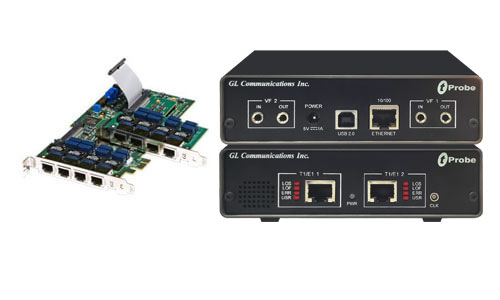
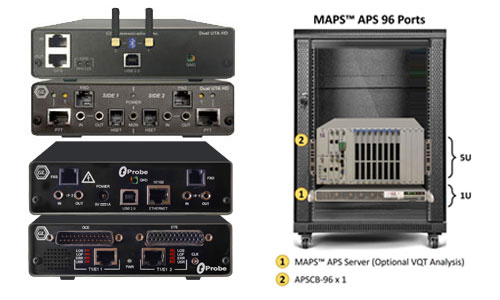
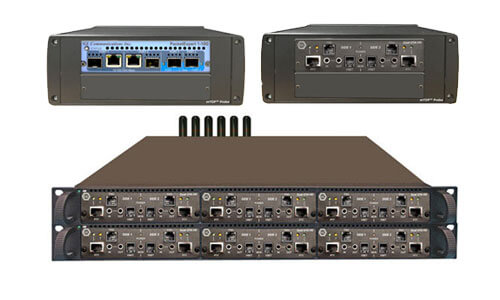
GL's new tProbe™ is an enhanced version of our popular USB-based
T1 E1 VF Analyzer / Emulator. This hardware incorporates all the features of the previous analyzer such as portability, USB
interface, remote accessibility, scripting, and a vast collection of optional applications. Recently
tProbe™ was introduced with the following important enhancements:
- T1 E1 Pulse Shape and Jitter Measurement Analysis
- "Cross-port Through" and "Cross-port Transmit" Modes - these configurations make cabling with Drop/Insert and
Fail-Safe Inline Monitoring very easy
- Enhanced VF Drop and VF Insert Capabilities (including 3.5 mm or Bantam physical connection options)
- Improved circuitry for very accurate Digital Line Level measurements
- Ethernet interface for future standalone operation
- Easy calibration
- Forward thinking hardware design for future daughter board expansion applications
- Windows XP / Widows 7 operating system support with user-friendly GUI
- Lightweight (1.24 lbs) and small footprint (6.05" x 5.55" x 1.60")
tProbe™ comes with "basic software applications" for basic testing
needs and optional software applications that extend the capability far beyond the most expensive T1 E1 VF and Serial Data
testers. For example, capturing and transmitting an entire raw T1 E1 VF or Serial Data signal simultaneously on two full duplex
ports, or performing ISDN emulation, or SS7 analysis, or analyzing echo and voice quality.
Enhanced Loopback Modes:
tProbe™ supports Normal (no cross-port), Cross-port Through, and
Cross-port Transmit loopbacks.
Cross-port Through Loopback
This mode is similar to the standard Outward Loopback except that the signal received on Card 1 (Port 1) is transmitted
out onto Card 2 (Port 2). Likewise the signal received on Card 2 (Port 2) is transmitted out onto Card 1 (Port 1). This feature
allows monitoring T1 E1 lines in-line while still being protected from loss of power to the board. This mode is effected entirely
thru relays and eliminates complex cabling.
Cross-port Transmit Mode Loopback
In this Mode, the data that would normally be transmitted on Card 1 (Port 1) is diverted and transmitted on Card 2
(Port 2) and the data that would normally be transmitted on Card 2 (Port 2) is diverted and transmitted on Card 1 (Port 1).
The receive paths are completely unaffected. This mode is particularly useful for Drop and Insert and Error Injection
applications in which the board analyzes and may insert traffic running between two pieces of T1 E1 equipment. This feature
also eliminates complex cabling.
Future Capabilities Include
- 10/100 Ethernet Interface for standalone embedded applications
- 2-Wire Daughter Board for FXO and FXS (RJ-11) connections
- FXO - 2-Wire Calling/Answering, Caller ID, T1 E1 to 2-Wire FXO Drop or Insert, PC to 2-Wire FXO Drop or Insert
- FXS - Ring and Battery Voltage Generation, T1 E1 FXS Drop or Insert, PC to 2-Wire FXS Drop or Insert
- Optional DataCom Board (Dual DB-25 Connections) supporting the following DTE/DCE interfaces:
- RS-232 (V.28)
- X.21 (V.11)
- RS-449/V.36 (V.10 & V.11)
- EIA-530 (V.10 & V.11)
- EIA-530A (V.10 & V.11)
- V.35 (V.35 & V.28)
- Standalone Embedded Processor Flash and Platform Flash (SDRAM 512 MByte)
- Additional Daughter Boards planned include ADSL, Octal T1 E1, T1 E1 Switch, and many more.
For comprehensive information on the product, please refer to
tProbe™ web page.
Back to Latest News Page