Welcome to the January issue of GL Communications' Newsletter providing information and insight into our
Intrusive Network Voice Quality Testing Solution. This product offers a complete solution for
testing voice quality over PSTN, VoIP, TDM, and Wireless telecom networks. Its simplicity and ease of use make it ideal for hybrid
networks encountered in today's telecom environment.
An Overview
Today's telecommunication network is a combination of Wireless networks, VoIP networks and traditional PSTN networks.
In many cases, voice calls may originate in one network and terminate in another. Voice quality can easily become an important issue.
Efficient proactive monitoring can be a valuable diagnostic tool as well as a good indicator of combined network performance.
More and more operators will choose a complete voice quality testing solution to verify the quality of their service, thereby
providing better service for the end customer.
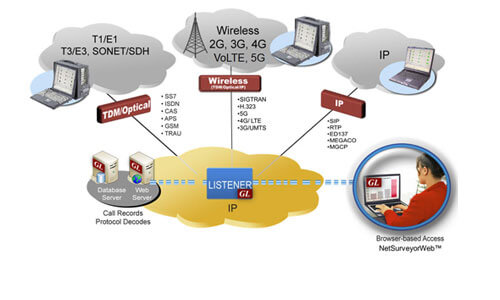
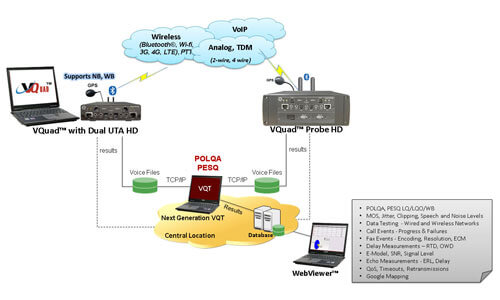
GL's Intrusive Network Voice Quality Testing Solution consists of the following important components: VQT Algorithm,
VQuad™ Node Sites, Regional Command Center (RCC), and Remote Client NetViewer™ (RCN). These are depicted below
and described further.
VQT Algorithm
This main algorithm residing at the RCC performs the VQT measurement on all "degraded voice files". It utilizes the ITU-T
P.862.1 PESQ algorithm. Some features include; auto measurement, jitter, clipping, latency, noise and signal measurements. Other
features include: a threshold rating system (excellent/good/fair/poor), sort/search capability on all results, and complete logging of
results within an accessible database.
Learn More about the VQT Algorithm
VQuad™ Node Sites
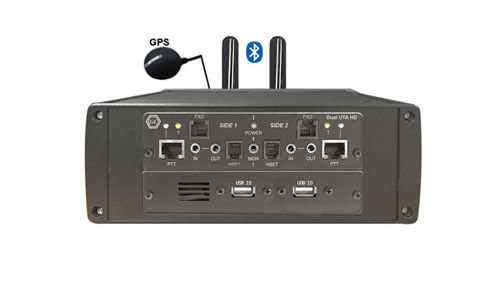
VQuad™ Node Sites make and receive calls under control of the RCN. Each VQuad™ node site can be equipped
with interfaces for;
- Wireless Units, i.e. Mobile Phones or Radios
- Analog/Digital/VoIP Phone Handsets
- FXO Analog Interfaces, i.e. 2-Wire PSTN
- VoIP (SIP Call Control) Interface
- T1 E1 (PRI ISDN/CAS) Interface
Each VQuad™ can perform automated call control for all interfaces through scripting, transmit / receive voice files (supports
both 8 and 16 bit PCM), and perform round trip delay (RTD) measurements. Each VQuad™ also supports complete bi-directional
testing.
Learn More
about VQuad™ Node Sites
Regional Command Center (RCC)
The RCC includes full control, automation, scripting, scheduling, and VQT Measurements for the entire region along with a
Degraded Voice File Transfer Utility (automatically transfers the Degraded Voice files from the VQuad™ nodes to the RCC).
The RCC controls all distributed sites, including such actions as
- starting voice transmission and reception tasks for each site at user-defined times,
- monitoring each site's working status in real time,
- automatic gathering of received (degraded) voice files for each site,
- and calculating and archiving voice quality scores in real time
The RCC can also be configured to continuously check the status of each distributed site. For a failed site the RCC will take
necessary actions for recovering, sending error messages to the Remote Client NetViewer™, and/or sending an alerting email to the
network administrator. All actions are user-definable.
Learn More about the Regional Command Center
Remote Client NetViewer™ (RCN)
The Remote Client NetViewer™ (RCN) can control many RCC's and view individual VQuad™node sites. The RCN can also
remote control individual VQuad™ sites and control the VQT Measurement process. From the RCN, one can build and edit RCC
and VQuad™ automation scripts, start and stop automation tests, and check overall status of the network. Using the powerful
query mechanism of the RCN, VQT results including MOS, Jitter, Clipping, RTD, Call Control Events, and Error Events can be searched
on a per measurement or per call basis. Results are displayed both in tabular and graphical formats.
Back to Latest News Page