Newsletter: GL Enhances TDM, Packet & Wireless Protocol Analyzers
Welcome to a September 2010 issue of GL Communications' newsletter providing information and insight into our
enhanced ISDN, GSM, PPP,
and SS1 protocol analyzers.
Overview
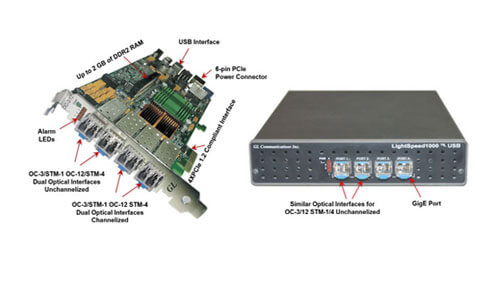
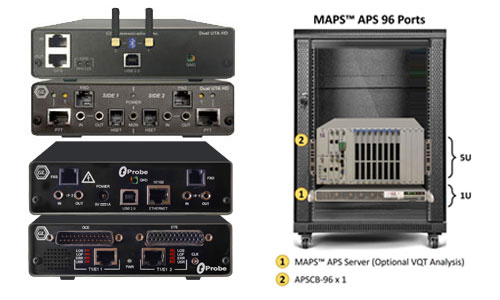
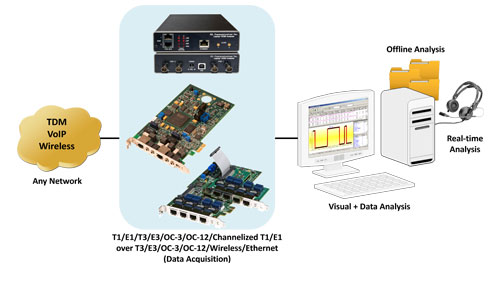
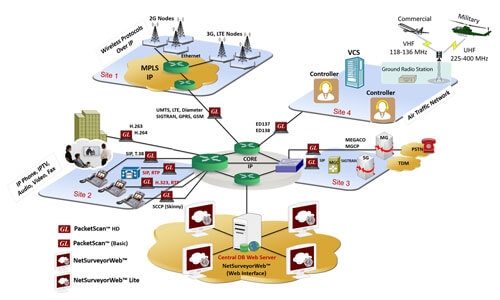
GL carries the widest array of protocol analyzers for TDM, Wireless, and Packet networks. Based on a uniform architecture
with identical features and functions, they can be used flexibly for a wide variety of tasks, including
- as independent standalone units for simple interface analysis
- as remote or offline analyzers
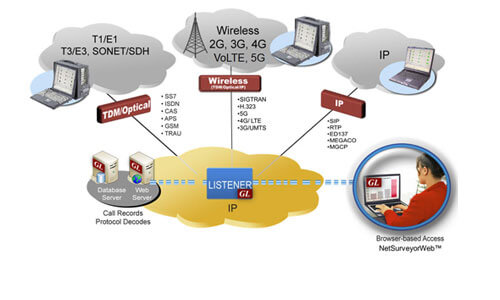
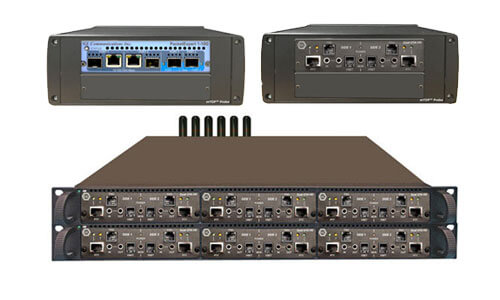
- as "probes" integrated with network surveillance systems
- as network elements for advanced traffic collection and processing
Typical examples include, continuous recording of protocol exchange on an ISDN interface, limited only by hard disk or
network storage space; or triggering, collecting and filtering for unique subscriber information and relaying such information
to a back end processor; or collecting CDR information for billing.
Recently Introduced Enhancements
GL's ISDN Analyzer can capture and analyze all frames on an ISDN PRI link. It decodes LAPD
according to Q.921, while, the ISDN Layer 3 information parsing is done based on the user's selection of the ISDN variant:
- ITU Q.931,
- AT&T/Lucent switch 4ESS and 5ESS (TR41449, TR41459 and 235-900-342),
- Nortel's DMS-100 and DMS-250 (NIS-A2111-1 and NIS-A211-4),
- Bellcore National ISDN-2 (NI-2),
- Euro ISDN (ETS-300 102-1),
- QSIG ETSI,
- ANSI T1.607,
- DPNSS, DASS2, and ARINC 746
- NEW -> QSIG-ECMA (Standard ECMA-143 4th Edition - December 2001)
As listed above the analyzer now supports the new protocol standard for QSIG-ECMA (Standard ECMA-143 4th
Edition - December 2001)
Other important features:
- Displays Summary, Detail, Hex-dump, Statistics, and Call Detail Views
- Call trace isolates call specific information i.e. status of each call (i.e. Active/Completed), duration of completed call,
Device No, Timeslot, CRV, Called and Calling Party number
- Call Detail Recording feature includes data link groups that help in defining the direction of the calls in a given network
and form logical groups comprised of unidirectional (either 'Forward' or 'Backward') data links
- Supports filtering and search based on SAPI, TEI, C/R, N(S), N(R), P/F, Supervisory Functions, and ISDN message types
For comprehensive information on our ISDN Analyzer, please visit ISDN Protocol Analyzer web
page.
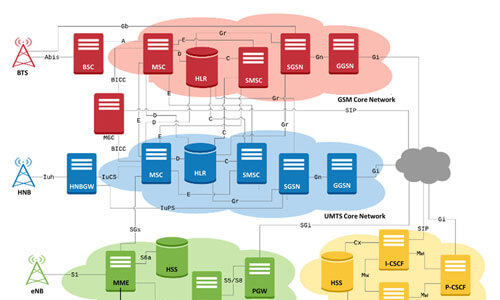
The GSM Analyzer is used to view and analyze GSM protocols using
GL's field proven Ultra E1 or Ultra T1 internal cards or Laptop E1 or T1 portable external products. The GSM Analyzer is
connected in a monitoring mode to an A-interface and/or an A-bis interface. Features include real time as well as offline
analysis, summary view displays of MTP2, MTP3, and higher layer GSM Message types, and detail views and decodes of
user selected frames.
Enhancements Introduced:
- Group Call Control (GCC) protocol (Specification - 3GPP TS 44.068 V9.0.0) is implemented to support VGCS (Voice
Group Call Service) feature for GSM-R (Global System for Mobile Communications - Railway)
- Broadcast Call Control (BCC) protocol (Specification - 3GPP TS 44.069 V9.0.0) is implemented to support VBS (Voice
Broadcast Service) feature for GSM-R (Global System for Mobile Communications - Railway)
Interfaces supported are:
- A (Interface between BSC and MSC),
- A-bis (Interface between BSC and BTS),
- Mobis (Motorola Proprietary Interface between BSC and BTS and also between BSC and PCU),
- B (Interface between the MSC and its associated VLR),
- C (Interface between the HLR and the MSC),
- D (Interface between the HLR and the VLR),
- E (Interface between MSCs),
- F (Interface between MSC and EIR),
- H (Interface between HLR and AuC),
- J (Interface between the HLR and the gsmSCF),
- Gs (Interface between SGSN and MSC),
- Ls / Lb / Lp Interfaces (Interfaces between MSC and SMLC),
- Up (Interface between UNC (UMA network controller) and MS)
Other important features include:
- Displays Summary, Detail, Hex dump, Statistics, and Call Detail Views
- Summary View displays MTP2, MTP3 information, GSM Message types, information about various channels used during
the call, frequency hopping and so on in a tabular format
- Call Detail View displays call statistics such as number of active/completed calls, durations of the completed calls, Type
of Call (e.g. SMS/Location Update/Authentication/Speech Call), IMSI/TMSI associated with each call
- Call Detail Recording feature includes data link groups that help in defining the direction of the calls in a given network
and form logical groups comprised of unidirectional (either 'Forward' or 'Backward') data links
For comprehensive information on the analyzer, please visit GSM Protocol Analyzer
web page.
The ML PPP Analyzer can be used to capture and decode a host of
PPP protocols exchanged between pairs of nodes over T1 E1 links. It provides useful analysis of the PPP, ML PPP, and MC
ML PPP protocols which includes distribution of protocols, protocol fields, frame lengths and frame status.
Enhancements Introduced:
PPP and ML PPP Analyzers now include VoIP Packet Data Analysis to analyze VoIP calls transported by TDM lines. It has
also been enhanced with new decodes to support Compressed RTP and Multiplexed PPP
Other Important Features:
- Supports a host of protocols including PPP, ML PPP, Multi-Class ML PPP, IPCP, BCP, PPP MUX CP, CRTP, BPDU, PAP,
CHAP, HTTP, SNMP, STUN, FTP, DNS, and DHCP
- Ability to test and perform numerous measurements across WAN- LAN or LAN-LAN connection
- Ability to test and analyze HDLC based PPP protocol in synchronous environment
- Provides Summary, Detail, Statistics, and Hex dump Views
- Summary View provides the information about few important fields (Dev #, Time Slot, Layer 3 Protocol, LCP message
type and higher protocol specific information like Destination and Source IP address, Destination and Source TCP as well
as UDP port details, HTTP/FTP message type, and so on)
For comprehensive information on the analyzer, please visit PPP Protocol Analyzer web
page.
GL's SS1 Analyzer detects and analyzes tone sequences that make up
SS1 dial digits. Sequences of pulse and guard tones are detected, decoded, and assembled into their corresponding dial
digits.
Enhancements Introduced:
- Real-time and File-based analysis
- Generates and introduce SS1 Dial Codes on Transmit Channels using SS1 Dialer
- Controls mark & space frequencies and duration, and power during transmission of SS1 Tones
- Dual monitoring capability allowing multiple instances of SS1 analyzer to simultaneously tap E and W direction traffic
- Ability to capture either TDM or audio signals
- Configuration screens to conveniently specify the criteria used to evaluate the sequence of SS1 tones, including
specifying the use of 2-digit or 3-digit dial codes
- Display of received dial codes, including the characteristics of the underlying tones. Dial codes whose underlying tone
sequences do not meet stated criteria are clearly identified with the erroneous tone characteristics highlighted
For comprehensive information on the analyzer, please visit SS1 Protocol Analyzer
web page.
Back to Latest News Page
|