Download this whole document in PDF Format.
Introduction
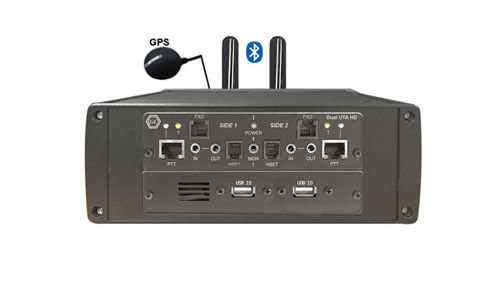
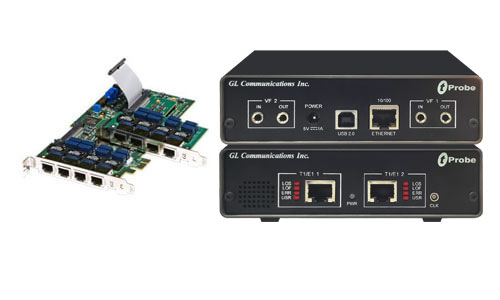
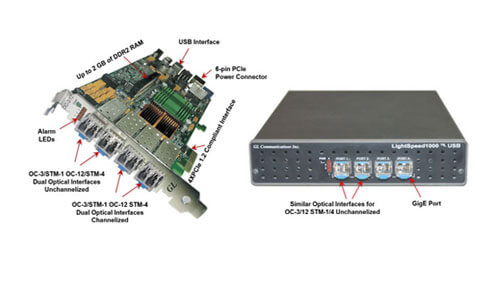
GL's Super T1 and Super E1 Cards can
be used to test echo canceller performance in a wide variety of network configurations, including:
- conventional telephone networks
- networks with satellite connectivity
- wireless networks such as cellular and PCS
Many important performance characteristics discussed and specified in Recommendation G.168 can be easily tested as
well as other important multichannel tests.
Overview of Echo Canceller Testing
Echo Canceller function and location in a network (Figure 1):
See Figure 1
Echo cancellers are placed in networks as shown in Figure 1, intended to cancel the echoes introduced by the nearest
echo path (the nearest 2/4 wire hybrid), also called the tail. Acoustic echoes could also be introduced by end devices such as speakerphones. Generally,
in terrestrial voice networks, there are two echo cancellers in an established voice connection, one at each tail. In cellular networks, there may only
be one echo canceller, canceling the terrestrial tail echo. Most recent echo cancellers are generally digital and operate on multiple channels
simultaneously. Some overall performance parameters concerning echoes in a network are:
- Any connection with a one way delay of 25 ms or greater requires an echo canceller.
- A talker requires that any echo heard in the earpiece be at least 46 to 54 dB below his/her own speech level.
Echo Canceller functions (Figure 2 and 3):
See Figure 2
An echo canceller operates on the principle that a portion of the signal in the receive path is reflected with some linear distortion into the send path. DC offsets and frequency
translation are other distortions that may be introduced by the echo path elements. The linear distortion can be estimated and subtracted from the send path. The receive path is transparent.
The send path is digitally processed and not transparent. The echo estimation process is constantly adapting to the echo path (which could be changing with time) through a
feedback process. During double talk, the adaptation process is frozen.
See Figure 3
Echo Canceller Testing (Figure 4):
See Figure 4
A generalized block diagram for echo canceller (EC) testing is provided in Figure 4. A variety of stimulus signals
can be injected into the Receive Input of the EC. The echo path can be modeled at near end using DSP techniques. The input and output of the EC may be captured for post analysis.
Echo path stimulus with recording (Figure 5a):
See Figure 5a
This script permits the continuous transmission of any file (Composite Source Signal (CSS) is shown) into the receive input of the EC. Simultaneously, the send output and the receive input is continuously recorded for post analysis. A program such as Spectra Plus or Adobe Audition
can be used to display the waveform in synchronism. The file transmission can be preceded with signalling, such as may be required for setting up a call.
Echo path stimulus with real time power monitor (Figure 5b):
See Figure 5b
This script permits the continuous transmission of any file (Composite Source Signal (CSS) is shown) into the receive input of the EC. Simultaneously, the send output and the receive input levels are continuously measured and displayed on the screen. This script may be used to observe the EC performance in real time.
Typical echo path impulse response (Figure 5c):
See Figure 5c
An impulse response such as showncan be captured by transmitting into the receive input of an EC, a file with impulse spikes at regular intervals. Such a file, 'impulse.pcm' has been provided.
Simulation of Echo Path (Figure 6):
See Figure 6
Simulation of the echo path involves, simulating the hybrid reflection and loss and the transmission delay of the echo path. This can be conveniently done using buffering and DSP techniques.
Scripts that perform these functions on single and multiple channels are provided.
Double Talk Simulation with Single Echo (Figure 7):
See Figure 7
Echo cancellers must be able to detect double talk quickly and disable the non-linear processor in the send path.
To simulate this condition, a double talk speech file has been provided, that can summed into the echo path.
Echo path simulation with VF Channel (Figure 8):
See Figure 8
An analog connection can be connected during the simulation of the echo path for testing live analog connections such as speech, modem, fax, etc.
Double talk simulation with multiple echo paths (Figure 9):
See Figure 9
Complex and composite echo paths are illustrated (Figure 10):
See Figure 10
Description of G.168 TestsScripts are being developed to test the following Recommendation G.168 test. Contact GL Communications for latest status.
Test No. 1 - Steady state residual and returned echo level test:
This test tests the general performance of the echo canceller for ERL's of greater than 6 dB and input levels in the range of - 30 dBmO to 0 dBmO (hereafter referred to as normal input levels).
With the NLP disabled, the echo canceller should provide an additional 25 to 30 dB of loss through cancellation. With the NLP enabled, the return level should be less than -65 dBmO for most input levels.
See Screenshot of Test No 1
See Screenshot of Test No 1 - pic2
Test No. 2 - Convergence tests:
Tests the convergence time of the echo canceller for normal input levels and ERLs. Three cases are identified:
Test 2A
Convergence test with NLP enabled - Essentially, within 1 sec (plus the echo path delay), the return level should be as specified in Test No.1.
See Screenshot of Test No 2A
Test 2B
Convergence test with NLP disabled - Within 1 sec (plus the echo path delay), the loss due to cancellation and the echo path should exceed 16 dB.
See Screenshot of Test No 2B
Test 2C
Convergence test with background noise - A background noise source is added to the return path at a level 15 dB below the incoming signal level. With the NLP disabled the convergence time
should be less than 1 sec with returned levels at least 15 dB less than the applied signal level. A criterion has not been established for this case with the NLP enabled.
See Screenshot of Test No 2C
Test No. 3
Performance under conditions of double talk:During conditions of double talk, the echo canceller should continue cancellation. However, should not change
its echo path model so as to introduce distortions such as clipping and noise contrast. Three test have been identified:
Test 3A
Double talk test with low near end levels
See Screenshot of Test No 3A
Test 3B
Double talk test with high near end levels
See Screenshot of Test No 3B
Test 3C
Double talk test under simulated conversation
See Screenshot of Test No 3C
Test No. 4 - Leak rate test:
This test measures how rapidly the H register values (impulse response) decay to zero. This test is performed with the NLP disabled. A signal is applied to R(in) to allow the echo canceller
to converge and then is removed (set to idle code ?) for two minutes. The signal is then reapplied and the return level is measured. The steady state level should not have decayed by more than 10 dB.
See Screenshot of Test No 4
Test No. 5 - Infinite return loss convergence test:
This test ensures that the echo canceller does not generate echo in the presence of an input signal if the echo path is momentarily
disconnected, i.e. the echo path loss becomes infinite.The criteria for this test have not been established.
See Screenshot of Test No 5
Test No. 6 - Non divergence on narrow band signals:
This test verifies that the echo canceller remains converged on narrowband signals such as DTMF and single frequency
tone after initially converged on wideband signals such as CSS. Criteria have not been established for this test.
See Screenshot of Test No 6
Test No. 7 - Stability test:
This test verifies that the echo canceller remains stable for narrowband signals such as a single frequency tone. A test tone is applied and the canceller is allowed to converge. The tone is continuously applied, and the residual signal level from the canceller
is measured after two minutes.
See Screenshot of Test No 7
Test No. 8
Non convergence of echo cancellers on specific ITU-T No. 5, 6, and 7 in-band signalling and continuity check tones:Test the echo canceller in the presence of single and dual frequency tones used in signalling systems.
Test No. 9
Comfort noise test:Test to verify that the noise applied to the S(out) port of the echo canceller is equal to the noise seen at the S(in) port of the canceller. The adaptation of the canceller to changing levels of S(in) noise is also tested.
See Screenshot of Test No 9
Test No. 10
Facsimile test under call establishment phase:
Test No. 11
Tandem echo canceller test:Test No. 12 - Residual echo test:
Test No. 13
Performance with ITU-T low bit rate coders in echo path:
Test No. 14
Performance with V.Series low speed data modems:
Other Tests:
A variety of other test performance tests that Recommendation G.168 does not address can also be performed.
Echo path capacity test
This tests the maximum echo path delay that an echo canceller will cancel
Channel by channel tests
This tests each channel for proper echo canceller operation Scripts. There are some specialized scripts that
have been written by GL engineers (using GL's Scripted Control Software Product) that find ready application in the field of echo canceller testing
They are listed in the below table
| Script Name |
Script Description |
| complex.scr |
Performs complex echo generation |
| danterm.scr |
Receive a call from a DMS-250 and then simulate echo path on a single channel |
| dandms.scr |
Send signalling information prior to sending echo canceller stimuli; Send CSS and capture on one board |
| danvf.scr |
Simulate echo path on all timeslots except for one timeslot on which VF Input and VF Output is permitted |
| dan3a.scr |
Simulate echo path on a single channel with double talk source file |
| dan4.scr |
Send tone capture on one board |
| dan2.scr |
Two board configuration: On the first board, send CSS and capture return signal; on the second board, simulate echo loop |
| dan1.scr |
Send CSS and capture one board. Assumes that echo loop simulations are being done on a diferent PC |
| dan7.scr |
Send CSS or QRSS and monitor power on one board |
| dan6.scr |
Send CSS and monitor power on one board |
| dan3.scr |
Simulate echo path on a single channel |
| dan5.scr |
Send impulse train, capture impulse response on one board |
| fanhuang.scr |
|
| dspatten.scr |
Multiple DSP operators; tests multiple channel attenuate operation |
| dsploop2.scr |
Multiple DSP operators; tests multiple channel loop back operation |
| phaserev.scr |
|
| echogen.scr |
Performs complex echo generation |
| dspgenrx.scr |
Multiple DSP operators; tests multichannel dsp operations. Receive channels are processed and sent back out. Channels are generated, processed and sent out also |
| dspdelay.scr |
Multiple DSP operators; test multiple channel delay operation |
| dialtone.scr |
Shows how to generate U.S. dial tone |
| dcoffset.scr |
Show how to introduce a DC offset to any signal |
Glossary of Echo Canceller Terms:
| Echo Canceller Term |
Description |
| acoustic echo |
echo caused by some portion of the speaker output being fed back to the microphone input. |
| automatic level control (alc) |
sometimes performed by echo cancellers if an imbalance in speech levels exists. |
| comfort noise |
noise introduced into the send path to compensate for the total silence produced by the non linear processor action. Sometimes the original background noise may be substituted. |
| composite or complex echo |
the addition of multiple echoes |
| composite signal source |
a test signal used to test echo cancellers consisting of noise, speech and silence periods |
| convergence and convergence time |
the process or time required for the echo canceller to adapt to the echo path |
| echo canceller |
a device used to cancel echoes produced by 2/4 wire hybrids in a telephone network |
| echo path |
a reflection path that causes echo and upon which the echo canceller operates |
| echo path capacity |
a cancellers maximum echo path delay limit |
| echo path delay |
the echo delay seen by the echo canceller |
| echo return loss |
the level of the reflected signal compared to the original signal |
| echo return loss enhancement |
the additional loss introduced into the echo signal by the canceller operation |
| far end |
the side on which the canceller does not operate; the opposite of the near end |
| H register |
the impulse response coefficients stored in the echo canceller |
| leak time |
a measure of the decay of a converged echo canceller |
| near end |
the side upon which the canceller is designed to operate |
| non-linear processor (nlp) |
technique used to eliminate the residual echo |
| receive path |
the path through the echo canceller of the original signal (not the echo signal) |
| residual echo level |
the level of the signal after echo cancellation but before nlp application |
| returned echo level |
the output of the echo canceller |
| send path |
the path upon which the canceller operates |
| sidetone |
the instantaneous echo heard on the phone to provide 'the feel of a live connection |
| talker echo |
the echo heard by the talker when he/she speaks into the phone |
| tone disabler |
in band tones that disable the echo cancellers; may be necessary for some modem connections and signalling. |
Back to Echo Canceller Testing Application Notes Main Page