GL Communications Highlights Comprehensive Ethernet and IP Network Performance Testing with PacketCheck™
Gaithersburg, Maryland, USA – Sep 11, 2026 – GL Communications Inc. – highlights its PacketCheck™ – Software Ethernet/IP Tester, a PC-based solution for generating, analyzing and validating Ethernet and IP traffic across Layer 1 through Layer 4 in LAN and WAN environments.
Ethernet and IP networks must reliably transport traffic while maintaining throughput, packet delivery and low latency. Packet errors, dropped or out-of-sequence frames, network congestion, overloaded switches and routers, and deteriorating physical connections can affect network performance. Engineers therefore require controlled and repeatable testing to evaluate network behavior, identify performance issues and validate network infrastructure.
To address these requirements, GL Communications provides PacketCheck™, which uses a PC’s Network Interface Card to generate controlled traffic, measure network performance and identify packet-delivery and delay issues. The software provides a common test environment for physical connections, Ethernet switches, routers and end-to-end IP networks, supporting direct Ethernet, switched LAN, routed IP, VLAN and MPLS configurations.
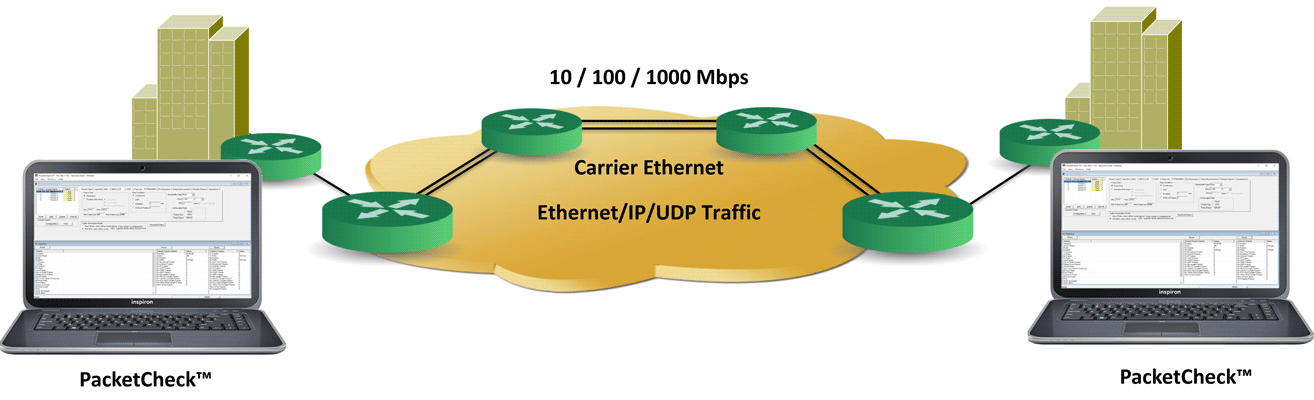
PacketCheck™ supports testing across multiple network layers, including Layer 1 Bit Error Rate Testing (BERT) using PRBS and fixed patterns, Layer 2 Ethernet with configurable MAC parameters and Stacked VLAN, Layer 2.5 Stacked MPLS with up to three MPLS stacks, Layer 3 IP, and Layer 4 UDP, TCP and ICMP traffic generation and analysis.
Vikram Kulkarni, Sales Director of GL Communications, states, “PacketCheck™ generates controlled multi-stream traffic and evaluates Ethernet and IP network performance across multiple protocol layers from a standard PC platform. With comprehensive measurements for bit errors, throughput, packet loss, delay and out-of-sequence traffic, engineers can validate network performance and troubleshoot packet-delivery issues across LAN and WAN environments.”
For realistic network testing, PacketCheck™ generates multiple full-duplex traffic streams with independently configurable MAC, VLAN, MPLS, IP, UDP, TCP and ICMP parameters. Streams can operate in Transmit Only, Receive Only, or Transmit and Receive modes. Fixed, random and statistical frame sizes, configurable Frame Size Buckets with probability distributions, Burst and Inter Frame Gap modes, PRBS and user-defined BERT payloads, jumbo frames, zero-padding and file-based traffic generation provide flexibility to reproduce a wide range of traffic conditions.
PacketCheck™ provides stream-wise and aggregate statistics for measuring Bit Error Rate, Bit Error Count, Tx/Rx throughput, packet counts, Packet Loss, Out-of-Sequence Frames, Errored Frames, Sync Loss, Round Trip Delay and One-Way Delay. Sequence-number tracking, along with configurable Out-of-Order Detection Window and Loss Declaration Timeout settings, helps distinguish genuinely lost frames from delayed or reordered traffic.
For delay testing, Smart Loopback swaps source and destination MAC, IP and UDP information in incoming traffic and retransmits the traffic through the same interface, supporting Round Trip Delay measurements. PacketCheck™ also supports ARP and IP-to-MAC address resolution. Streams can be resolved before testing to populate MAC/routing tables and help avoid unnecessary flooding during Layer 3 testing.
The solution also supports controlled traffic impairments, enabling engineers to evaluate how networks and Devices Under Test respond to error conditions. Users can delete or insert bytes, replace or toggle bits, and apply logical AND, OR and XOR operations with configurable offsets, masks, intervals and durations.
For traffic analysis and repeatable testing, PacketCheck™ can capture traffic in PCAP/PCAPNG or GL proprietary HDL formats, replay previously recorded traffic, record received payloads, generate BERT diagnostic logs and capture unidentified traffic through a Default Stream. Captured traffic can be further analyzed using Wireshark® or GL’s PacketScan™.
PacketCheck™ also provides flexible reporting for both completed and long-duration tests. Complete test results can be generated in PDF format, while periodic CSV reports capture stream statistics at configurable intervals. Flush, Split and Combined Periodic Report options simplify management and analysis of results from extended and multi-stream tests.
PacketCheck™ is suited for Ethernet and IP network performance testing, bandwidth assessment, switch and router testing, bit error and throughput measurement, packet loss and delay analysis, Stacked VLAN and MPLS validation, Layer 3 and Layer 4 network testing, controlled impairment testing, traffic capture and replay, and LAN/WAN troubleshooting. MFR-IP-PacketCheck™ additionally generates and receives IP traffic over Frame Relay links with multiple Virtual Channels.
 Back to Press Releases Index Page