|
 |
 |
 |
 |
|
|
 |
|
 |
 |
 |
| |
|
 |
|
Home > Latest News
Welcome to another October issue of GL Communications' Newsletter. This newsletter provides a quick overview of voiceband
codecs and how they differ in voice quality. It also describes additional features added to GL's Packet Test Tools
PacketScan™ and RTP Toolbox™.
Do you know your Codecs?
The word "codec" is a compression of the two words "coder decoder" and is used to identify a voice compression algorithm.
Engineers are always looking to transmit or store voice in the least bandwidth or space - thus the need for more sophisticated
codecs. Applications include:
- Wireless networks where efficient use of scarce frequency spectrum is important
- VoIP networks where packetized and compressed voice is used to transmit over the World Wide Web
- PCs, MP3 players, and mobile phones where codecs are used to store and play music
Many codecs have been added to GL's Packet Test Tools:
PacketScan™ and RTP Toolbox™ as well as many enhanced
features:
- more codecs (wideband and narrowband)
- more voice quality support with trigger actions on poor voice quality
- more signal processing functions
- ability to capture poor calls and transmit them by e-mail for analysis
- and video support
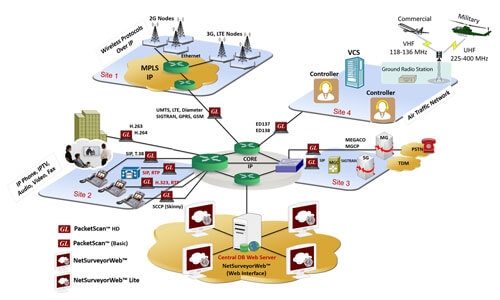
GL's PacketScan™ is a real-time VoIP analyzer that non-intrusively captures live IP traffic, and segregates them into
SIP /H323 / Megaco / MGCP calls and collects statistics about the calls. Applications include monitoring of IP phones, Gateways,
IP Routers, Switches, and Proxies. Its real-time nature makes it an outstanding tool for live monitoring of VoIP traffic as well as
long-term traffic statistics gathering.
GL's RTP Toolbox™ is an application that is used to create, monitor, analyze, and terminate multiple RTP traffic streams
(sessions). Its graphical nature makes it perfect for detailed analysis of signal processing elements in VoIP networks. The
Command Line Interface (CLI) for RTP Toolbox makes it ideal fit for automated testing of Media Gateways, ATAs, Echo
Cancellers, and other signal processing devices in VoIP networks.
A brief summary of the new features and enhancements introduced to RTP Toolbox™ ver 1.33 are:
- R factors / MOS now supported for more codecs
R factor is a non-intrusive voice quality rating factor
based on the quality of packet flows. Its voice quality score is based on various network parameters, including codec type,
packet loss, packet jitter, and packet delay. Mean Opinion Scores (MOS) are calculated using the ITU-T G.107 E-Model to
determine the transmission-rating factor (R-Factor).
R factors/ MOS is now supported for more Audio and Video codecs including:
- Mulaw and Alaw - widely used codecs in TDM telephony
- ADPCM family of codecs - G726 (40 kbps), G726 (32 kbps), G726 (24 kbps), and G726 (16 kbps)
- GSM610 - widely used in GSM wireless networks
- G729, G729B - widely used VoIP codec
- AMR - Adaptive Multi-Rate, widely used wireless codec in GSM and 3G networks
- ILBC (20 msec), ILBC (30 msec) - Internet Low Bit Rate Codec is a royalty free codec developed by
Global IP Sound
- Speex NB
A more comprehensive list of codecs and their details with respective voice quality is provided at this link
Codec Listings.
- ILBC codec is supported for 20 ms and 30 ms packet size
The iLBC (Internet Low Bit Rate Codec)
codec enables graceful speech quality degradation in the case of lost frames, that occur due to lost or delayed IP packets.
This codec is suitable for real time communications such as, telephony and video conferencing, streaming audio, archival
and messaging. The iLBC codec is an algorithm that compresses each basic frame (20 ms or 30 ms) of 8000 Hz, 16-bit
sampled input speech, into output frames with rate of 400 bits for 30 ms basic frame size and 304 bits for 20 ms basic
frame size. The codec supports two basic frame lengths: 30 ms at 13.33 kbit/s and 20 ms at 15.2 kbit/s, using a block
independent linear-predictive coding (LPC) algorithm.
- Option to Monitor user-defined tones in the Command Line Interface (CLI) in addition to the standard dual tones
This feature allows the users to define their own tones. By specifying low and high frequencies, the user can
monitor the defined tones. The user can also perform a particular action depending upon the tones detected, as is done in
IVR applications. The different types of tones that can be generated using the application are:
- User defined tones
- Standard tones - mf digits, dtmf digits, mfc-r2 forward digits, mfc-r2 backward digits
- Single tones of single frequency
- EVRC codec now supports Header Free Packet Format and the default Bundled Packet Format in the GUI and CLI
- The Header-Free Packet Format
The Header-Free Packet Format is designed for
maximum bandwidth efficiency and low latency. Only one codec data frame can be sent in each Header-Free format packet.
- The Default Bundled Packet Format
A bundled/interleaved format is included to reduce
the effect of packet loss on speech quality and spread the overhead of the RTP header over more than one speech frame.
- G.722 Wideband codec support
G.722 Speech coding with a wider bandwidth than that offered in
telephony results in major improvement in represented speech quality. G.722 wideband speech coding algorithm supports bit rates
of 64, 56 and 48 kbps. Its overall delay is around 3 ms, and is small enough to protect echo problems. In addition, the codec provides
acceptable performance even with bit error rates up to 10E-3. This requirement ensures that performance degrades gently even
under the worst transmission conditions that one may encounter in a telecommunications network.
For more information about GL's RTP Toolbox™ click here.
A brief summary of the new features and enhancements introduced to PacketScan™ ver 2.0.32 are:
- Supports WinPcap 3.1
WinPcap is the industry-standard tool for link-layer network access in Windows
environments. It allows applications to capture and transmit network packets bypassing the protocol stack, and has additional
useful features, including kernel-level packet filtering, a network statistics engine and support for remote packet capture.
- R factors/MOS supported for more codecs
R factors/MOS is now supported for more audio and video
codecs: Mulaw, Alaw, G726 (40 kbps), G726 (32 kbps), G726 (24 kbps), G726 (16 kbps), GSM610, G729, G729B, AMR,
ILBC (20 msec), ILBC (30 msec) and SPEEX.
- EVRC and ILBC Codec support
EVRC codec supports both header free and bundled packet format
and ILBC supports both 20 msec and 30 msec packet size.
- Record audio and video data of a session to a file in QuickTime format
PacketScan™ can monitor
video calls and display both audio and video RTP streams in summary view. There is a provision to view video calls using a filter.
Users can record video calls to a file in QuickTime format, which can be viewed by VLC player. Record video option is available
for both Auto Detected RTP Calls and SIP Calls. Supported Video Codecs are:
- H263+
- H263++ CIF 190 kbps
- H263++ CIF 350 kbps
- H263++ CIF 512 kbps
- H263++ QCIF 128 kbps
- H263++ QCIF 64 kbps
- H263++ QCIF 80 kbps.
H.263 - is a video codec designed by the ITU-T as a low-bit rate encoding solution for videoconferencing.
It was first designed to be utilized in H.324 based systems (PSTN and other circuit-switched network videoconferencing and
videotelephony applications), but has since found use in H.323 (RTP/IP-based videoconferencing), H.320 (ISDN-based
videoconferencing), RTSP (streaming media) and SIP (Internet conferencing).
H.263 was developed as an evolutionary improvement based on experience from H.261, the previous ITU-T standard for
video compression, and the MPEG-1 and MPEG-2 standards.
QCIF - Quarter Common Intermediate Format, a videoconferencing format that specifies data rates of
30 frames per second (fps), with each frame containing 144 lines and 176 pixels per line. This is one-fourth the resolution
of Full CIF.
CIF - A video format used in videoconferencing systems that specifies a data rate of 30 frames per
second (fps), with each frame containing 288 lines and 352 pixels per line.
- Triggered Actions and E-mail Support
PacketScan™ has the ability to send e-mails based on a
trigger such as "poor MOS score" on a call. Details of a call such as the call setup protocol details and the captured audio
that transpired on the call can be sent as an attachment to the e-mail.
- PacketScan™ as part of a Network Management System
PacketScan™ has the ability to send
via TCP/IP all collected "traffic summary" data such as CDRs, MOS, jitter, gap, and other useful statistics to a central
database as part of a Network Management System. This feature makes PacketScan™ very powerful indeed as the
performance of an entire VoIP network can be readily assessed and monitored in realtime.
For comprehensive information on GL Communications' PacketScan™ click
here.
Back to Latest News Page
|
| |
|
 |
|
|
 |
|