Related Links
DCOSS SS7
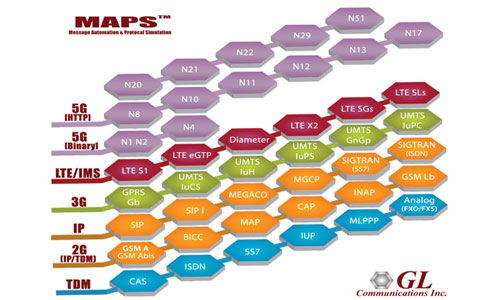
The following are available protocols for the DCOSS system.
Within each protocol, the DCOSS user interface allows all protocol parameters, protocol setup
parameters as well as call setup parameters to be configured by the user. Thus, a user may
completely change the configuration for a given protocol, induce protocol errors or protocol
violations, as well as create a completely new configuration for a given protocol. This allows
great flexibility within a specified protocol. It should be noted, however, that the protocol
configurations delivered with the DCOSS system are certified for a specific network/country and
may not be modified. However, the certified configurations may be copied.
- CAS T1/E1
- R1 (WINK)
- T1 Loopstart
- T1 Ground Start
- T1 Feature Group D
- T1 Immediate Start
- E1 MFC-R2
Certified Countries Available: Argentina, Bahrain, Bolivia, Brazil, Chile, China, Columbia, Czech Republic, Honduras, Indonesia, Korea, Malaysia, Mexico, Panama, Philippines, Singapore, Thailand, and CCITT
- E1 Digital European CAS (Italy, Netherlands, Sweden)
- E1 Digital E&M (Brazil and Indonesia)
- E1 International Wink Start
- User-Configurable State Machine
- SS7 Signaling - MTP 1-3, ISUP, TUP, TCAP/SCCP, and SCP
- PRI ISDN (Europe, USA, Asia)
| Europe |
France Telecom VN6 (ETSI) EuroISDN (Available countries: Austria, Denmark, Finland, Greece, Iceland, Ireland, Italy, Liechtenstein, Luxembourg, Netherlands, Norway, Portugal, and Spain) Belgium, China, Great Britain, Sweden, Germany, Singapore, European QSIG |
| USA |
(includes ISDN-NFAS) Northern Telecom DMS 100 AT & T 5ESS10 AT&T 4ESS US National ISDN2 (BellCore) USA QSIG |
| Asia |
Australian Telecom 1 Hong Kong Telephone Nippon Telegraph Telephone Korean Telecom |
- GR-303
- SS5
- No Call Control
Additional Protocol Information
Go to SS7 Page
SS7 is a very flexible, yet complex signaling protocol.
Establishing a working link(s) as well as placing simple and complex calls is not always
easily accomplished. DCOSS SS7 provides the required flexibility to handle all your SS7
requirements.
Screenshot of SS7 Protocol Parameter Configuration
The DCOSS SS7 may be configured as either an SSP, STP
(allows SSP as well as STP operation simultaneously), or SCP. From 4 to 16 SS7 signaling links may be defined
by the user per SS7 board. These signaling links may either be user-defined timeslot/trunk associated with any
of the DCOSS digital trunks, timeslots associated with the optional SS7 Dual T1/E1 trunk interface, or
up to three links with the optional V.35 interface. If either the optional SS7 T1/E1 trunk
interface or the optional V.35 interface is used, all other digital trunks associated with
DCOSS (up to 16 trunks) will be capable of handling the SS7 voice channels.
Each user-defined SS7 signaling link also has a linkset
association. Multiple SS7 signaling links may share a single linkset, thus providing SS7 link
redundancy.
SS7 calls are identified using a Circuit Identification
Code (CIC). The CIC may be an arbitrary value. DCOSS SS7 allows the user to custom associate a
CIC to a timeslot/trunk and thus create a circuit to timeslot mapping table.
In addition to the link parameters and CIC mapping
(as described above), all parameters, required for SS7 messages, may be modified within DCOSS.
MFC-R2
The following are all parameters associated with the MFC-R2
protocol. These parameters may be modified and saved, within the DCOSS database, under a
user-defined configuration.
Screenshot
of MFC-R2 Protocol Parameter Configuration
Flow Control Parameters
Expected Number of DID digits
Expected Number of ANI digits
Number of DID before ANI
Calling Party Category
Ring/Busy Control
Ring Frequency 1 (Hz)
Ring Frequency 2 (Hz)
Ring ON-Time
(ms)
Ring OFF-Time1 (ms)
Ring OFF-Time2 (ms)
Busy Frequency 1 (Hz)
Busy Frequency 2 (Hz)
Busy ON-Time (ms)
Busy OFF-Time (ms)
Ring/Busy Tone Ampl (IDU)
Compelled Tones Ampl
(IDU)
Compelled/Flow Control Timers
Compelled Timers (sec)
Forward Tones Max ON-Time
Forward Tones Max OFF-Time
Inbound Compelled Cycle Timer
Flow Control Timers (msec)
- Inbound, Release Guard Time
- Inbound, Line Qualification Timers
- During Idle
- During Compelled Sequence
- During Connected
- Outbound, Line Qualification Timers
- During Idle
- During Compelled Sequence
- During Connected
- Outbound, Seizure Acknowledge Time
- Outbound, Max Time before receipt of Group B backward tone and call answered (sec)
- Outbound, Max Time between generation of Group II forward tone and detect Group B backward tone
- Outbound, Time in which clearback, seen by outbound, is treated as remote hangup
Re-Answer Pulse (msec)
Time to wait for Re-Answer Pulse
Length of Re-Answer
Pulse
Compelled Tones
Compelled Tones (select appropriate tone)
- Backward Group A Tones
- Send next DID
- Send Group I category
- Send next ANI
- Send Group II tone (switch to Group B tone)
- Backward Group B Tones
- Indicate congestion
- Indicate unallocated number
- Indicate busy
- Indicate line out of order
- Forward Tones indicating end or non-availability
- End of DID
- End caller's category
- End of ANI (caller id avail)
- End of ANI (caller id restrict)
- Backward Tones indicating acceptance of call
- Call accepted in Group B (charge)
- Call accepted in Group B (free)
- Call accepted in Group A
- Alternative tone for call accepted in Group B
- Request or Indication Tones
- Outbound tone in Group II
- Default User Category (Group I)
- After Category I, no ANI's avail
- Backward Group B tone to reject incoming call
- Backward Group A Tones
- Repeat DID N-1
- Repeat DID N-2
- Repeat DID N-3
- Repeat all DID's (restart dialing)
- Backward Group C Tones (when collecting ANI's)
- Rquest outbound to send DID's; send next DID
- Rquest outbound to send DID's; repeat last DID
- Inbound request the nature of the circuit
- Inbound request if half-echo suppressor needed
- Forward Group A tones that outbound plays
- No satellite link in circuit
- Satellite link in the circuit
- Half-echo suppressor needed
Signaling Flags/Mask
Signaling Flags (On/Off)
- Bit C - ON
- Bit D - ON
- Expect Metering Pulses on the A-Bit
- Expect Metering Pulses on the B-Bit
- Expect Metering Pulses on the C-Bit
- Inbound Clearing Back signaled by a Release Guard
- Half-Echo Suppression is needed in international
- Bit Information
- Ignore Bit Faults during Ring
- Detect and Abort the Call
- Next DID does not come
- Pulse Congestion
- Pulse Request for Group II Tone
- Length of Delay after Outbound Protocol hangs up before place new call
- No delay
- 400 ms delay
- 700 ms delay
- 1000 ms delay
- Type of Bit Detector (definition of simultaneously bit transitions on a line)
- Zero
- 5 ms
MFC-R2 Mask
Valid DID Tones in target country
Valid ANI Tones in target
country
Valid Category Tones in target country
Valid Group II Tones in target country
Category Tones that imply no ANI follows
Back to Digital and Analog Call Simulation Index Page