Design of Climate Controlled Outdoor Communications Cabinets
Overview
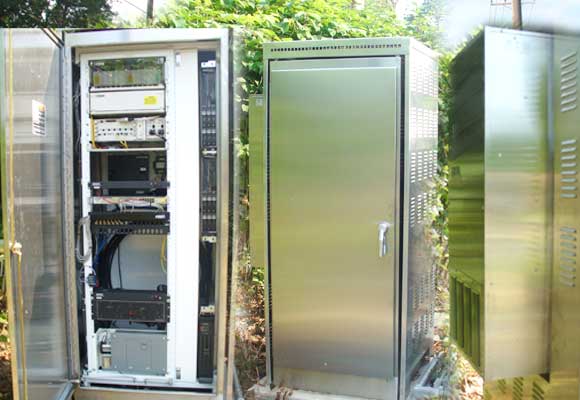
GL has designed climate controlled outdoor cabinets that house sophisticated electronic equipment, such as computers and servers consisting of microprocessors, fiber optic devices, Ethernet routers and switches, UPS units, and other semiconductor components. These electronic systems and components are very susceptible to high temperatures and high humidity. Overheating and condensation inside the cabinet would shorten their life expectancies and cause major failures. Hence, they require an environment controlled for heat and humidity for proper functioning.

Technology
Technologies available for controlling the environment inside the cabinets are:
- Fans/blowers
- Heat exchangers
- Air conditioners
Fans/blowers:
A simple forced-air cooling system utilizing ambient air is usually adequate in clean, non-hazardous environments having acceptable ambient temperatures. Fans or blowers, combined with a low-cost air filter, would meet the heat removal needs of typical electronic and electrical equipment. Some guidelines to select fans or blowers:
- Fans may be used if ambient cooling air can be used and the system has a low static pressure
- Blowers may be used if ambient cooling air can be used and the system has a higher static pressure
Heat exchangers and air conditioners:
Selection of a particular type is site and application specific. Some guidelines to select the right type:
- Heat exchangers may be used if the temperature inside a cabinet can be allowed to remain moderately higher than the ambient
- Air conditioner may be used if the temperature inside a cabinet needs to be equal to or lower than the ambient
A heat exchanger consists of a fluid-filled heat pipe' assembly while an air conditioner is typically a freon type. Heat exchanger units are only good for very minor cooling needs, for cabinets equipped with relatively small amount of heat dissipation, and in moderate climates. Even with minimal equipment installed inside a cabinet, a heat exchanger would not come close to cooling it adequately when outside temperature is in the 80s (°F). The heat exchangers do not provide sufficient cooling in a hostile environment even when combined with fans, blowers, sun-shields etc., and air conditioners provide a good alternative solution.
Factors to Consider
Designing a climate controlled, modern-day communications cabinet is complex and requires extensive knowledge and experience. Some factors that go into design considerations are:
- Size and type of communications equipment
- Equipment placement inside cabinet
- Mounting systems for the equipment
- Total estimated power dissipation
- Site location requirements
- Proper grout sealants and conduits
- Protection standards, grounding, etc.
- Environment (climate, sun-loading)
- Type of thermal and humidity management
- Electromagnetic interference
- Security systems and access
- Remote monitoring and control
- Materials
- Accessories
GL's Solution
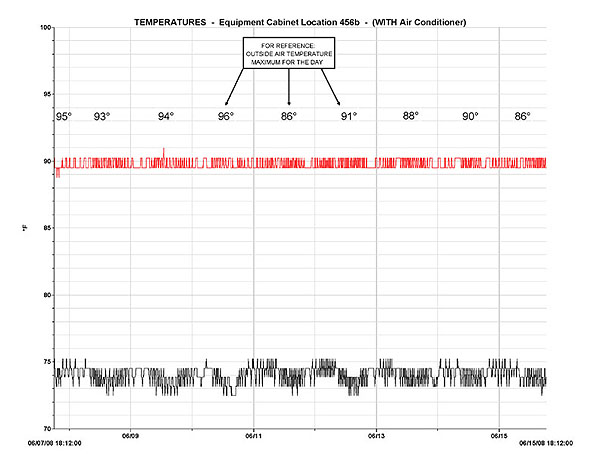
Using the information gathered during the above study, along with our knowledge and experience, GL's engineers have designed and specified climate controlled outdoor cabinets. Figure 2 shows the temperatures inside a typical GL-designed climate controlled outdoor cabinet. The graph shows that the air temperature near the top of the cabinet interior, shown in black, stays very close to 73°F, even when the outside temperature reaches 96°F. The temperature near the hot fan exhaust of a high power dissipation fiber optic communications chassis, shown in red, stays nearly constant close to 90°F, which is perfectly acceptable. GL's climate control solution has, thus, insured that our customers' communications links remain highly reliable even under adverse weather conditions.