Echo Canceller Testing
Voice Quality Enhancement Testing
Voice Quality Testing
Request a Quote
EC Testing - TDM Brochure EC Testing - VoIP Brochure
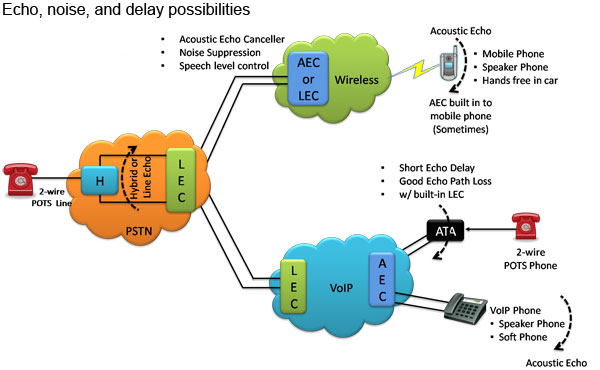
Overview
GL Communications has the broadest range of testing solutions for echo cancellers (EC). We also offer testing services for compliance testing per G.168.
Our hardware platforms for testing EC software can be PCIe T1 E1 Cards, or the tProbe™ T1 E1 Units, or Ethernet, or no hardware whatsoever.
- For testing ECs in a TDM environment
- Simulating & Monitoring Acoustic Echo Cancellation as per G.167 and P.340 Standards - TDM Wireless
- For testing ECs in a VoIP environment
- Simulating & Monitoring Acoustic Echo Cancellation as per G.167 and P.340 Standards - VoIP
- For testing your developmental EC software without any hardware
- For Voice Quality Test Solutions per G.160 and G.169
- For Active Voice Level and Noise Level Monitor
- For monitoring voice band network traffic
- For manipulating the input audio (tones, and voice) files with impairments
- Recommended Accessories and Training Packages
Testing Services for G.168 Compliance - we can test, document, and certify your product. Call us at +1 301 670 4784.
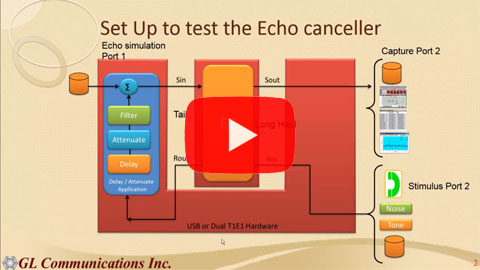
TDM (or Analog) EC Testing Solutions
- TDM Solution 1. Network Monitoring of Hybrid Echo and Voice Quality
- The Voice Band Analyzer (VBA) is an analysis tool for monitoring the quality of voice band traffic (including hybrid echo) over VoIP, TDM and wireless networks
- VBA works in conjunction with GL's TDM, Packet, and Wireless non-intrusive capture products, such as T1 and E1 Call Capture and Analysis, VoIP PacketScan™, and GSM, CDMA, and 3G Call Capture Products. VBA instantly detects voice file captures and with appropriately installed analysis modules, monitors speech levels, noise levels, and hybrid echo. Other analysis modules such as ITU-T P.561, P.562, P.563, fax and modem analysis, and many others can be hosted as plug-ins
- The VBA application can also operate on pre-captured files. It supports A-Law, µ-Law, 16-bit PCM (Intel), 16-bit PCM (Motorola) and MS Wave file formats
- Required software VBA032 at each probe location and PKV170 Network Surveillance Software
- Required hardware - 1U rack PC with sufficient hard disk for capturing over 10,000 calls (80 GB HD) for each VBA colocated with a probe
- Additional hardware - T1 E1 analyzer platforms with Call Capture Analysis Software
- TDM Solution 2. For Quick Testing and Verification of EC Performance
- User Friendly GUI Based Software that simulates delay, loss, double-talk, noise, and other impairments for all timeslots on T1 or E1 systems or analog interfaces - uses xx062 Echo Path Delay/Loss Simulation Software
- Required software xx062 and xx020
- Additional recommended software xx063, xx065, and xx066
- TDM Solution 3. For Accurate Field Characterization of Echo Paths, Impulse Responses, Delay, and Loss Statistics
- A true EC that models the echo path characteristics including a graphical impulse response, echo path delay, echo path loss, and other useful statistics. Can be used to actually cancel echo in a live circuit
- Uses xx066 Digital Echo Canceller Software
- Record / Playback Software xx020
- Additional recommended software xx062 and xx063
- TDM Solution 4. For Field Measurement of Echo Return Loss and Echo Loop Delay
- Allows intrusive and non-intrusive measurement of Echo Return Loss (ERL) and Echo Path Delay (EPD) - uses xx063 Echo Path Delay / Loss Measurement Software. This method of characterization uses correlative method and is not as accurate as xx066 software. Required software xx063, xx062, and xx020
- Additional recommended software xx066
- Alternative solution is a offline assessing tool for different echo types (sidetone, line, and acoustic echo) along with non-intrusive measurement of Echo Return Loss (ERL) and Echo Path Delay using GL's Echo Measurement Utility (EMU037). Recommended software are
- For Mobile Phones - VQuad™ with Dual UTA HD
- For TDM - VQuad™ with T1 E1 analyzer platforms
- For 4Wire - VQuad™ with Dual UTA HD
- Application Note - Measuring Delay and Loss Over Circuit and Packet (VoIP) Networks
- TDM Solution 5. For Live Monitoring of EC Operation
- Monitor Rin, Rout, Sin, and Sout signals in real-time, displaying signal power and the waveform amplitude - uses xx017 Real-Time T1 E1 Multi-Channel Audio Bridge. This solution is only available with our legacy PCI cards. Please call to discuss. Required software xx017 and SA026. Additional recommended software xx020, xx062, and xx066
- TDM Solution 6. EC Compliance Testing per G.168 Using Manual Methods
- GL's Manual Test Suite for testing compliance of ECs with G.168 provides the ultimate flexibility for almost any type of network environment and configuration. Tools are provided for thorough G.168 compliance testing including hybrid simulation, application of stimulus, capture of response, and graphical analysis of response. Required software xx020, xx065, xx062. Additional recommended software xx063 and xx066
- TDM Solution 7. Fully Automated EC Compliance Testing per G.168 Standard
- User Friendly GUI to configure and run thousands of test cases for all possible variations of echo path loss, delay, hybrid filters, etc. Automatically provides test case -by- test case results in easy to understand "pass" or "fail"
- Uses xx067 Automated Echo Canceller Testing Software - and includes xx019 Tx/Rx File Utility or xx600, xx610, and xx630 WCS components
- Consult with GL design choices
- Other recommended software
- Delay Attenuate Software (xx062)
- Echo Path Measurement Software (xx063)
- Digital Echo Canceller Software (xx066)
- Record / Playback Software (xx020)
- Manual G.168 Compliance Test Suite (xx065)
- TDM Solution 8. For Semi-Automated and Scripted EC Testing
- Simple modifiable scripts to run each and every G.168 test - uses xx068 Semi-Automated and Scripted Echo Canceler Testing Suite - included are the following WCS components xx600, xx610, and xx630 and Matlab, C++, or LabView Clients
- Additional recommended software xx020, xx062, and xx066
- TDM Solution 9. For Testing Developmental EC Software (w/o Hardware)
- Automated EC Testing software can be used to verify compliance of developmental EC software to G.168 standards -uses a specially configured xx067 Automated Echo Canceller Testing Software
- TDM Solution 10. For End-to-End Subjective Testing
- Simulate a real network with echo paths at one or both ends. Also simulate bulk transmission delay. Requires two dual T1 or E1 cards (4 ports) and xx062 and SA008a.
- TDM Wireless Solution 11. Simulating & Monitoring Acoustic Echo Cancellation as per G.167 and P.340 Standards - TDM Wireless
- This software is designed to test the Acoustic Echo Cancellation of the following per G.167, including
- Simulate acoustic echo into modules such as a Sound Card, a Mobile Phone, a Regular Phone, an IP Phone, or a Speaker Phone
- Generate dynamic (changing) acoustic echo
- Test acoustic echo cancellers in mobile phones and other signal processing devices
- Acoustic filter types includes Static and dynamic kinds of Small Office, Medium Office, Large Office and room impulse response (RIR) generator based on room parameters
- Levels for pseudo speech, Echo path delays and losses
- Dynamism is incorporated into DSP operators within our Windows Client Server (WCS) software, which allows real-time testing using DSP commands to perform functions such as Amplification/Attenuation, Delay, Filter, File Tx/Rx, Logical operations, Echo Cancel, and so on.
- Automated AEC testing concepts are implemented within the software for various End to End Applications (Mobile & TDM) scenarios
- Stimulus / Simulation all Digital (TDM Applications)
- Stimulus / Simulation all Analog (Mobile Phone Applications)
- The following components are either required or recommended
- XX600 - Basic Client/Server Scripted Control Software (included)
- Any of the T1 E1 analyzer platforms
VoIP EC Testing Solutions
- VoIP EC Networking Solution. Network Monitoring of Hybrid Echo and Voice Quality
- The Voice Band Analyzer (VBA) is an analysis tool for monitoring the quality of voice band traffic (including hybrid echo) over VoIP, TDM and wireless networks
- VBA works in conjunction with GL's TDM, Packet, and Wireless non-intrusive capture products, such as T1 and E1 Call Capture and Analysis, VoIP PacketScan&trade, and GSM, CDMA, and 3G Call Capture Products. VBA instantly detects voice file captures and with appropriately installed analysis modules, monitors speech levels, noise levels, and hybrid echo. Other analysis modules such as ITU-T P.561, P.562, P.563, fax and modem analysis, and many others can be hosted as plug-ins
- The VBA application can also operate on pre-captured files. It supports A-Law, µ-Law, 16-bit PCM (Intel), 16-bit PCM (Motorola) and MS Wave file formats
- Required software PKV100 and VBA032 at each probe location and PKV170 PacketScanWEB - Network Surveillance Software
- Required hardware - 1U rack PC with sufficient hard disk for capturing over 10,000 calls (80 GB HD) for each VBA colocated with a probe
- Additional hardware - PC for PKV100 PacketScan™ Software
- VoIP Solution 1. Manual G.168 EC Compliance Testing of ATAs and Gateways with Two Wire Interfaces
- This solution permits testing ECs from the IP side for general performance and compliance to G.168. It is applicable to testing ECs within Gateways or ATAs (Analog Telephone Adapters). Uses PKB100 - RTP Toolbox™ software and PKB105 - G.168 Manual Compliance Test Suite with GLC View software
- When testing ATAs, echo path delay (EPD) and echo path loss (EPL) may not be controllable due to being embedded in the ATA or Gateway
- VoIP Solution 2. Manual G.168 EC Compliance Testing of ATAs and Gateways with T1 E1 Interfaces
- This solution permits testing ECs from the IP side for general performance and compliance to G.168. It is applicable to testing ECs with Gateways or ATAs when there is a T1, E1, or 4-wire analog interface at the TDM side. In this case, and due to the T1, E1, or 4wire analog interfaces, the echo path loss (EPL) and echo path delay (EPD) are full controllable with the delay / attenuate software
- Uses the following components:
- PKB100 - RTP Toolbox™ software
- PKB105 - G.168 Manual Compliance Test Suite with GLC View software
- Any of the T1 E1 analyzer platforms
- Delay Attenuate Software (xx062)
- Record / Playback Software (xx020)
- Manual G.168 Compliance Test Suite (xx065)
- Additional recommended software xx063 and xx066
- Uses GLC View to manually analyze and verify G.168 compliance
- VoIP Solution 3a. Automated G.168 EC Compliance Testing of ATAs and Gateways - All IP Solution
- This solution permits automatic testing of ECs from the IP Side, but some special conditions apply. It requires that Rout and Sin be available thru the IP interface. In general, this solution may not apply to most ATAs and Gateways. However, if Rout and Sin are available thru the IP interface, than full compliance testing of the EC and complete simulation of the EPD and EPL is possible
- The following components are either required or recommended
- PKB100 - RTP Toolbox™ software
- PKB067 - AutoECTest - Automatic G.168 Compliance Test Suite
- PKBxxx - RTB Toolbox™ Server software and Command Line Software
- VoIP Solution 3b. G.168 EC Compliance Testing of Gateways - TDM / VoIP Interfaces
- Automated testing of all G.168 cases
- Echo Path Loss (EPL), Echo Path Delay (EPD), and hybrid dispersion fully controllable in T1 E1 card
- Use of RTP ToolBox™ (PKB100) and Client-Server (PKB110) for automation on IP side
- Use of Windows Client Server (xx600, xx610, and xx630) for automation on TDM side
- Any of the T1 E1 analyzer platforms
- Use of Windows Client Server (xx600, xx610, and xx630) for automation on TDM side
- Automatic procedures are very similar to the procedures provided at Fully Automated EC Compliance Testing per G.168 for TDM systems
- Test ECs in Gateways
- VoIP Solution 4. Automated G.168 EC Compliance Testing of Gateways - Back to Back Gateway Solution
- This solution permits automatic testing of ECs from the TDM side, but in back to back Gateway configuration
- The following components are either required or recommended
- Any of the T1 E1 analyzer platforms for the TDM interface
- xx067 AutoECTest - Automatic G.168 Compliance Test Suite with either Windows Client Server (WCS) software or Tx/Rx File Utility software
- Other recommended software
- Delay Attenuate Software (xx062)
- Echo Path Measurement Software (xx063)
- Digital Echo Canceller Software (xx066)
- Record / Playback Software (xx020)
- Manual G.168 Compliance Test Suite (xx065)
- Additional recommended software xx063 and xx066
- VoIP Solution 5. For Field Measurement of Echo Return Loss and Echo Loop Delay
- This solution includes a offline assessing tool for different echo types (sidetone, line, and acoustic echo) along with non-intrusive measurement of Echo Return Loss (ERL) and Echo Path Delay using GL's Echo Measurement Utility (EMU037)
- Application Note - Measuring Delay and Loss Over Circuit and Packet (VoIP) Networks
- The following components are either required or recommended
- For VoIP - VQuad™ or RTP Toolbox™
- For 2Wire - VQuad™ with Dual UTA HD
- VoIP Solution 6. Simulating & Monitoring Acoustic Echo Cancellation as per G.167 and P.340 Standards - VoIP
- This software is designed to test the Acoustic Echo Cancellation of the following per G.167, including
- Simulate acoustic echo into modules such as a Sound Card, a Mobile Phone, a Regular Phone, an IP Phone, or a Speaker Phone
- Generate dynamic (changing) acoustic echo
- Test acoustic echo cancellers in mobile phones and other signal processing devices
- Acoustic filter types includes Static and dynamic kinds of Small Office, Medium Office, Large Office and room impulse response (RIR) generator based on room parameters
- Levels for pseudo speech, Echo path delays and losses
- Dynamism is incorporated into DSP operators within our Windows Client Server (WCS) software, which allows real-time testing using DSP commands to perform functions such as Amplification/Attenuation, Delay, Filter, File Tx/Rx, Logical operations, Echo Cancel, and so on.
- End to End Application Scenario- Stimulus RTP (Ethernet) / Simulation Analog or Digital (VoIP IP Phone Applications)
- The following components are either required or recommended
- PKB100 - RTP Toolbox™ software
- PKBxxx - RTB Toolbox™ Server software and Command Line Software
For Voice Quality Test Solutions
- Solution 1. Voice Quality Test Solutions
- This software is designed to test the functionality of the voice enhancement devices per G.160, including
- voice quality tests per P800/P861/P862
- noise reduction tests
- automatic level control tests
- noise compensation tests
- Test results are presented in easy to hear "audible" and easy to understand graphical formats
- Required software xx067 and includes xx019 Tx/Rx File Utility or xx600, xx610, and xx630 WCS components
- Also required VQT001 and VQT003. Consult with GL for design choices
- Additional recommended software xx020, xx062, and xx066
- Solution 2. Voice Enhancement Device Test Per G.160 and G.169 (Discontinued - please Contact Us for more info)
Active Voice / Noise Level Monitor
- Solution 1. Active Voice / Noise Level Monitor
- This application continuously measures
- speech power levels,
- noise power levels,
- speech activity factor,
- dc offset, and
- long term average power
- The application operates on all or selected timeslots, or on stored files. GUI applications provided with "basic software" that comes with the purchase of T1 and E1 Cards. Feature in WCS is provided with xx630
- Echo Canceller Testing Application Notes
- Testing EC functions on VoIP Gateways
- Echo & Propagation Delay Measurement System for Wireless and Landline Circuits
- Measuring Delay and Loss Over Circuit and Packet (VoIP) Networks
- GL's Echo Canceller Training Document
- Echo Canceller Testing Using any of the T1 E1 analyzer platforms
- Echo Canceller Test Configurations Using GL Products
- An Architecture for Multi-Channel Echo Canceller Testing per G.168 Requirements
- G.168 Echo Canceller Test Suite Document
- How to Test an Echo Canceller with Analog Interfaces
- How to Insert Echo Onto a Live Connection
Recommended Accessories and Training Packages
- SA013 - T1 E1 On Site Training Class (not including travel or hotel)
- SA021 - File Edit Software
- SA026 - Adobe Audition Multitrack Sound File Viewing and Editing Software
- SA048 - Goldwave Sound File Viewing and Editing Software
- SA017A - RJ48C to RJ48C Straight Cable, 10ft. cable
- SA017A - RJ48C to RJ48C Crossover Cable, 10ft. cable
- SA008a - Handset Adapter with Handset
- SA022 - Extended 1 Yr. Software Upgrades and Hardware Warranty, and Comprehensive Support for Basic and Optional Software